
Architecture as Economic Moat: Design, Scarcity, and Value Preservation in Silicon Valley Housing Markets
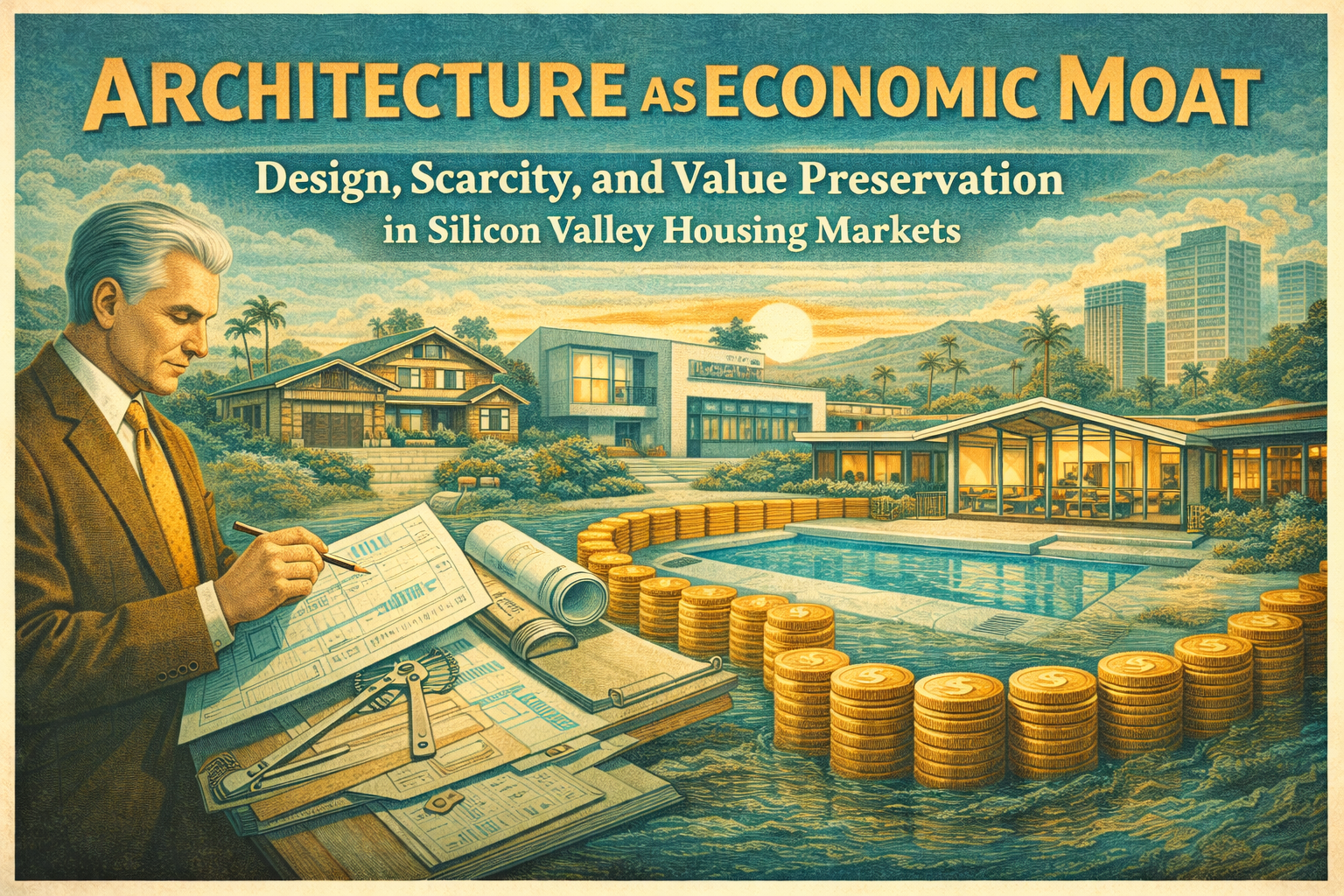
Silicon Valley represents one of the most information-efficient, capital-saturated, and technologically optimized real estate markets in the world. Traditional determinants of residential value—location, square footage, school districts, and amenities—have been extensively mapped, priced, and arbitraged, resulting in a housing market where differentiation is increasingly elusive. In such an environment, this paper argues that architecture has emerged as the last durable economic moat: a non-replicable, culturally embedded, and scarcity-driven source of long-term value protection.
Drawing from economic moat theory, urban studies, architectural history, and behavioral finance, this paper examines how architectural integrity—rather than cosmetic luxury—functions as a structural advantage in Silicon Valley housing markets. Through narrative analysis and regional case studies, particularly mid-century modern housing and architect-led residential design, the paper demonstrates that architecture operates simultaneously as a scarcity mechanism, a signaling device for cultural capital, and a form of risk mitigation across market cycles. The findings suggest that in markets characterized by extreme transparency and competition, architectural design is not merely an aesthetic preference but a core economic asset with implications for developers, investors, agents, and urban policy.
I. Introduction: The End of Traditional Real Estate Advantages
For much of the twentieth century, residential real estate value in Silicon Valley was governed by a familiar hierarchy of advantages: proximity to employment centers, access to elite educational institutions, scarcity of developable land, and, eventually, sheer scale and luxury. These factors functioned as effective moats—buffers that insulated properties from competition and preserved value over time.
Today, those moats have largely collapsed.
Silicon Valley has evolved into one of the most efficient housing markets in the United States, if not globally. Information asymmetry—long the lifeblood of real estate advantage—has been systematically eliminated. Buyers possess real-time access to pricing histories, neighborhood analytics, school performance metrics, commute simulations, zoning data, and comparative inventory. Capital, both domestic and international, is abundant and highly mobile. Construction techniques, materials, and finishes have been standardized and optimized for speed and margin. Marketing reach, once a differentiator, has been flattened by digital platforms and algorithmic distribution.
In such a market, the majority of homes—particularly at the upper end—have become functionally interchangeable.
This commoditization is most visible in the contemporary luxury segment. Large homes with high-end finishes, expansive amenity packages, and premium locations increasingly compete on marginal differences in price rather than on intrinsic distinctiveness. Renovations often converge toward a narrow band of aesthetic norms dictated by social media, builder templates, and risk-averse design decisions. The result is a housing landscape rich in capital investment yet poor in meaningful differentiation.
And yet, despite this convergence, certain properties consistently defy market gravity. They trade faster, command premiums, and retain liquidity during downturns. These homes provoke not comparison but conviction. Buyers do not merely evaluate them; they attach themselves to them.
The distinguishing factor is rarely location alone, nor size, nor amenity count.
It is architecture.
This paper advances the central thesis that architecture—defined not as surface-level styling but as structural design integrity encompassing proportion, light, materiality, spatial logic, and cultural coherence—has become the final defensible moat in Silicon Valley real estate. Unlike other advantages, architecture resists rapid replication. It cannot be mass-produced without dilution, reverse-engineered without loss, or algorithmically optimized without sacrificing meaning. It operates at the intersection of economics and culture, where scarcity is not imposed by regulation or geography alone but by human creativity, discipline, and taste.
In a region shaped by technological acceleration, architecture remains stubbornly analog.
The sections that follow will examine how this condition emerged, why Silicon Valley is uniquely susceptible to real estate commoditization, and how architecture functions as an economic, cultural, and psychological counterweight. Through theory and case study, the paper will argue that architecture is no longer ancillary to real estate value—it is central to its preservation.
II. Defining “Moat” in Real Estate Economics
The concept of an economic moat originates in competitive strategy and value investing, where it describes a firm’s ability to sustain excess returns by protecting itself from competitive erosion. Traditionally articulated through frameworks such as Michael Porter’s competitive advantage theory and later popularized in investment discourse, moats are understood to arise from factors such as cost leadership, network effects, brand loyalty, regulatory barriers, and intellectual property.
Real estate, however, has historically been a weak candidate for true moat formation.
Housing markets are typically characterized by high substitutability, fragmented ownership, and slow-moving innovation. While location scarcity and zoning constraints can produce temporary barriers to entry, these forces rarely generate durable differentiation between individual assets within the same market. In most metropolitan regions, residential properties compete primarily on price, condition, and convenience, with long-term value driven more by macroeconomic cycles than by asset-specific defensibility.
Silicon Valley complicates this model.
Unlike traditional housing markets, Silicon Valley exhibits several characteristics that accelerate the erosion of conventional moats. First, it operates under extreme capital saturation. Wealth concentration among technology founders, executives, and investors has produced a buyer pool with unusually high purchasing power and low sensitivity to incremental price differences. Second, information transparency is nearly total. Buyers are often analytically sophisticated, accustomed to evaluating assets through data-rich frameworks, and supported by professional advisors with access to the same datasets as sellers.
Third, construction and renovation processes have become increasingly standardized. Advances in project management, prefabrication, and global supply chains have compressed the variance in build quality across new and renovated homes. What once distinguished a high-end residence—custom materials, imported finishes, bespoke detailing—has become replicable at scale.
In this environment, traditional real estate advantages function less like moats and more like prerequisites. Location is necessary but insufficient. Square footage provides utility but not defensibility. Amenities enhance comfort but not uniqueness. Even scarcity of land, while real, applies broadly rather than selectively.
For a moat to exist under such conditions, it must meet three criteria simultaneously:
Non-replicability – it cannot be easily copied or mass-produced.
Durability – it must retain relevance across economic and cultural cycles.
Buyer-specific attachment – it must reduce substitutability by narrowing the universe of acceptable alternatives.
Architecture, as this paper argues, uniquely satisfies all three.
III. The Commoditization of Housing in High-Capital Markets
The paradox of Silicon Valley housing is that as prices have risen, differentiation has declined.
Over the past two decades, rising land values and construction costs have incentivized risk minimization among developers and homeowners alike. Design decisions increasingly prioritize resale neutrality over architectural conviction. Floor plans converge toward proven templates. Finishes track prevailing aesthetic trends. Exterior forms soften toward inoffensive modernism or nostalgic traditionalism. The objective is not to inspire, but to avoid alienation.
This dynamic is reinforced by digital platforms. Image-driven marketplaces, social media feeds, and design aggregation sites reward visual familiarity. Homes that conform to dominant aesthetic norms are more easily categorized, compared, and marketed. Over time, this feedback loop produces a narrowing of acceptable design language, particularly in the luxury segment where perceived resale risk carries high absolute costs.
The result is a form of architectural monoculture.
Luxury homes may differ in scale, but not in spirit. Kitchens blur together. Open-plan living spaces replicate endlessly. Materials are swapped, but spatial logic remains unchanged. Even when labeled “custom,” many homes differ only superficially from one another, sharing the same underlying assumptions about how space should be organized and experienced.
From an economic standpoint, this sameness is corrosive.
When assets are visually and spatially interchangeable, buyers default to comparative analysis. Decision-making shifts from emotional conviction to spreadsheet optimization. Time on market lengthens. Price sensitivity increases. In downturns, liquidity evaporates rapidly as buyers hesitate, knowing that alternatives are plentiful.
Commoditization also alters the role of renovation. Rather than enhancing distinctiveness, many renovations accelerate convergence. Homeowners renovate not to express architectural intent but to align with prevailing norms. This produces what might be described as “design inflation”: ever-increasing investment yielding diminishing differentiation.
Against this backdrop, architecture—true architecture—emerges not as a stylistic preference but as an economic counterforce.
Where commoditized housing invites comparison, architecture invites commitment. Where sameness expands the competitive set, architecture narrows it. In doing so, architecture does not merely decorate value; it restructures the competitive field itself.
IV. Architecture as a Scarcity Engine
Scarcity in real estate is often framed as a function of land constraints or regulatory limits. Yet these forms of scarcity operate at the market level, not the asset level. They restrict supply broadly but do little to distinguish one property from another within the constrained zone.
Architectural scarcity operates differently.
Authentic architectural design—whether mid-century modern, modernist, or architect-led contemporary—requires a convergence of conditions that are inherently difficult to reproduce. These include not only technical skill but also conceptual clarity, cultural literacy, and a willingness to accept aesthetic risk. Architecture, in this sense, is not merely built; it is authored.
This authorship is what creates scarcity.
Unlike finishes or fixtures, architectural decisions are embedded early in the design process. They govern proportions, structural rhythms, relationships between interior and exterior, and the choreography of light and movement. Once established, these elements are difficult to alter without fundamentally remaking the building. They are also difficult to imitate convincingly without replicating the underlying design intelligence that produced them.
As a result, architecturally coherent homes form a finite and slowly expanding subset of the housing stock. Even in periods of intense development, the proportion of homes with true architectural integrity remains small. Market forces that favor speed, predictability, and broad appeal work against the production of such homes.
In Silicon Valley, this scarcity is amplified by cultural context. The region’s design literacy—shaped by proximity to innovation, global talent, and modernist traditions—creates a buyer population capable of recognizing and valuing architectural coherence. Scarcity, in this case, is not merely physical but perceptual. The ability to see architecture as architecture becomes part of the moat itself.
Thus, architecture functions as a scarcity engine that operates independently of land supply, regulatory frameworks, or market cycles. It produces differentiation where none should theoretically exist and sustains value where commoditization would otherwise dominate.
V. Architecture, Cultural Capital, and Buyer Psychology
To understand why architecture functions as a moat in Silicon Valley, it is necessary to move beyond classical price theory and into the domain of cultural economics. Housing decisions—particularly at the upper end of the market—are not governed solely by utility maximization. They are deeply intertwined with identity formation, social signaling, and the accumulation of cultural capital.
Cultural capital, as articulated in sociological and economic literature, refers to non-financial assets that confer social advantage: taste, education, aesthetic fluency, and symbolic literacy. In Silicon Valley, where financial capital is widely distributed among the buyer class, cultural capital becomes a primary axis of differentiation.
Architecture is one of its most legible expressions.
Architecturally distinctive homes operate as signaling devices. They communicate not wealth per se, but discernment. Unlike conspicuous luxury—large scale, overt opulence, or excessive ornamentation—architectural clarity signals restraint, intentionality, and intellectual alignment. This distinction is particularly salient among technology-sector buyers, whose professional identities are often built around optimization, elegance of solution, and system-level thinking.
For such buyers, architecture performs a cognitive function. It aligns with how they understand the world.
Empirical observation within Silicon Valley markets suggests that architecturally coherent homes attract a narrower but more committed buyer pool. These buyers self-select not merely on budget or location, but on aesthetic worldview. Once engaged, they exhibit behaviors consistent with reduced substitutability: fewer comparison properties, faster decision-making, and greater tolerance for price deviation relative to comparable homes lacking architectural distinction.
This phenomenon produces what might be described as psychological moat effects. While a commoditized home competes against dozens of near-equivalents, an architecturally significant home competes against memory, aspiration, and identity. The buyer is not choosing among houses; they are choosing whether this house reflects who they believe themselves to be.
Such dynamics are difficult to quantify, but they manifest repeatedly in transaction behavior. Architecture transforms housing from a fungible good into a semi-positional one—valued not only for its use, but for its symbolic placement within a cultural hierarchy.
VI. Case Study: Mid-Century Modern Housing and the Eichler Phenomenon
Few architectural typologies illustrate the economic power of design scarcity more clearly than mid-century modern housing in Silicon Valley, particularly the developments associated with Joseph Eichler. Originally conceived as an experiment in democratized modernism, these homes have evolved into some of the most resilient residential assets in the region.
Eichler homes embody several characteristics that reinforce architectural moat formation.
First, their supply is fixed. Built primarily between the late 1940s and mid-1960s, Eichler developments represent a closed historical chapter. Unlike contemporary “modern-style” homes, they cannot be meaningfully replicated without sacrificing authenticity. Post-and-beam construction, radiant heating systems, atrium-centered plans, and extensive use of glass were not aesthetic flourishes but structural commitments tied to a specific era of experimentation.
Second, Eichler homes possess internal coherence. Their design language extends from structure to circulation to landscape integration. Even when updated, successful renovations tend to preserve the underlying architectural logic rather than overwrite it. This coherence enables adaptability without erasure, a critical factor in long-term value retention.
Third, Eichlers occupy a distinct cultural niche within Silicon Valley. They resonate with the region’s self-image as a place of innovation, optimism, and resistance to traditional hierarchies. Ownership of such a home is not merely a housing choice but an affiliation with a design lineage that mirrors the Valley’s own mythology.
From a market perspective, these attributes translate into measurable outcomes. Eichler homes frequently outperform non-architectural comparables in similar locations, even when smaller in size or less conventionally “luxurious.” They demonstrate liquidity in downturns and attract out-of-area buyers willing to compromise on other variables to secure architectural authenticity.
Importantly, not all modern homes enjoy this advantage. The distinction lies in authorship and intent. Eichlers are not merely modern in appearance; they are modern in conception. This difference—between style and substance—marks the boundary between architectural moat and aesthetic mimicry.
VII. Architectural Integrity Versus Renovation Cycles
One of the most persistent misconceptions in residential real estate is the belief that renovation is equivalent to value creation. While renovations can enhance marketability, they rarely generate durable differentiation unless anchored to strong architectural foundations.
Finishes age. Appliances date. Design trends cycle. What remains constant are the structural decisions embedded in the building: ceiling heights, window placement, circulation paths, and spatial proportions. These elements determine how a home is experienced, not merely how it is photographed.
Architectural integrity, in this sense, functions as a form of temporal insulation.
Homes with coherent architectural bones are more resilient to aesthetic obsolescence because they support reinterpretation. A well-proportioned room can accommodate multiple design languages across decades. A thoughtfully integrated indoor-outdoor relationship remains desirable even as materials change. Conversely, homes with weak architectural logic require continual cosmetic intervention to maintain relevance, often at increasing cost.
In Silicon Valley, where renovation budgets routinely reach seven figures, this distinction carries economic weight. Renovation-heavy strategies that ignore architectural coherence tend to produce diminishing returns, particularly when multiple properties converge toward similar outcomes. The market eventually discounts the effort, recognizing sameness beneath the surface.
By contrast, architecturally grounded homes benefit from what might be described as renovation leverage. Each improvement compounds existing value rather than attempting to manufacture it anew. This leverage explains why some homes appreciate not despite their age, but because of it—their architecture provides a stable platform upon which successive generations can build.
VIII. Architecture as Downside Protection Across Market Cycles
Real estate markets are cyclical, but assets do not experience cycles uniformly. In downturns, differences in liquidity, buyer conviction, and perceived substitutability become pronounced. It is under these conditions that architectural moats are most clearly revealed.
During market contractions, buyers exhibit heightened risk aversion. Decision timelines lengthen, comparative analysis intensifies, and price sensitivity increases. Commoditized assets—those that resemble many others—suffer disproportionately. Faced with uncertainty, buyers defer action, confident that alternatives will remain available or become cheaper. Liquidity dries up not because demand disappears, but because commitment does.
Architecturally distinctive homes behave differently.
Because they occupy a narrower competitive set, such homes are less exposed to the paralysis induced by abundance. Buyers interested in a specific architectural typology—whether mid-century modern, modernist, or architect-led contemporary—often perceive scarcity even in broader downturns. The opportunity cost of waiting is higher, as comparable substitutes are limited or nonexistent.
This dynamic produces two important effects.
First, price discovery occurs more efficiently. While architecturally significant homes may experience moderation in pricing during downturns, they are less likely to undergo prolonged stasis. Transactions continue, albeit at recalibrated levels, preserving liquidity and market visibility.
Second, downside volatility is reduced. Because architectural homes attract conviction buyers rather than marginal ones, they are less vulnerable to abrupt shifts in sentiment. The buyer’s decision is anchored not only in financial expectations but in long-term personal alignment. This anchoring dampens the reflexive discounting seen in more generic inventory.
From an investment perspective, architecture functions as a form of risk-adjusted return enhancer. It does not eliminate exposure to macroeconomic forces, but it reshapes the distribution of outcomes—reducing tail risk while preserving upside potential.
IX. Implications for Developers: Design as Capital Allocation
For developers operating in Silicon Valley, the implications of architectural moat theory are significant. Traditional development models emphasize cost control, speed, and broad appeal—strategies well-suited to markets where differentiation is unnecessary or impossible. In Silicon Valley, however, these same strategies increasingly undermine long-term value creation.
Architectural investment is often treated as discretionary—a line item to be trimmed if budgets tighten. Yet this framing misunderstands architecture’s role. Design decisions made early in the development process exert outsized influence on a project’s competitive position, pricing power, and durability.
Developments that pursue architectural clarity—even at higher upfront cost—benefit from several structural advantages:
Reduced reliance on finish-driven differentiation
Greater resilience to aesthetic trend shifts
Stronger narrative coherence for marketing and resale
Increased appeal to design-literate, conviction-driven buyers
Conversely, developments that default to lowest-common-denominator design often require escalating investment in marketing and concessions to achieve absorption, particularly as inventory increases.
Importantly, architectural ambition does not imply maximalism. Many of the most successful architecturally distinctive homes are modest in scale but rigorous in execution. The economic advantage lies not in extravagance, but in coherence.
For developers, architecture should be understood not as ornamentation but as capital structure—a foundational choice that governs the asset’s behavior over time.
X. The Evolving Role of Agents and the Importance of Architectural Literacy
As architecture assumes greater importance in value differentiation, the role of real estate agents evolves accordingly. In commoditized markets, agents function primarily as transaction facilitators—pricing assets, managing exposure, and navigating process. In architecturally differentiated markets, agents become interpreters.
Architectural literacy—the ability to recognize, articulate, and contextualize design intent—emerges as a critical professional competency. Homes with architectural significance do not sell themselves through features alone. Their value must be framed, narrated, and translated for buyers who may sense distinction intuitively but lack the vocabulary to justify it.
This narrative function has tangible economic consequences. Properties whose architectural stories are clearly articulated:
Travel further through social and professional networks
Generate higher-quality buyer engagement
Experience fewer misaligned showings
Command stronger emotional commitment
Agents who lack this literacy risk mispricing such homes or marketing them as interchangeable luxury, eroding the very moat that gives them advantage.
More broadly, architectural storytelling reshapes market perception. It elevates discourse from comparison to interpretation, from specification to meaning. In doing so, it reinforces the scarcity and distinctiveness upon which architectural moats depend.
XI. Architecture as the Final Human Variable
Silicon Valley real estate occupies a paradoxical position within modern housing markets. It is simultaneously one of the most capitalized and most commoditized environments in which residential assets trade. Information symmetry, technological sophistication, and global liquidity have eroded many of the traditional mechanisms through which homes once differentiated themselves. Location, scale, amenities, and even renovation quality—long regarded as durable advantages—have been increasingly neutralized by replication and standardization.
Within this context, architecture emerges not as a residual preference but as a structural constant.
This paper has argued that architecture constitutes the last durable economic moat in Silicon Valley housing markets precisely because it resists the forces that have flattened other forms of differentiation. Architecture cannot be mass-produced without dilution, automated without loss of meaning, or optimized solely through data without sacrificing coherence. It is authored rather than assembled, interpreted rather than consumed, and culturally embedded rather than economically abstract.
The power of architecture as a moat lies in its multidimensionality. Economically, it reduces substitutability and reshapes competitive sets. Psychologically, it converts evaluation into attachment and comparison into conviction. Culturally, it functions as a form of capital—signaling taste, literacy, and identity in a market where financial capital alone no longer distinguishes buyers. Temporally, it endures across renovation cycles and market downturns, providing resilience where cosmetic luxury fades.
Most importantly, architecture remains human.
In a region defined by technological acceleration, algorithmic decision-making, and rapid replication, architecture stands apart as a domain where scarcity is created not by regulation or geography alone, but by creativity, discipline, and intentional risk. Its value is not merely that it is difficult to copy, but that it requires judgment—an irreducible human input that resists commoditization.
For developers, this implies a reorientation of capital allocation away from surface-level luxury and toward design integrity. For agents, it necessitates architectural literacy and narrative competence as core professional skills. For investors, it reframes risk not only in financial terms but in cultural alignment and long-term relevance. For cities, it raises questions about the cumulative economic cost of architectural sameness and the long-term value of design stewardship.
Architecture, then, is not an aesthetic luxury layered onto Silicon Valley real estate. It is the mechanism through which meaning, scarcity, and durability are reintroduced into a market that has optimized nearly everything else.
In the end, the most valuable homes in Silicon Valley will not be those that merely reflect prevailing trends, but those that articulate a coherent vision—of space, of living, and of identity—that cannot be easily replaced. In a market where nearly everything has become scalable, architecture remains resolutely singular.
That singularity is the moat.
At the forefront of Silicon Valley’s luxury real estate market, the Boyenga Team at Compass is widely recognized for representing architecturally significant and design-driven homes across the Bay Area.
Led by Eric Boyenga and Janelle Boyenga, the team brings a rare combination of market intelligence, architectural literacy, and strategic negotiation to every client relationship. Their approach goes beyond traditional sales metrics, focusing instead on design integrity, long-term value preservation, and buyer psychology—especially critical in Silicon Valley’s highly competitive luxury segment.
As trusted advisors to discerning buyers and sellers, Eric and Janelle work to ensure that exceptional homes are positioned not as commodities, but as irreplaceable assets. By translating architectural intent into compelling market narratives and aligning each property with the right buyer audience, the Boyenga Team consistently delivers outcomes that reflect both financial performance and design significance.
For clients who believe that architecture matters—and that true luxury lies in authenticity, restraint, and enduring value—the Boyenga Team represents a distinctly elevated standard of real estate representation.
References
Porter, M. E. Competitive Strategy: Techniques for Analyzing Industries and Competitors.
Buffett, W. Economic Moats and Long-Term Value Creation (various shareholder letters).
Bourdieu, P. Distinction: A Social Critique of the Judgement of Taste.
Glaeser, E. L. Triumph of the City.
Jacobs, J. The Death and Life of Great American Cities.
Florida, R. The Rise of the Creative Class.
Case, K. E., & Shiller, R. J. “Is There a Bubble in the Housing Market?”
Architectural Record; Harvard Design Review (various issues on modernism and housing).
Eichler, J. (archival materials and historical analyses).
Urban Land Institute reports on housing differentiation and design economics.