
Property Nerds: Why Obsessive Local Expertise Beats Algorithms in a Zillow World
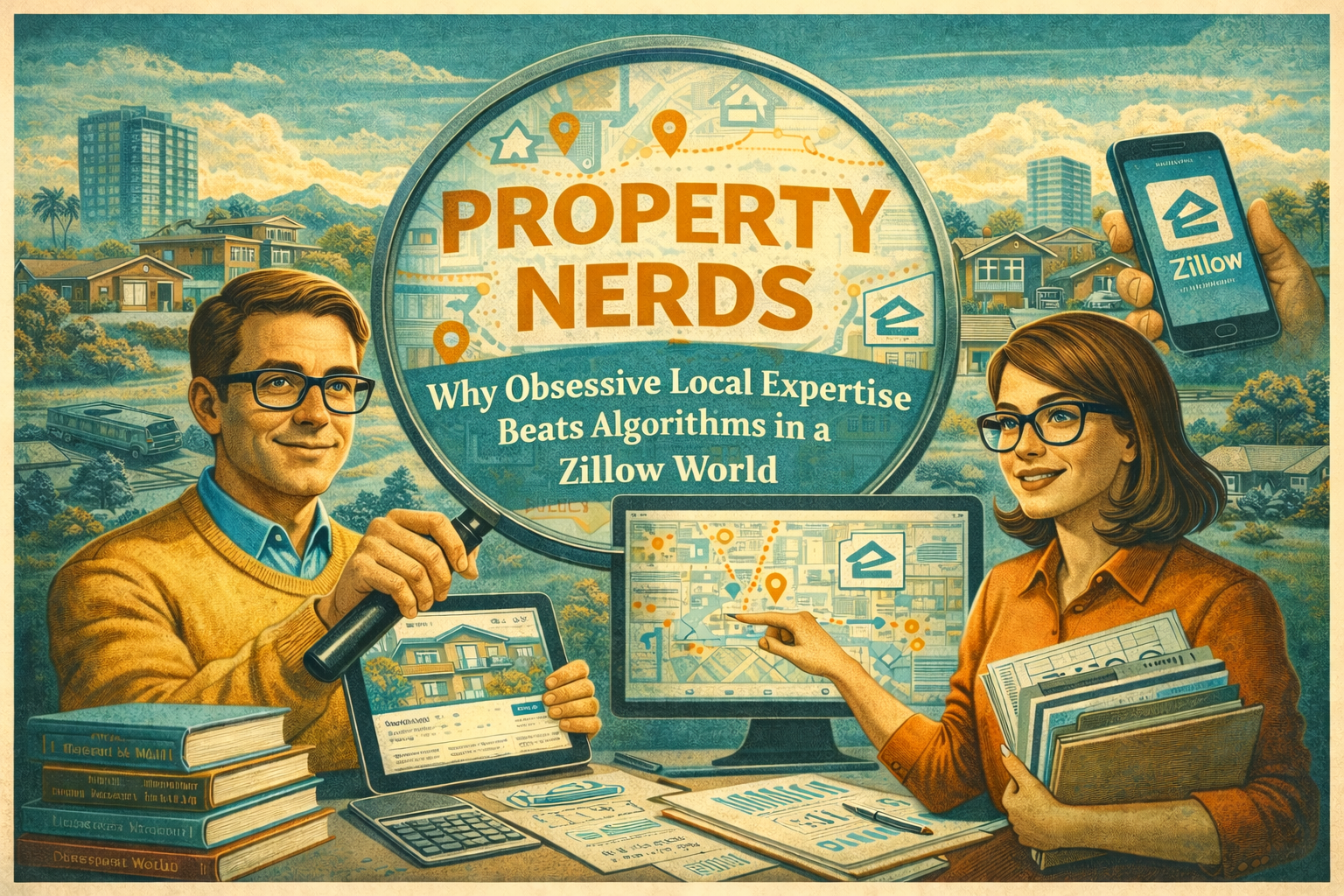
In the past decade, residential real estate has undergone a quiet but profound shift. Information—once guarded by brokers, fragmented across local MLS systems, and interpreted through human judgment—has become ubiquitous. Platforms such as Zillow now offer instant price estimates, comparable sales, neighborhood statistics, and predictive analytics to anyone with a smartphone.
This democratization of data was expected to flatten the industry. Instead, it has done something more interesting: it has made deep expertise more valuable, not less.
As algorithms standardize information, competitive advantage has moved away from access and toward interpretation. In real estate, as in many knowledge-driven industries, the winners are no longer those with the most data—but those who understand context, nuance, and human behavior at a granular level. These professionals might be called “Property Nerds”: practitioners who develop obsessive local expertise and use it to outperform markets increasingly shaped by averages.
When Information Stops Being Insight
Zillow and similar platforms excel at what algorithms do best: aggregating large datasets, smoothing volatility, and producing generalized estimates. Their models are effective at answering broad questions—How is the market trending? What have comparable homes sold for recently? How does one zip code compare to another?
But real estate value does not live at the zip-code level. It lives at the level of streets, school boundaries, architectural intent, buyer psychology, and future expectations. These variables are difficult to quantify and nearly impossible to model at scale.
The result is a growing gap between knowing the numbers and understanding the market.
In practice, this gap shows up in familiar ways:
Homes with identical statistics selling weeks apart at materially different prices
Renovations that cost six figures but fail to add commensurate value
Buyers overpaying for perceived scarcity while overlooking better long-term assets
Sellers pricing to algorithmic confidence rather than strategic positioning
Algorithms explain the past. Markets, however, are driven by expectations about the future.
The Strategic Value of Hyperlocal Fluency
In Silicon Valley, where the Boyenga Team operates, this dynamic is especially pronounced. Cities like Cupertino, Sunnyvale, Los Altos, and Palo Alto are often treated as single markets by portals and casual observers. In reality, each contains dozens of micro-markets with distinct behaviors.
Within a single city, pricing can diverge significantly based on:
Elementary school boundaries and feeder patterns
Specific subdivisions or legacy tracts
Architectural pedigree and design integrity
Street orientation, noise exposure, or walkability
Buyer composition (tech executives, design-forward buyers, multigenerational families)
Two homes may appear interchangeable on a platform yet trade at dramatically different values because buyers perceive them as fundamentally different assets.
Property Nerds understand this distinction intuitively. Their expertise is not built from dashboards alone, but from repeated exposure: touring homes, tracking buyer reactions, negotiating transactions, and watching how micro-markets behave over time. This accumulated judgment cannot be crowdsourced or automated.
Architecture as Strategy, Not Aesthetic
Nowhere is this more evident than in architecturally significant housing, such as mid-century modern and Eichler homes—an area where the Boyenga Team has developed particular depth.
To an algorithm, a renovated Eichler is simply a three-bedroom, two-bath home of a certain size. To a knowledgeable buyer, however, value depends on far subtler factors:
Whether original post-and-beam construction has been preserved
How radiant heating systems have been maintained or altered
Whether renovations respect original proportions or compromise them
How atrium orientation affects light, privacy, and livability
These elements influence not only immediate buyer appeal but also long-term resale performance. Agents without architectural fluency often misprice these homes or market them generically, missing the buyers who value authenticity and are willing to pay a premium for it.
Here, obsessive expertise is not a stylistic preference—it is a financial one.
Strategy Over Transactions
The most consequential difference between algorithm-driven real estate and expert-driven real estate lies in decision-making.
Portals react. Property Nerds anticipate.
The Boyenga Team’s approach emphasizes strategy over transaction volume. Pricing, for example, is not treated as a mechanical output of comparable sales but as a signal shaped by:
Buyer pool depth at specific price points
Timing relative to school calendars and hiring cycles
Inventory pressure within narrowly defined submarkets
The psychological impact of scarcity or abundance
This strategic framing allows sellers to lead the market rather than chase it—and allows buyers to compete effectively without relying solely on escalation.
Why Sellers Underperform—and Buyers Overpay
Most sellers who underperform do not fail because of poor presentation or lack of exposure. They fail because their property is misunderstood. Without expert positioning, homes are marketed to the wrong audience, priced against the wrong benchmarks, or stripped of the narrative that explains their value.
Similarly, buyers who overpay often do so not out of emotion, but out of incomplete context. Without guidance rooted in local pattern recognition, they mistake averages for inevitabilities and competition for value.
In both cases, the cost of misunderstanding far exceeds the cost of expertise.
The Broader Implication
Real estate is not unique. Across industries—from finance to medicine to management consulting—the proliferation of data has shifted advantage toward those who can synthesize information, exercise judgment, and understand human behavior within specific contexts.
In that sense, Property Nerds represent a broader professional archetype: experts who thrive not despite transparency, but because of it.
As platforms like Zillow continue to improve, the baseline level of information will only rise. Paradoxically, this makes deep, localized, experience-based expertise more—not less—essential.
Zillow World
Algorithms have changed real estate. They have not replaced it.
In markets defined by complexity, emotion, and long-term consequences, obsessive local expertise remains the decisive factor. The Boyenga Team’s success illustrates a simple but often overlooked truth: when everyone has access to the same data, advantage belongs to those who understand what the data cannot explain.
In a Zillow world, Property Nerds are not relics of the past.
They are the future of professional value.
The Boyenga Team at Compass is widely recognized for its obsessive focus on local market intelligence, architectural expertise, and strategic representation across Silicon Valley’s most competitive luxury markets.
Led by Eric Boyenga and Janelle Boyenga, the team has built its reputation on a simple but demanding philosophy: expertise is earned, not automated.
Rather than relying on generalized pricing models or surface-level analytics, Eric and Janelle Boyenga work hands-on with buyers and sellers to interpret market signals that algorithms miss—micro-neighborhood behavior, architectural integrity, school-boundary dynamics, buyer psychology, and long-term resale considerations.
As luxury home experts, the Boyenga Team specializes in:
High-value Silicon Valley neighborhoods
Architecturally significant and design-forward homes
Mid-century modern and Eichler properties
Strategic pricing and positioning for premium outcomes
Their role is not merely transactional. They act as strategic advisors—guiding clients through complex decisions where nuance, timing, and judgment materially affect outcomes.
In a market increasingly shaped by data transparency, the Boyenga Team represents a different standard of value: deep local fluency combined with disciplined strategy and client-first representation.