
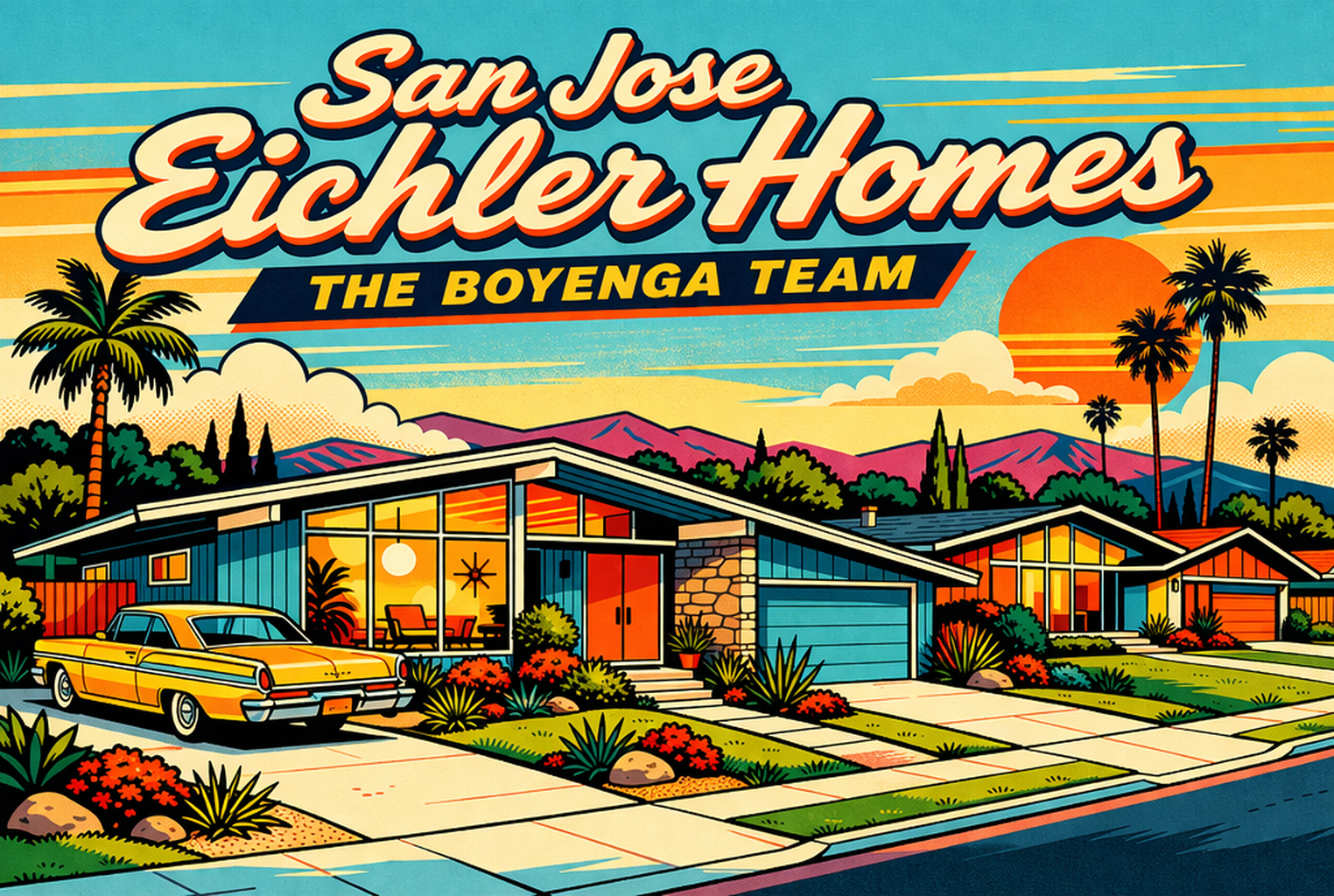
San José’s Eichler Enclave: Willow Glen’s Mid-Century Modern Gem
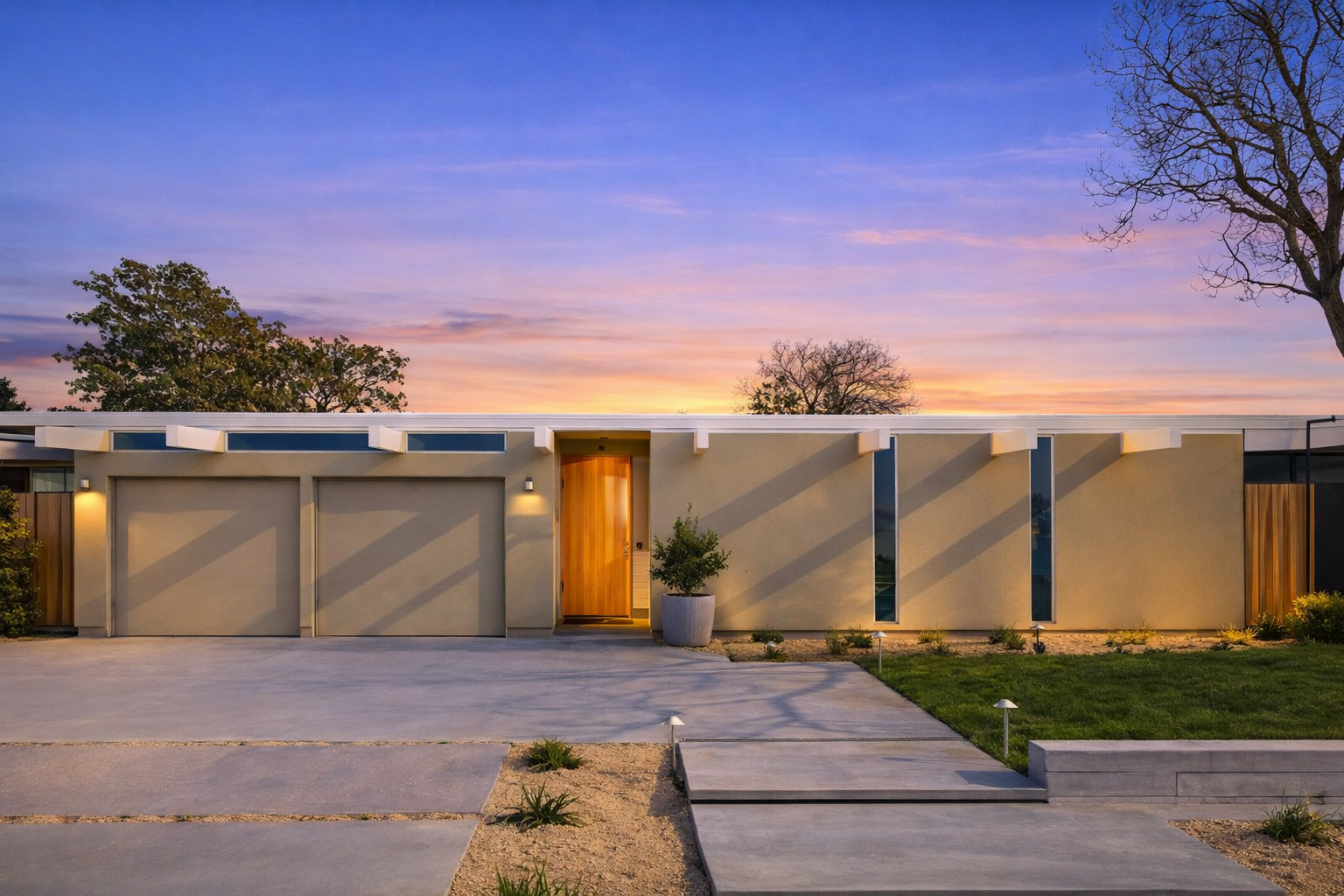
A mid-century modern treasure nestled in Willow Glen, San Jose, this Eichler neighborhood is a vibrant community of historic design. San Jose’s Eichler tract homes – built 1951–1962 in several pockets like Fairglen and Rose Glen – stand as living testaments to postwar modernism. In Willow Glen alone, roughly 350 Eichler homes were erected between 1957 and 1962, making it the Bay Area’s largest Eichler enclave. These residences feature the classic mid-century hallmarks – flat and low-pitched roofs, exposed post-and-beam wood framing, expansive walls of glass, open-plan interiors, and indoor-outdoor atriums – all designed to blur the line between home and California nature. Today, Eichler homes remain immensely desirable among Silicon Valley buyers and architecture enthusiasts for their timeless design and bright, airy feel; as one real estate blog notes, Willow Glen’s Fairglen Eichlers are a “mid-century gem in a charming community,” essentially living architectural time capsules.
The lifestyle appeal here is equally unique. Fairglen residents take pride in their modernist neighborhood with community events and home tours celebrating Eichler design. Block parties and an annual Eichler Home Tour showcase original features – from authentic colored-accent exteriors to vintage George Nelson clocks – underscoring the tract’s cohesive mid-century spirit. Willow Glen’s tree-lined streets and friendly cul-de-sacs invite evening strolls, while downtown Willow Glen (just a couple of miles east on Lincoln Avenue) offers cafes, boutiques, and restaurants that cater to both families and professionals. Younger homebuyers and Silicon Valley executives alike are drawn to the area’s design-forward character and close-knit community, enjoying everything from local schools and parks to quick access into the heart of Silicon Valley.
The Boyenga Team at Compass is known as Silicon Valley’s Eichler and mid-century modern specialist. With decades of data-driven luxury real estate experience, Eric and Janelle Boyenga have built a reputation for guiding buyers to architecturally significant homes and helping sellers maximize value on rare Eichler properties. As “Eichler Home Specialists,” they leverage Compass’s cutting-edge marketing tools and their deep understanding of Eichler history to find exclusive, often off-market, opportunities for clients. The Boyengas understand that in this neighborhood, clients aren’t just buying a house – they’re buying a piece of design heritage.
Historical Roots of Willow Glen’s Eichler Neighborhood
The Willow Glen Eichler enclave traces back to Joseph Eichler’s vision of modern housing for everyday families. Eichler Homes began developing San José tracts in the early 1950s. The first was Morepark (later called Rose Glen) – a 33-lot subdivision on Richmond Avenue and Menker Avenue built in 1952–54. This was followed in 1957 by the first Fairglen tract (about 30 homes off Dry Creek Road) just southwest of Willow Glen, and then the expansive Fairglen Additions in 1959–60 (Units 1, 2, and 3 south of Curtner Avenue) with roughly 218 homes. In 1961–63 Eichler built Hudson (adjacent to Fairglen Additions) and Fairhaven (off Stevens Creek Boulevard near Campbell), adding another 57 homes. In total, San José developed seven Eichler subdivisions (five neighborhoods) between 1952 and 1963, all rooted in Eichler’s goal of bringing modern, affordable design to suburban California.
Eichler’s partner architects brought avant-garde design to these tracts. Early homes in Willow Glen were designed by Anshen & Allen and the Los Angeles firm Jones & Emmons (A. Quincy Jones and Frederick Emmons), both already noted for California Modernist houses. By 1960, Eichler’s in-house architect Claude Oakland refined the designs on site, introducing variants like the dramatic double A-frame roof model that would become local icons. Floor plans included a mix of courtyard, carport, and atrium models – typically 3- or 4-bedroom, 2-bath layouts on ~6,000 ft² lots. The interior innovations were no less impressive: Eichlers featured radiant concrete slab heat, clerestory windows, and built-in amenities that were unusual in tract homes. These California Usonian-inspired houses prioritized light, air, and simple materials (often Philippine mahogany paneling).
Over the decades, Willow Glen’s Eichler neighborhood has undergone careful preservation and modernization. Many homeowners have sensitively updated kitchens, bathrooms, and utilities, but significant efforts have been made to protect each home’s original character. In fact, Fairglen (the main Eichler subdivision here) was designated a National Register Historic District in 2019, acknowledging its intact mid-century architecture. The City of San José is now finalizing Eichler Neighborhood Objective Design Standards for the Fairglen Additions, which will streamline renovations while requiring that visible exterior changes “maintain the historic character” – for example by preserving wood siding, glass atriums, and other signature elements. These guidelines help ensure that new roofs, additions or facelifts complement the tract’s classic aesthetic.
Architectural Highlights and Home Inventory
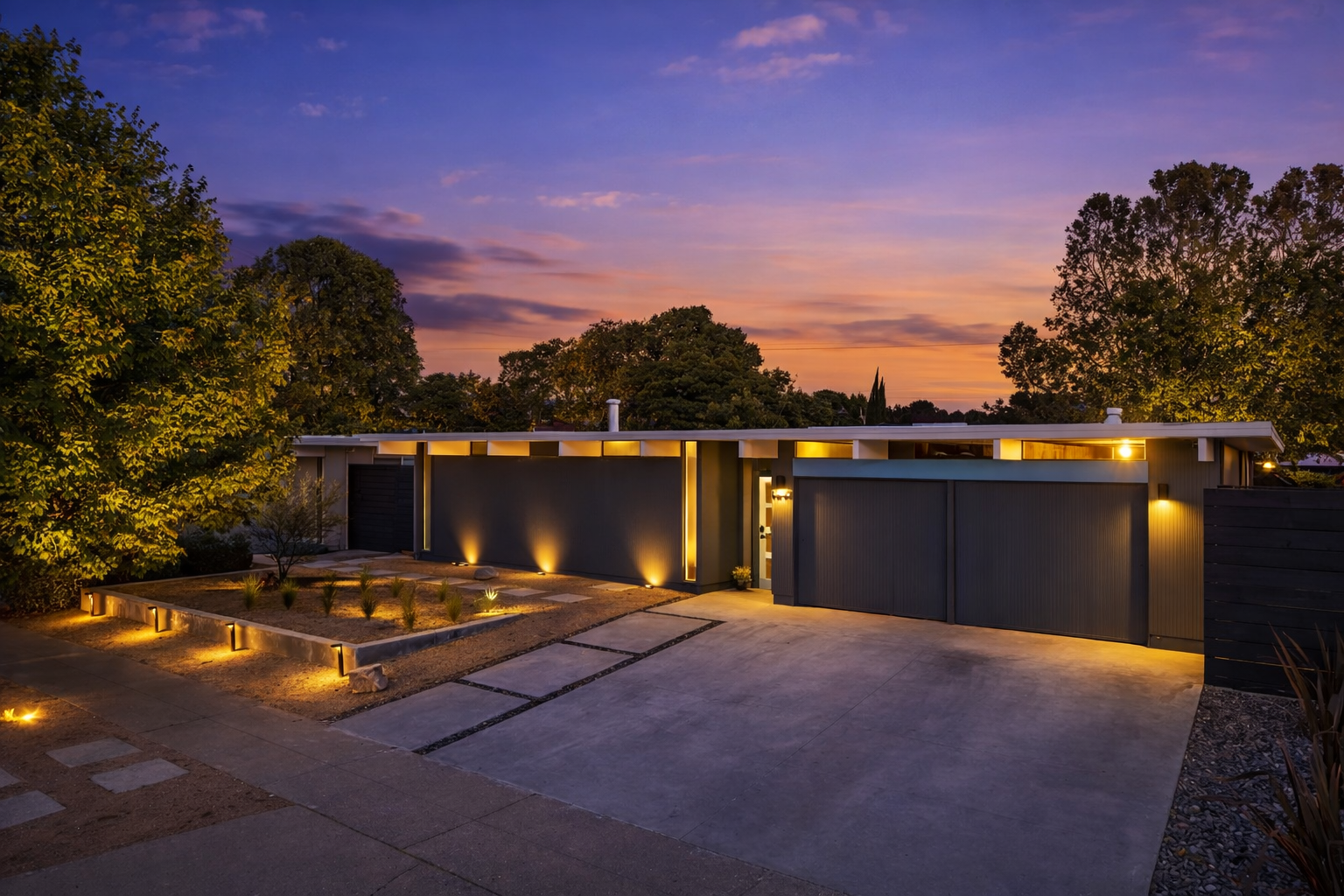
Willow Glen’s Eichler homes embody the defining elements of Eichler design. Common features include flat or low-pitched gabled roofs with broad overhangs, long spans of floor-to-ceiling glass, and open, single-story layouts. Many houses have interior atriums – private open-air courtyards – or landscaped courtyard entries flanked by glass walls. Exposed post-and-beam construction and mahogany wood finishes create an organic, sculptural interior. Signature details often include clerestory windows (rows of glass high on the walls), radiant concrete floors, and minimalist built-in cabinets and sunken living rooms. In the later models (especially in Fairglen Additions and Fairhaven), Eichler even played with striking rooflines like the double-A-frame, which provided soaring interior volumes and became instant neighborhood landmarks.
Typical home sizes: Most Eichlers here are in the 1,200–1,800 sq ft range. Original listings show 3-bedroom, 2-bath models as the norm, with some 4-bedroom variations. Atrium homes often sat at the larger end (up to ~1,800+ sq ft). Fairhaven homes (built last, 1962–63) are on average larger – around 1,700 sq ft – while the early Rose Glen tract homes are more modest (around 1,200–1,300 sq ft).
Lot sizes: Streets in Willow Glen feature winding roads and cul-de-sacs; lots are generous, typically about 6,000 ft². This provides sizable front and back yards with mature oaks and lawns. Many homes back onto greenbelts or parks, and the tree canopy gives the area a lush, established feel.
Neighborhood layout: The main Eichler core (often simply called “Fairglen Eichlers”) runs west of Booksin Avenue, on streets and courts with names like Fairglen, Fairwood, Fairlawn, Fairorchard, and Andalusia. Additional Eichler clusters extend north and south: the Fairglen Additions along Comstock Lane, Hudson Drive and Raleigh Drive, and the original 1957 “Dry Creek” Eichler group (nicknamed “Ginkgo Glen”) on Adele and Margot Places south of Curtner Avenue. In all, the Willow Glen area contains the greatest concentration of Eichler homes in San Jose. Just a few streets away, you’ll find conventional post-war ranch homes and later construction, providing a clear visual transition in styles.
Why modern buyers love these Eichlers: The architectural vision still resonates. Open plans and large glass expanses allow abundant natural light and fluid indoor-outdoor living – ideal for entertaining and California’s climate. Residents praise the sense of space, views of gardens from every room, and the mid-century charm. The durability of Eichler homes, plus their historic pedigree, means they often command premium prices: atrium models in particular can sell 10–20% above asking. Even non-architect buyers remark on the “spacious and organic” feel these homes offer, far different from cookie-cutter tract houses. In short, Eichler homes appeal to today’s design-forward buyers precisely because they were forward-looking in the 1960s.
Demographics and Community Profile
Willow Glen’s Eichler neighborhood sits in one of San Jose’s most affluent and well-educated areas. Zip code 95125 (which covers much of the Eichler tracts) has about 54,000 residents over roughly 7.3 square miles. It is a mature, stable neighborhood: average household size is ~2.5 people, and homeownership is high. The community skews professional and family-oriented – an analysis by NeighborhoodScout found 72.5% of Willow Glen workers hold executive, management or professional positions, reflecting the large share of tech and business employees. Indeed, educational attainment is high: about 56% of adults here have at least a bachelor’s degree, well above national averages.
Economically, Willow Glen households are prosperous. The median household income is around $148,000 (significantly above San Jose’s already high average), and per capita income is about $94,000. The median owner-occupied home value is roughly $1.65 million, reflecting the upscale nature of these neighborhoods. Poverty and unemployment rates are extremely low (roughly 6–7%). The area ranks in the top 15% of U.S. neighborhoods for wealth; in fact, almost 0% of children live in poverty here, underscoring the family stability.
Willow Glen is ethnically and culturally diverse. About 25% of residents report Mexican or Latino ancestry, and significant minorities include Asian and White households. The linguistic mix is mostly English-speaking (over 70% primarily speak English at home), but Spanish, Chinese, and Korean are also common. The neighborhood boasts one of Silicon Valley’s lowest rates of child poverty nationwide.
In recent years, tech-industry migration has bolstered demand. Buyers from San Francisco and Silicon Valley appreciate Eichler homes’ design pedigree and value the quiet suburban lifestyle within reach of tech jobs. In particular, tech entrepreneurs and executives value the design-forward architecture and connectivity. Older families remain from the original Eichler era, while younger professionals moving in often regard owning one of these mid-mod classics as a badge of niche culture. Homeownership rates remain high (over 90%), with only a small fraction of investors. Overall, the demographic profile is predominantly upper-middle-class and highly educated, exactly the kind of market Eichler envisioned – families and professionals seeking “California modern” living.
Schools and Education
For many buyers, top-rated schools are a key draw. The Eichler enclave straddles a couple of school districts. Principally, San José Unified School District (SJUSD) serves Willow Glen: Willow Glen Elementary (K–5) and Willow Glen Middle (6–8) feed into Willow Glen High School (9–12). Cambrian Park Elementary District and Campbell Union High District serve adjacent Cambrian areas: students there attend Farnham Elementary, Price Middle, and Branham High. Collectively, the area is known for strong public schools – many are rated above-average. For instance, Booksin Elementary (SJUSD) has a solid rating (~7/10), and Branham High is highly regarded in Silicon Valley. (GreatSchools scores tend to reflect good basic performance; note that some middle schools score lower, around 4–5/10, leading some families to pursue magnet programs or private education for that level.)
Beyond public schools, Willow Glen families have excellent private and charter options. Nearby are the open-enrollment Stratford School (Cupertino) for K-8, Challenger and Kings Academies, and the distinguished Manor School and Kaiser schools. Within a short drive are dozens of top private K-12 schools, from faith-based to independent academies. Higher education is well within reach as well: Stanford University and Palo Alto’s colleges are only ~30 minutes away, while San José State, Santa Clara University, and community colleges (West Valley, De Anza, Foothill) are all within a 10–20 minute drive. The strong school and college landscape in and around Willow Glen helps sustain high real estate values and attract families committed to educational excellence.
Parks, Shopping, and Lifestyle Amenities
Residents of Willow Glen enjoy a rich suburban lifestyle with abundant amenities. The Eichler tracts are surrounded by leafy parks and recreation. Wallenberg Park, just north of the Eichlers, offers expansive sports fields, tennis courts, an outdoor pool, and picnic areas. Willow Street Park (Frank Bramhall Park) is a few blocks away with a newer playground and community center. Within walking distance is Booksin Park (on Booksin Avenue) and small tot lots tucked into the neighborhood courts. To the south in Cambrian Park, Houge Park (14 acres of fields, basketball and playground) and Doerr Park (with softball and soccer fields) provide major open space for families. Pet-owners love Butcher Dog Park, and the Cambrian Branch Library serves as a local cultural hub. A network of trails and greenbelts connects these spaces – nearby Los Gatos Creek and Guadalupe River trails are just a short bike ride away for hiking or biking.
Downtown Willow Glen is a major lifestyle asset. A mile east, Lincoln Avenue’s historic “village” district (restaurants, bakeries, coffee shops, boutiques, and art galleries) adds a charming, walkable village vibe. Sit-down breakfast spots (like Bill’s Café) and craft coffeehouses are popular weekend destinations. For wider retail, Santana Row and Westfield Valley Fair malls are about 10–15 minutes away, and local shopping centers (like Cambrian Square and the new Cambrian Village development) offer everyday conveniences such as grocery stores, banks, and pharmacies.
This blend of amenities makes Willow Glen Eichlers especially attractive. Young families appreciate the safe, leafy streets and school/community activities. Remote-tech workers relish high-speed fiber internet, home offices with garden views, and nearby coffee shops to work from. Architecture enthusiasts delight in weekend neighborhood walks where many Eichler owners display pride in original design features. In short, the lifestyle here balances suburban tranquility with Silicon Valley connectivity: kids can bike to parks safely, parents can stroll to cafes, and the evening skyline of downtown San José is visible just 10–15 minutes away.
Commuting and Tech Access
While Willow Glen feels suburban, it’s exceptionally well-located for Bay Area commuters. Downtown San José and Diridon Station are under 10 minutes away by car, putting Caltrain, ACE trains, and the future Google campus within easy reach. For Silicon Valley tech hubs: Apple Park in Cupertino is about a 12–15 minute drive (via Highway 85); Google’s Mountain View campus is ~20 minutes (via 280); Cisco in North San José ~20 minutes; Netflix and LinkedIn in downtown SJ are ~15 minutes. The Midpeninsula (Palo Alto/Stanford) is roughly 25–30 minutes via 85. Downtown San Francisco is accessible via nearby highways (87 to 101) or Caltrain (Caltrain ~90 minutes to SF). Major corridors – Highways 87, 280, 85 and 17– all converge within a few exits of Willow Glen, providing multiple routes to San Francisco or the East Bay. (For example, Highway 85 north leads directly to Cupertino, 280 north goes to Palo Alto/SF, and 17 south gives quick access to Los Gatos and Highway 9.) In practice, tech-company employees prize Willow Glen for the “best of both worlds”: a peaceful neighborhood retreat that still delivers a rapid commute to work.
Public transit options are moderate – there is no Caltrain station in Willow Glen itself – but nearby use of Diridon or Lawrence stations is common. The VTA light rail is a few miles to the west, and bus routes run along main corridors. However, most commuters here drive or telecommute, given the shorter distances. High homeownership and ample private parking mean most families rely on cars, though the commute times are well below Silicon Valley averages.
Real Estate Market Trends
The Eichler neighborhoods of San Jose represent one of the most competitive mid-century markets in Silicon Valley. As of 2025, Willow Glen Eichler homes are commanding prices around $2.0–2.5 million on average. In fact, Boyenga Team analysis shows San José Eichler homes averaging about $2.05M, with standout models reaching $2.3M–$2.4M. This pricing is about 10–20% lower than comparable mid-century homes in Cupertino (where top schools boost values). By contrast, Eichlers in Palo Alto often trade in the $3–4M range, while Redwood City’s Eichler sales are closer to $1.6M. Locally, the large Fairglen/Willow Glen tract keeps prices relatively stable: modest remodels might list around $1.8M–$2.2M, whereas fully renovated atrium models frequently fetch $2.5M or higher.
Over the past decade, prices in this area have steadily climbed. From roughly $1.2M in 2015 to over $2M today, values have appreciated in line with Silicon Valley growth. Inventory remains tight: Eichler homes seldom sit on the market for long. In fact, about 90% of Eichler homes here sell above their list price, often after multiple-offer bidding wars. Sunnyvale Eichler subdivisions, for example, regularly close at 110% of list; Willow Glen’s market similarly sees well-maintained Eichlers selling 10–20% above asking, especially if original features are intact and attractive. Buyers who specifically want an Eichler “show willingness to pay extra” – particularly for coveted atrium models and double A-frames.
Comparing neighborhoods, Willow Glen Eichlers enjoy a slight school-driven discount versus South Palo Alto or Cupertino, but their architectural charm keeps demand high. Typical days on market are a few weeks (often much shorter for turnkey listings), which is longer than the frenzy seen in Palo Alto but still brisk by most standards. Overall, the investment outlook is strong: Eichler enclaves retain value exceptionally well because they are limited in number and culturally cherished. Experts note that owning in Fairglen or Fairhaven is not just a home purchase but an ownership in Silicon Valley’s architectural heritage – a factor that continues to attract both local tech buyers and design-focused investors.
Notable Sales and Market Examples
Recent transactions underscore the premium on quality and style. For example, in 2024 a rare double-A-frame Eichler (the former tract model home) in Fairglen sold for about $2.35M, roughly 15% above the neighborhood’s average Eichler price. Similarly, a fully updated 4-bedroom, 2-bath Fairglen atrium Eichler (around 1,755 sq ft) sold close to $2.4M. These deals illustrate that buyers pay top dollar for iconic mid-century design. By contrast, a more modest 3/2 Eichler that needed major renovation might list around $1.6M – a clear differential for condition and style.
Architectural uniqueness also drives demand. Buyers seek homes with intact period features. Real estate data show that atrium models – with their private garden courtyards – “may sell 10–20% over list” if well restored. In practice, this means a sensitively remodeled Eichler can easily achieve prices rivaling or exceeding conventional luxury homes of similar size. Even Eichlers requiring work tend to attract cash offers or investors who specialize in mid-century rehab, so price per square foot remains very strong in this niche market.
Meanwhile, competing neighborhoods have their own dynamics. Cambrian Ranch homes (non-Eichler) have lower entry prices, but do not fetch the same premiums. Campbell’s Pruneridge area has few Eichlers, and Los Gatos has none of note – making Willow Glen one of the few places local Eichler buyers need focus on. Buyers looking for this style from San Francisco to Los Altos all concentrate here, creating a micro-market where knowledge and timing matter (hence why Eichler specialists like the Boyenga Team are so in demand).
The Boyenga Team Advantage
As Silicon Valley Eichler experts, Eric and Janelle Boyenga bring unparalleled insight to this market. Known as the “Property Nerds,” they combine decades of high-end real estate experience with a passion for mid-century modern design. Clients choose the Boyenga Team to find architecturally significant Eichler homes that match their lifestyle, often guiding buyers to off-market opportunities that others miss. On the seller side, the Boyengas know exactly how to present an Eichler’s best features – from staging to photography – to maximize value. They leverage Compass’s luxury marketing tools and targeted networks so that each Eichler listing reaches design-forward buyers. In short, the Boyenga Team markets Eichler homes as the unique art pieces they are, rather than generic listings.
Their Silicon Valley reputation speaks to their success. The Boyenga Team has brokered record sales in Eichler neighborhoods, and their past clients include architects and tech executives who specifically sought out the Boyengas’ Eichler expertise. They are frequently quoted in Architectural Digest and industry publications on the Eichler phenomenon, further highlighting their niche leadership. When buyers trust the Boyengas with finding “the perfect Eichler,” they benefit from the agents’ intimate knowledge of local Eichler history, pricing nuances, and the best renovation contractors and inspectors. Likewise, Eichler sellers work with the Boyenga Team because they understand how to maximize price – by emphasizing original details and tapping into the right pool of affluent, design-savvy buyers.
In short, The Boyenga Team truly embodies “Silicon Valley Eichler expertise.” They have the rare combination of technical market knowledge, historical passion, and a commitment to “geeking out” on every Eichler detail for their clients. For anyone looking to buy or sell an Eichler in Willow Glen or the greater San Jose area, the Boyenga Team offers unmatched service: from predictive analytics that identify likely sellers, to off-market listings only revealed to their network, to a design-driven marketing strategy that resonates with Eichler enthusiasts. Their leadership ensures that both buyers and sellers realize the full potential of these architecturally unique homes.