
Eichler Homes in San Mateo: A Design-Forward Guide for Luxury Buyers
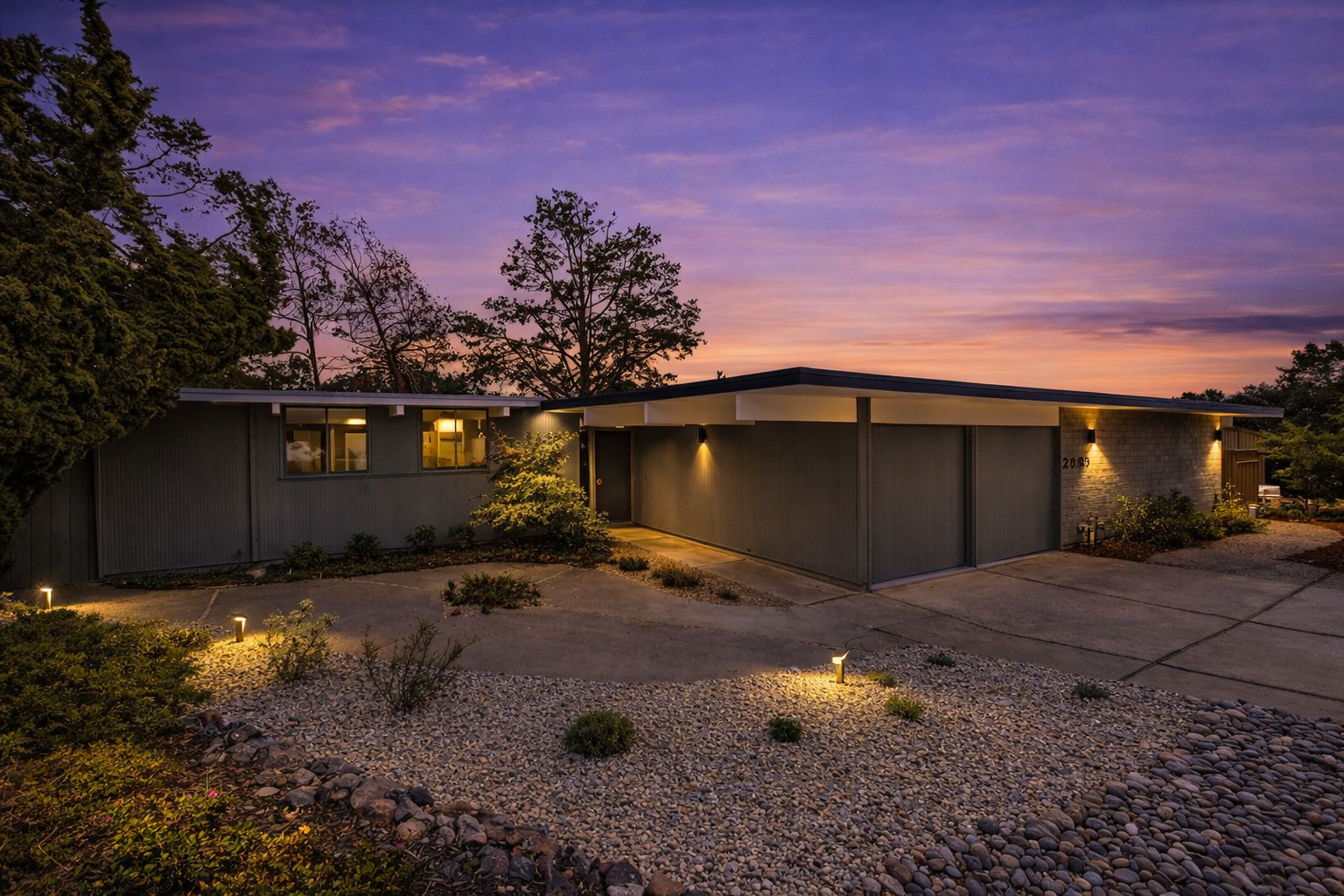
Why San Mateo’s Eichler enclave still feels like the future
On a fog-kissed ridge west of downtown, the Highlands reads like a California story written in glass, redwood, and sunlight. Streets bend into cul-de-sacs; deer and wild turkeys are common enough to feel like neighbors; and many backyards seem to dissolve into open space. Yet this is not an isolated retreat—it’s a mid-Peninsula address with a daily rhythm calibrated for Silicon Valley: school drop-offs, Caltrain commutes, and weekend hikes that start minutes from your front door.
What makes the Highlands exceptional is that its beauty is not accidental. This community is widely regarded as the largest—and most ambitious—single concentration of homes built by visionary developer Joseph Eichler, whose postwar neighborhoods helped define what we now call “California Modern”: post-and-beam structure, indoor-outdoor living, and dramatic planes of glass that frame nature as artwork. In a region where new construction often chases the aesthetics of mid-century modernism, the Highlands offers the real thing—an intact architectural landscape where “originality” and “tasteful modernization” are not marketing phrases, but daily decisions.
Among Silicon Valley buyers, Highlands Eichlers remain highly desirable because they sit at the intersection of design and lifestyle permanence: open floor plans that still feel contemporary, one-story living that can be rarer than it should be at this price point, and a collector-like scarcity created by finite inventory and decades of cultural relevance. The result is a neighborhood that functions as both a place to live—and, increasingly, an “architectural asset class” where design fidelity can translate into market premium.
For clients who care about architecture, details matter. The difference between a sympathetic restoration and an overbuilt remodel can impact not only resale value, but also the integrity of the atrium experience—how light moves through the home, how the roofline reads from the street, and whether the original indoor-outdoor “thesis” still holds. That’s where The Boyenga Team comes in: as design-forward real estate specialists who treat mid-century modern homes as cultural objects, not just square footage. Their work is rooted in deep local knowledge and the high-touch, data-driven marketing ecosystem of Compass.
The making of the Highlands: origins, architects, and the Eichler experiment
The Highlands is often discussed “as if” it were simply a neighborhood within San Mateo. In practice, it’s more nuanced—and that nuance matters for buyers. The Highlands (also known as San Mateo Highlands) is an unincorporated community and U.S. Census-designated place in San Mateo County. It sits west of San Mateo proper, bordered by Interstate 280, State Route 92, Polhemus Road, and Crystal Springs Road—geography that helps explain both its views and its privacy.
Eichler’s Highlands work unfolded primarily between 1956 and 1964, resulting in a community described in architectural scholarship as his largest development—hundreds of modernist homes built in a scenic hillside setting overlooking the Peninsula watershed.
Eichler’s core idea: modernism for daily life
Eichler’s philosophy was not simply “mid-century style.” He was pursuing a postwar proposition: that modern architecture—once associated with custom commissions—could be systematized and delivered at scale, without sacrificing elegance. In the Highlands, this meant repeating floor-plan types, standardizing structural systems, and using cost-efficient materials in ways that still created a sense of air, light, and openness.
Equally consequential was the social dimension. Archival architectural writing on the Highlands notes that Eichler adopted, in 1960, a policy of selling his homes without discrimination—a meaningful stance in a mid-century context where segregation and exclusion were still embedded in many housing practices.
The architects: a “who’s who” of California Modern
One reason Highlands homes read as unusually refined for tract housing is the depth of architectural talent tied to the broader Highlands project. Scholarly documentation of the development links the work to multiple notable architects and firms, including Anshen + Allen (and, within that orbit, Claude Oakland), the Los Angeles modernists A. Quincy Jonesand Frederick Emmons (often working as the firm Jones & Emmons), and other modernist figures such as Raphael Soriano and Pietro Belluschi.
Eichler’s design language is frequently discussed as an evolution of the West Coast’s relationship with modernism—one influenced by the indoor-outdoor sensibility of California living and, more broadly, by the American modernist lineage associated with Frank Lloyd Wright.
Growth, governance, and change over time
Over the decades, the Highlands has evolved in three ways that buyers should understand:
First, governance and services are not “typical city neighborhood” governance. The area is served by special districts and county-level structures, including the Highlands Recreation District (a locally governed district with an elected board that meets regularly) and County Service Area structures governed by the San Mateo County Board of Supervisors. This matters because it shapes how some services are delivered and how community amenities are managed and funded.
Second, the “HOA question.” The Highlands Community Association is described as a volunteer-run community association—not a homeowners association—and thus does not function as an HOA with enforcement authority. For buyers who value architectural freedom or who are cautious about HOA governance, that distinction is meaningful.
Third, preservation and remodeling trends have matured. In early renovation eras, some owners enclosed atriums, altered rooflines, or replaced original materials in ways that diluted modernist intent—often in pursuit of more “traditional” suburban aesthetics. In recent years, a more preservation-literate buyer pool has often favored sympathetic renovation: restoring original lines, using design-appropriate finishes, and upgrading performance (insulation, glazing, systems) without erasing the home’s core identity.
Architectural highlights and housing inventory: what defines a San Mateo Eichler
The Highlands is not “one look.” It’s an ecosystem of variations: atrium-centered models, courtyard layouts, view lots perched near open space, and even rare prototypes that have become historic landmarks. Still, the neighborhood shares a consistent architectural DNA that sophisticated buyers tend to recognize within seconds.
Signature Eichler elements you’ll see again and again
Architectural surveys of the Highlands describe hallmarks that define both the experience and the resale narrative of these homes: post-and-beam construction, extensive glass, atriums or interior gardens, radiant floor heating, and flat or gently sloped rooflines that emphasize horizontal proportion over vertical mass.
The emotional impact is real: floor-to-ceiling glazing creates a sense of transparency; the atrium serves as a private outdoor “room” at the heart of the plan; and sightlines often run from the entry through the atrium to the backyard, making even modest square footage feel expansive.
Floor plans, scale, and what “typical” really means
Highlands homes were built with repeatable plan sets. Architectural documentation notes multiple model series, including floor plans identified as SM-214, SM-216, SM-222, and SM-224, among others—an important reminder that “an Eichler” is not a monolith, but a family of related planning ideas.
In real-world buyer terms, the most common Highlands shopping profile tends to include one-story 3-bedroom/2-bath and 4-bedroom/2-bath atrium models, while certain pockets include larger footprints and a smaller number of original two-story Eichlers. Contemporary listings and sales in the neighborhood frequently reflect this pattern, with examples such as 3/2 and 4/2 homes in the ~1,500–1,800 square foot range, alongside larger and more customized variants.
Lot sizes in the Highlands are often described as generous by local standards—frequently cited in the ~7,000–8,000 square foot range—with some properties backing to open space or situated on view-oriented parcels that amplify the indoor-outdoor experience.
The rarefied layer: prototypes and architectural landmarks
The Highlands is also home to one of the most famous “experimental” Eichler projects: the X-100, an all-steel prototype built in 1956 as a showpiece (“steel house of the future”) for the wider Highlands development. When opened to the public, architectural documentation notes that up to 150,000 people toured it during its exhibition period—an extraordinary cultural footprint for a suburban tract-house prototype.
In 2016, the X-100 at 1586 Lexington Avenue was listed on the National Register of Historic Places (reference number 16000381), underscoring how seriously this “neighborhood architecture” is now treated in the national historic context.
“Other” housing types nearby: context for buyers who want options
While the Highlands is best known for Eichlers, it’s not exclusively Eichler. Real estate and neighborhood documentation notes that there are also non-Eichler, more traditional two-story homes by other developers in portions of the neighborhood—useful context for buyers who love the Highlands location but want different construction, ceiling heights, or mechanical systems.
The other major San Mateo Eichler pocket: 19th Avenue Park
Beyond the Highlands, San Mateo’s other widely discussed Eichler concentration is 19th Avenue Park: a more compact, more uniform tract (often characterized as “over 200 homes”) developed in the early-to-mid 1950s, with smaller lots that are frequently cited around roughly 5,000–5,500 square feet.
For buyers comparing “San Mateo Eichlers,” the distinction is strategic:
Highlands tends to offer larger lots, more view adjacency, and a more topographically dramatic setting. 19th Avenue Park tends to offer a flatter, more central San Mateo experience with a different neighborhood fabric and—often—more modest scale.
Demographic and socioeconomic profile: who lives here, and why it matters for value
Luxury real estate decisions are rarely just about the home—they’re about the micro-economy and social ecosystem that supports long-term value: schools, stability, and the professional networks that shape buyer demand.
Population and place identity
Because the Highlands is a Census-designated place and unincorporated community, it’s helpful to distinguish between “San Mateo” as a city market and the Highlands as a specific enclave. The Highlands CDP recorded a 2020 population of 2,359.
From a buyer standpoint, this small population is a feature: it’s one of the reasons the Highlands has a distinct community identity (and community amenities) rather than feeling like an anonymous subdivision.
Socioeconomics and education: the Peninsula pattern, amplified
Most publicly cited socioeconomic data is reported at the city or county level rather than at the micro-neighborhood level—especially for smaller CDPs. Still, the broader context is unambiguous: San Mateo is a high-income, highly educated Peninsula city, and San Mateo County is among the most affluent counties in the United States.
For San Mateo city, the U.S. Census Bureau reports (2020–2024) a median household income of $165,980, a bachelor’s degree or higher attainment rate of 57.8% (age 25+), and an owner-occupied housing unit rate of 49.9%.
At the county level, San Mateo County’s median household income is reported at $158,855 (2020–2024), with a mean travel time to work of 26.4 minutes (workers age 16+). County demographic reporting also highlights high educational attainment and significant international diversity, including a large foreign-born share and a high percentage of residents speaking a language other than English at home.
Professional demographics: why Silicon Valley buyers focus here
A key reason Highlands Eichlers command consistent buyer attention is alignment with Silicon Valley professional lifestyles. While buyers come from many backgrounds, the Peninsula’s employment ecosystem tends to draw tech workers, founders, executives, and other high-income professionals who prioritize (a) commute optionality, (b) high-performing school pathways, and (c) design-forward homes that feel distinct in a market saturated with conventional construction.
Community amenities and the “not an HOA” advantage
One of the Highlands’ most value-supportive elements is that it offers structured amenities without conventional HOA governance. The Highlands Recreation District—locally governed by an elected board—operates community recreation facilities and programs, with district offices located at 1851 Lexington Avenue.
In parallel, the area’s public-agency landscape includes county service areas and special districts that support local services—real infrastructure that helps explain why the community “functions” with cohesion, even without an HOA model.
School districts and education landscape: the school path that supports demand
Even for buyers without children, schools influence resale liquidity: they shape who can compete for the home, how broad the buyer pool is, and how future demand holds up during market cycles.
Public schools serving the Highlands
Homes in the Highlands are commonly associated with the public-school pathway that includes Highlands Elementary School (K–5) and Borel Middle School (6–8), both within San Mateo-Foster City School District. The California School Dashboard provides official accountability reporting for both schools.
For high school, the pathway most commonly referenced in current listings includes Aragon High School within the San Mateo Union High School District—again reflected in state accountability reporting and in listing-level school district assignments.
School assignment can vary by address and district policies; SMFCSD explicitly notes that its school locator provides preliminary assignments and that final enrollment depends on availability, a practical detail that buyers should confirm during due diligence.
Private school options nearby
For buyers considering private education, the Highlands sits near a dense cluster of respected Peninsula options. Examples include The Nueva School (with a Hillsborough campus and a San Mateo campus), Crystal Springs Uplands School, Junípero Serra High School, and The Carey School. Official directory and school contact sources confirm these institutions and their locations.
Higher education in reach: community college to world-class research
On the public higher-ed side, College of San Mateo (1700 W. Hillsdale Boulevard) is nearby, part of the San Mateo County Community College District, which also includes Cañada College and Skyline College.
For global brand equity (and a major regional employer), Stanford University anchors the Peninsula’s innovation ecosystem and remains a key driver of Silicon Valley’s long-term economic gravity.
Neighborhood attractions and lifestyle: where design meets the good life
The Highlands lifestyle is best described as “nature-first, city-close.”
Parks, trails, and open space—your backyard is bigger than your lot line
Residents are close to watershed landscapes and trail systems that define Peninsula outdoor life. The Sawyer Camp Trail segment of the Crystal Springs Regional Trail is widely used for walking, running, and cycling, with county park documentation noting amenities such as restrooms, picnic areas, and the landmark Jepson Laurel.
Nearby, Pulgas Ridge Open Space Preserve provides miles of trails and ridge-top viewpoints, managed by Midpeninsula Regional Open Space District (Midpen).
The Highlands’ visual drama is also tied to the Peninsula watershed landscape and the proximity of the reservoir system. The region’s watershed and reservoirs are operated by the San Francisco Public Utilities Commission (SFPUC), and the Crystal Springs Dam has been recognized for its engineering and historical significance.
Recreation amenities: a true community differentiator
What sets the Highlands apart from many design-centric neighborhoods is the presence of a structured, neighborhood-scale recreation system. Highlands Recreation District provides community programming and facilities, and its location and governance structure are publicly documented. For many buyers, that’s the difference between “beautiful houses” and “a complete community.”
Dining, coffee, and culture: San Mateo’s everyday luxury
While the Highlands itself is residential—and intentionally quiet—San Mateo offers a deeply developed dining scene. The Downtown San Mateo Association describes downtown as a concentrated district with a major restaurant lineup spread across a compact footprint, supported by a restaurant guide that reads like a culinary index.
For remote workers and weekend routines, coffee culture is part of the Peninsula lifestyle. Examples include Philz Coffee - San Mateo (downtown) and neighborhood staples like Baking Arts & Coffee and Blue Bottle Coffee in Bay Meadows, each with locally published location details.
For retail and entertainment, Hillsdale Shopping Center positions itself as a major Peninsula shopping destination with a large store roster and extended hours—practical convenience that matters more than most people expect until they live here.
And for weekend-reset calm, San Mateo’s Central Park and Japanese Garden is a signature civic amenity. The city describes the Japanese Garden as designed by landscape architect Nagao Sakurai of Tokyo’s Imperial Palace, emphasizing features like the tea house, koi pond, and bamboo grove.
For waterfront recreation, Coyote Point Recreation Area offers a broad range of activities—boating, picnicking, playgrounds—and includes CuriOdyssey for hands-on science and animal experiences.
Commuting and Silicon Valley employer access: the strategic value of mid-Peninsula
The Highlands is prized not only for what it is—but for what it connects to.
Highways and the “choose-your-direction” commute
The neighborhood’s borders—Interstate 280 and State Route 92—are not footnotes. They enable a flexible commute strategy: north to San Francisco and SFO corridors, south to core Silicon Valley employment centers, and east-west connectivity across the Peninsula.
Rail and transit: Caltrain access
For rail commuters, Caltrain service is a defining Peninsula advantage. Station-level documentation confirms the presence of nearby stops, including Hillsdale (commonly used for northern and southern Peninsula commuting).
Employer ecosystem: Silicon Valley in practical reach
From the Highlands, commutes commonly target the major regional employer ecosystem—including Apple Park, Google, Meta, NVIDIA, Adobe, Cisco, and Netflix—with Stanford University anchoring the educational and research layer of the same innovation geography.
Real estate market analysis and case studies: what the data says—and what it means
Eichler homes don’t trade like generic housing stock. They behave more like a niche luxury category with three pricing drivers layered on top of conventional real estate fundamentals:
location (Peninsula + commute), design integrity (originality and architectural clarity), and quality of modernization (systems + finishes without breaking the modernist thesis).
Market snapshot: Highlands pricing in context
As of February 2026, market tracking for San Mateo Highlands reports a median sale price around $2,650,000 (all home types), up year-over-year—an illustration of how resilient this pocket can be relative to broader market mood shifts.
For context, broader county-level reporting shows a February 2026 median sale price of about $1.585M for San Mateo County, with average days on market around 13 days—reinforcing both the county’s competitiveness and the Highlands’ positioning as a high-tier submarket within it.
Appreciation over time: why long-term investors pay attention
At the county level, the FHFA All-Transactions House Price Index for San Mateo County rises from 191.13 (2015) to 288.75 (2024)—an increase of roughly 51% over that span.
At the metropolitan-division scale that includes San Francisco–San Mateo–Redwood City, the FHFA index grows from 374.49 (Q4 2015) to 515.73 (Q4 2025)—roughly a 38% increase across the decade.
These indices are not “Eichler-specific,” but they provide an empirical baseline for why Peninsula housing—and especially architecturally distinctive product in constrained neighborhoods—continues to be viewed as a durable long-term store of value.
Why Eichlers command architectural premium pricing
Eichler premiums tend to appear when three conditions coincide:
First, scarcity: the Highlands has a finite number of Eichlers (often described as 650+ to 700+), and no credible mechanism exists to “build more original Eichlers” in a way that recreates the same cultural and architectural legitimacy.
Second, buyer identity: many buyers are not only purchasing a residence; they’re purchasing membership in a design culture. That cultural demand is precisely what makes a home like the X-100—once a sales tool—now a registered historic property.
Third, performance modernization: the most competitive Eichlers typically address mid-century constraints (single glazing, older radiant heat infrastructure, older electrical/roof work) without erasing the architecture. Radiant heating, for example, is a signature feature—but it can raise due-diligence questions. Eichler Network guidance notes that copper radiant tubing is often repairable, while steel systems can become impractical to repair once corrosion begins, making system evaluation a serious component of the inspection process.
Case studies: representative Highlands and San Mateo Eichler sales
To illustrate how the market rewards design and modernization, consider these publicly reported examples:
A sold example in the Highlands: 2272 Bunker Hill Drive sold on October 15, 2025 for $2,920,000. At 1,710 square feet, that implies pricing around $1,708 per square foot—consistent with a market that pays for “fully transformed” presentation and modernized execution in a classic Eichler envelope.
A second Highlands example: 1651 Lexington Avenue sold on July 31, 2025 for $2,700,000 at approximately 1,550 square feet—roughly $1,742 per square foot, illustrating how prime Highlands product can command premium pricing even at smaller square footage when the design story is strong.
A 19th Avenue Park example within San Mateo: 1636 Celeste Drive sold on September 29, 2025 for $2,100,000 at 1,540 square feet—about $1,364 per square foot—showing how neighborhood submarket, lot profile, and renovation scope can influence valuation even within “San Mateo Eichler” product.
Finally, the ultra-rare architectural tier: the X-100 at 1586 Lexington Avenue—an experimental 1956 steel house—has been actively marketed as a singular architectural offering in the Highlands, with listing narratives emphasizing its prototype status and its historic registration. The home’s status on the National Register is documented in an official National Park Service pending list.
These are examples, not a comprehensive dataset; but they capture the pattern that affluent buyers tend to reward: architectural credibility + disciplined modernization + Highlands location.
The Boyenga Team advantage for Eichler and Mid-Century Modern buyers and sellers
In a niche market, expertise compounds.
The Boyenga Team positions itself as Silicon Valley real estate experts and founders within Compass, with a specialization that explicitly includes luxury homes and mid-century modern architecture—an alignment that matters when your buyer pool is design-literate and your listing story requires architectural fluency.
For buyers, that specialization often translates into three practical advantages:
Access to architecturally significant inventory and early-market opportunities, including Compass programs like “Coming Soon,” which create pre-marketing exposure and can reduce the negative signaling that comes from accumulating public days-on-market history.
A negotiation strategy that reflects how Eichler valuation actually works—where roof condition, radiant heat status, glazing upgrades, and atrium integrity can materially change both inspection posture and pricing psychology.
A design-forward network: including relationships with mid-century appropriate vendors (staging, landscaping, glazing, restoration specialists) who understand that Eichler updates are not generic cosmetic remodels—they’re preservation-aware performance upgrades.
For sellers, the Boyenga Team’s advantage often centers on presentation economics and distribution strategy:
Compass Concierge, described by Compass as a program that fronts the cost of home improvement services with zero due until closing, is a foundational tool for sellers who want to maximize price without front-loading renovation capital.
Compass Coming Soon marketing enables a pre-market runway that can generate demand and feedback before a full market launch—particularly valuable in design-focused niches where the “right buyer” may be a collector-type purchaser rather than a generic search-driven buyer.
For design-forward homes—especially Eichlers—premium marketing is not just about photography. It’s about narrative: materials, architects, plan lineage, indoor-outdoor experience, and the care taken to modernize systems without erasing intent. That narrative discipline is precisely what differentiates a luxury mid-century listing that feels like a magazine feature from one that feels like a commodity.