
Eichler Homes in Sunnyvale: Mid‑Century Modern Architecture, Lifestyle, and Luxury Market Insight
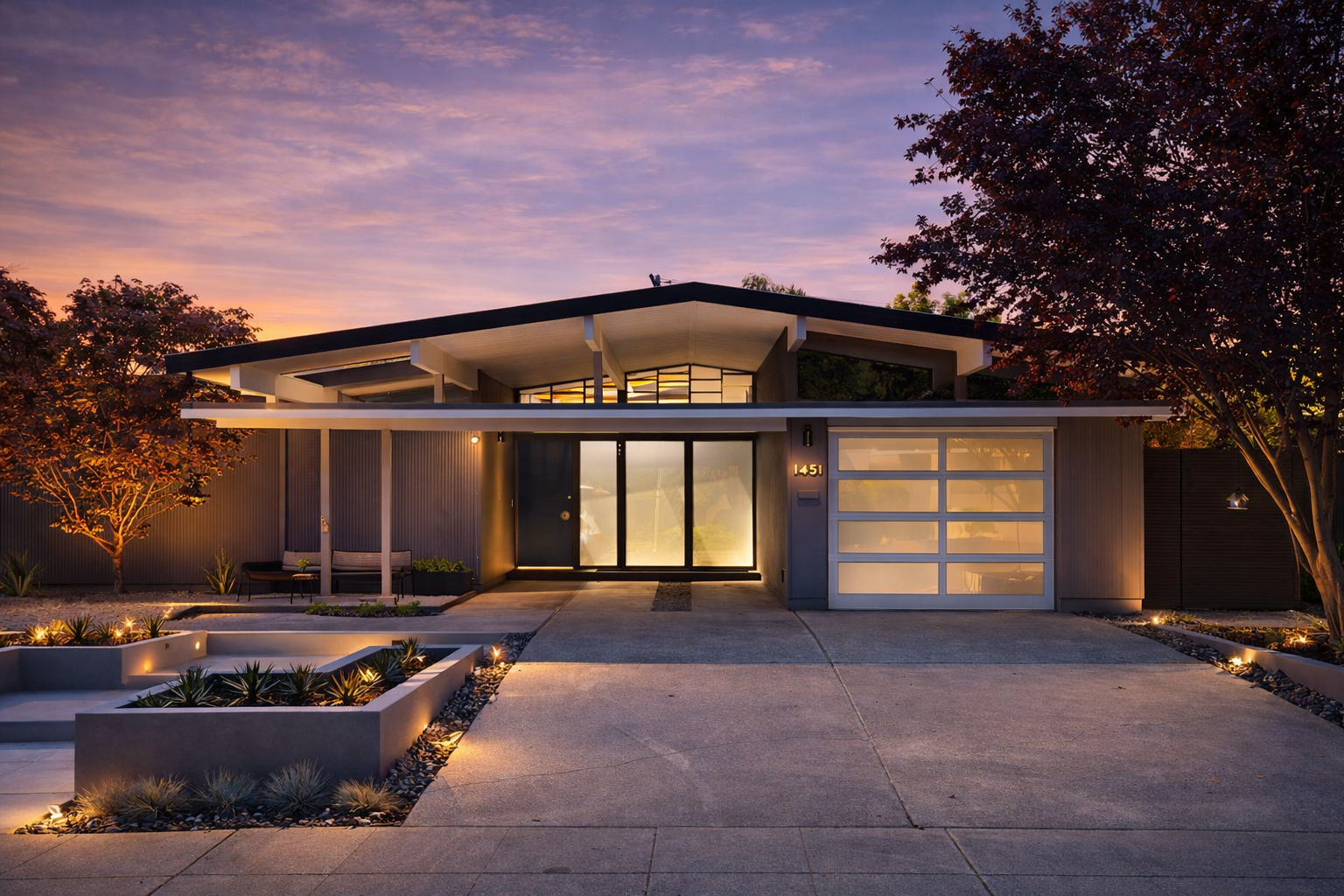
A modernist neighborhood story written in glass and light
There are places in Silicon Valley where the architecture feels like a philosophy you can walk through—where daily life is arranged around sunlight, breezes, and the quiet drama of a courtyard garden. Sunnyvale’s Eichler neighborhoods are exactly that: postwar modernism made livable, scaled for real families, and still remarkably contemporary in how they support work-from-home living, entertaining, and a design-forward lifestyle.
What makes these enclaves special is not simply that they contain mid-century modern homes. It’s that the city itself is tied to the origin story of the Eichler phenomenon; Sunnyvale’s own adopted design guidelines describe Eichler homes as distinctive post–World War II examples of modern residential architecture “having their birth” in the city, with the developer’s first homes constructed here in 1949. That matters to buyers—because provenance matters. In a region where neighborhood identity can turn on school boundaries and commute minutes, a Sunnyvale Eichler carries a rarer kind of value: architectural authorship and cultural legitimacy reinforced by municipal preservation policy.
Lifestyle is the other half of the equation. These are neighborhoods designed for indoor‑outdoor living in the most literal sense—glass walls facing private gardens, atriums open to the sky, and open plans that make even modest square footage feel expansive. Layer in Sunnyvale’s famous proximity to the Valley’s major campuses, plus parks, downtown energy around Murphy Avenue, and a Saturday farmers’ market rhythm that feels distinctly California, and you get why Eichler homes remain highly desirable among affluent homebuyers and architecture enthusiasts alike.
For buyers and sellers who want this intersection of design heritage and Silicon Valley utility, the right advisor changes outcomes. The The Boyenga Team—led by Eric Boyenga and Janelle Boyenga—positions itself as a design-forward, data-driven Silicon Valley specialist team, with public profiles emphasizing mid‑century modern knowledge and luxury marketing. In a niche where materials, rooflines, glazing systems, and city design review all influence valuation, specialization is not a slogan—it’s a practical advantage.
From orchards to atriums: Sunnyvale as the birthplace of the Eichler experiment
Sunnyvale’s Eichler legacy begins with a postwar housing need and a developer’s unusually ambitious belief: modern design should not be reserved for custom homes, but democratized—built at scale without losing architectural integrity. Sunnyvale’s design guidelines detail how Joseph Eichler pivoted from finance-oriented work into homebuilding in his mid‑40s, and how a brief period living in a home designed by Frank Lloyd Wrightstrongly influenced his commitment to integrating house and landscape.
The city’s account places the first Sunnyvale homes in 1949 as part of the “Sunnyvale Building Company,” a precursor stage before the signature post‑and‑beam refinement that followed once he engaged major modernist architects. Local historical interpretation from the Sunnyvale Heritage Park Museum similarly describes early tracts—such as the first “Sunnyvale Manor I” effort in 1949—followed by Sunnymount, establishing Sunnyvale as the proving ground for what would become a statewide architectural brand.
A critical turning point was Eichler’s recruiting of architect Robert Anshen and the firm Anshen and Allen, as well as Southern California architects A. Quincy Jones and Frederick Emmons. Sunnyvale’s guidelines explicitly identify these designers as key to the highly refined post‑and‑beam maisons that defined the “Eichler style.” Over time, the guidelines note that designers including Claude Oakland also shaped later work, reinforcing that these were architect-designed communities rather than mere “Eichler-esque” tract copies.
Scale matters in valuation, and Sunnyvale’s municipal documentation provides the most grounded local number: around 11,000 Eichler production homes were built across Northern and Southern California, with over 1,000 constructed in Sunnyvale between 1949 and 1972. That’s why, even among Bay Area Eichler markets, Sunnyvale reads as an epicenter rather than a footnote.
Where the Eichler neighborhoods are concentrated
In Sunnyvale, the best-known Eichler concentration for today’s buyers is in the southern and southwestern residential areas—mapped by the city as a set of “Eichler Neighborhoods” including Parmer Place, Fairbrae (and Fairbrae Addition), Rancho Verde (and Rancho Verde Addition), Primewood, Fairwood (and Fairwood Addition), plus Fairorchard, Rancho Sans Souci, and Fairpark Addition.
These mapped neighborhoods are not only recognizable by rooflines and glazing; they’re recognized by policy. Sunnyvale adopted its Eichler Design Guidelines in 2009 to preserve neighborhood character, respond to increasing second-story additions and incompatible infill, and provide a consistent foundation for design review decisions.
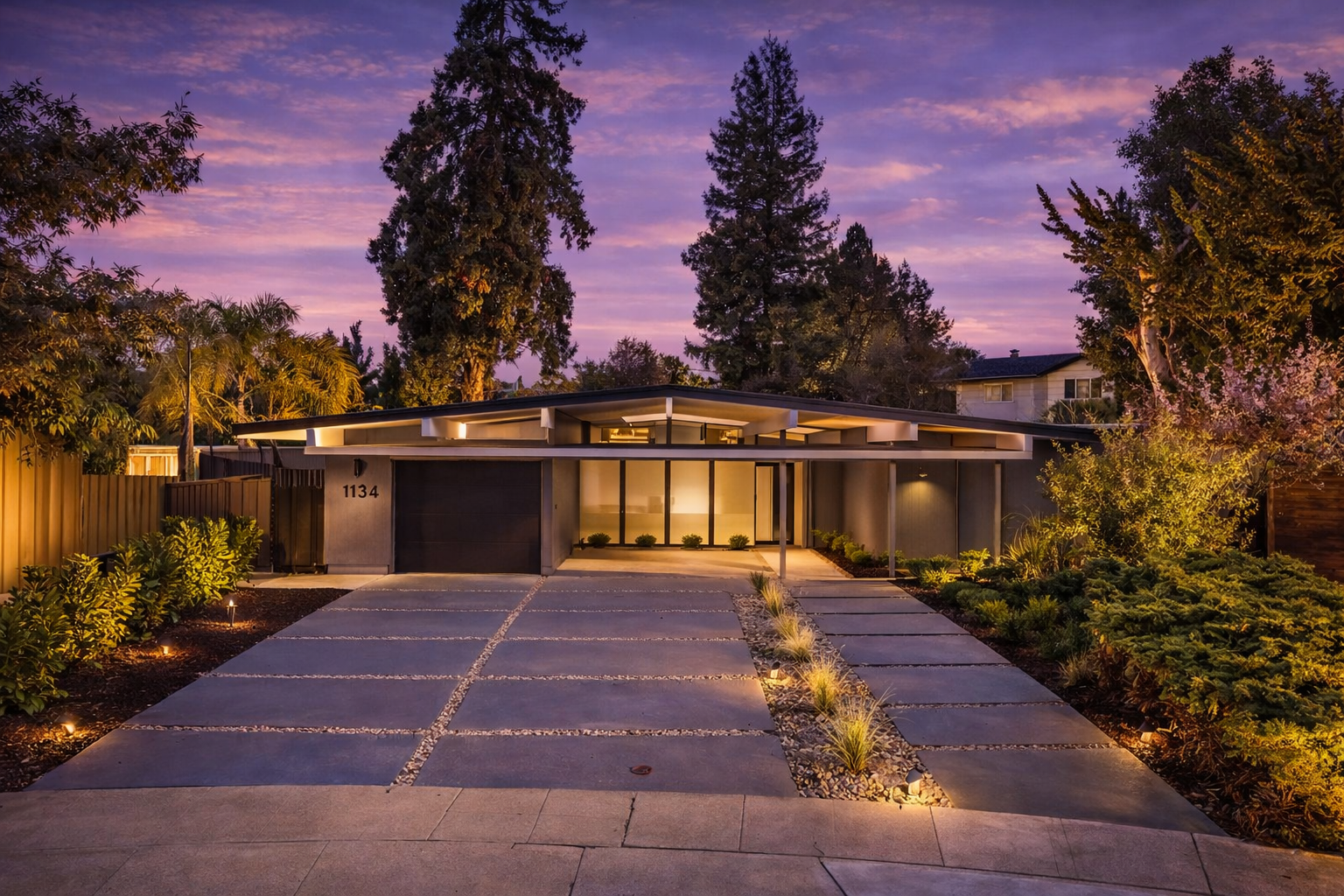
Preservation and remodeling: why Sunnyvale’s guidelines matter financially
Sunnyvale’s guidelines are explicit about the pressures that shaped the modern market: Eichlers are vulnerable to privacy intrusions from adjacent two‑story construction because of their extensive glass and open planning, and the city observed concerns about demolitions and replacement homes that felt incompatible with surrounding Eichler neighborhoods.
The resulting regulatory framework creates a subtle but very real market effect: buyers are not just purchasing a home; they are purchasing into a protected design context where the street rhythm—low roof plate heights, horizontal emphasis, and modern geometry—is treated as a civic asset. That tends to support long-term desirability, especially among design-literate buyers who see architectural coherence as part of neighborhood “luxury.”
Architectural DNA: what defines a Sunnyvale Eichler
Eichler homes are the rare tract houses where structure is aesthetic. The core system is post‑and‑beam construction, which reduces reliance on interior load-bearing walls and allows the open, flowing planning that reads as “custom” even when square footage is moderate. Sunnyvale’s guidelines enumerate signature characteristics: post‑and‑beam construction, strong interior/exterior relationships with large areas of glass facing private yards, and a horizontal design emphasis with modern geometric forms.
Atriums are the emotional center of many Sunnyvale models: the city describes open-to-sky atriums as common features, and even dedicates specific design guidance to atrium covers because these interventions can overwhelm the home’s original scale if done without restraint. When you step into one of these homes, the sequence is intentional: street-facing restraint, then a sudden reveal—glass, sky, and a private garden room that turns circulation into experience.
Materials and exterior language
Sunnyvale’s guidelines go further than abstract admiration; they document construction and cladding conventions that make an Eichler read as an Eichler. One example: vertical‑grooved wood siding and exposed concrete block appear repeatedly as recommended exterior wall expressions, with guidance on retaining the post‑and‑beam “honest structure” and a caution against highly textured, stylistically “busy” materials that fight the clean modern envelope.
That attentiveness matters to today’s remodeling economy. The city calls out a recurring reality: these houses were built fast, during a period with different energy assumptions, and with materials that can now require specialized replacement strategies. Its guidelines highlight common pressures: single-pane glazing, limited insulation, HVAC upgrades that risk visual disruption, and radiant heat systems that—in some cases—deteriorated when copper piping was not available.
Typical layouts, size ranges, and what buyers actually encounter
While each tract has its own mix of plans, current market examples show a remarkably consistent functional profile: single-story 3‑ and 4‑bedroom homes, often 2 baths, with a spectrum from ~1,300 square feet to just over ~2,100 square feet before expansions—an efficiency that still feels generous because of light and plan openness. For example, a Birdland-area Eichler listing at 1484 Kingfisher Way is shown around 1,328 sq ft (3/2), while another nearby sale at 1472 Kingfisher Way reflects a larger 4/2 profile at 1,721 sq ft. A Parmer Place corridor sale at 833 Cumberland Dr is listed at roughly 2,102 sq ft—illustrating how some Sunnyvale Eichlers push into larger family footprints.
Lot sizes tend to sit in the classic suburban sweet spot—large enough for outdoor living, lean enough for low-maintenance modern landscaping. A representative Birdland property page shows 6,528 sq ft lot size on a 1961-built Eichler example, aligning with the neighborhood’s prevalent “private yard as outdoor room” concept.
Why design-forward buyers keep paying a premium
The persistence of demand is not nostalgia; it’s utility aligned with contemporary taste. Eichlers were early adopters of features that modern buyers still want: generous glazing, indoor-outdoor flow, combined kitchen/family spaces, and plan flexibility that supports hybrid work (a fourth bedroom becomes office; the atrium becomes a meditation garden; the living/dining zone becomes the gathering stage). Sunnyvale’s guidelines explicitly recognize these innovations as trend-setting within mass-produced housing.
Preservation also has an emotional component that shows up in transactions. National preservation storytelling about Eichlers notes the atrium as a buffer between inside and outside and a light engine for California living—exactly the kind of lived experience that affluent buyers describe as “wellness design” today.
Who lives here: a high-achieving, globally connected community
Sunnyvale’s demographic profile reads like a Silicon Valley macro-trend distilled into a single city: highly educated households, high incomes, significant global diversity, and a professional base shaped by tech and engineering employment ecosystems. The U.S. Census Bureau reports a 2020 census population of 155,805 for the city, with a median household income around $186,170 (in 2024 dollars, 2020–2024) and exceptionally high educational attainment—94.4% high school graduate or higher and 69.3% bachelor’s degree or higher for adults 25+.
The city’s diversity is also a defining market factor. Data profiles compiling recent ACS estimates show a large foreign-born share (over 50% in a recent snapshot) and a majority-Asian population composition—patterns consistent with Silicon Valley’s global talent inflow. In real estate terms, this creates a buyer pool that is both internationally mobile and design-literate—often with exposure to modern architecture through travel, education, and the product-design culture of the Valley.
Homeownership is meaningful but constrained by price. Census QuickFacts tracks owner-occupied housing rate and housing value metrics for the city (2020–2024), reflecting the broader California dynamic: high demand meets limited supply. In this environment, Eichler neighborhoods act as a premium submarket inside Sunnyvale real estate: distinctive inventory, protected character, and a buyer base that actively searches for “Eichler homes for sale” rather than just “3/2 near tech.”
Buyer and resident patterns that show up on the ground
Migration and buyer interest data reinforce what agents experience anecdotally: most movement is intra‑metro, with households optimizing for commute and schools rather than leaving the region. In one recent relocation snapshot, 75% of Sunnyvale homebuyers were searching to stay within the metropolitan area. (Inference: within a metro that includes San Francisco, Peninsula, and South Bay markets, this “stay local” pattern often includes households shifting south for proximity to tech campuses and school fit—an internal migration logic that helps explain sustained Sunnyvale demand.)
Professionally, the city sits in the heart of Silicon Valley’s employment lattice, with commute patterns anchored by major campuses and transit infrastructure—one reason mid-century neighborhoods here are prized by executives who want design without sacrificing weekday logistics.
Education as an asset class: school districts and private options
In Silicon Valley real estate, schools are not a footnote—they are often the headline. Public boundary maps and district locator tools explicitly advise families to verify assignments when making major housing decisions, underscoring how central school placement is to buyer demand.
Public schools serving many Sunnyvale Eichler neighborhoods
Much of the most actively traded Eichler inventory in the city’s southern/western tracts sits near district seams, which is why verification matters. For high school, the Fremont Union High School District publishes attendance boundary guidance and maps for its high schools (including Fremont High School and others), and recommends using county or district locator tools for purchase decisions.
For K–8, segments of Sunnyvale are served by the Cupertino Union School District, which provides an address-based school locator with a clear disclaimer that assignments are preliminary until confirmed at registration. One frequently referenced elementary option for nearby Eichler tracts is Louis E. Stocklmeir Elementary School, which is listed within the Cupertino Union School District and currently carries a top GreatSchools rating on its profile page.
Other parts of the city fall within the Sunnyvale School District, which publishes boundary resources and a school finder tool for address-based confirmation. Because Eichler neighborhoods can be near borders, the practical guidance for buyers is constant across districts: verify with the official locator early—before contingencies compress your timeline.
Private school ecosystem and higher education nearby
Sunnyvale’s private school ecosystem is one reason affluent buyers see the area as resilient to changing school preferences: families have multiple pathways without leaving the South Bay. Meanwhile, access to major higher education institutions reinforces long-term demand and intellectual capital. Stanford University, with its primary address in Stanford, anchors regional prestige and workforce pipelines; Santa Clara University adds another major private-university presence nearby.
Community colleges also matter for both workforce upskilling and family logistics. Foothill College is a close regional resource (with a dedicated Sunnyvale Center), and nearby South Bay options include West Valley College and De Anza College.
The Sunnyvale lifestyle: parks, culture, dining, and everyday ease
Sunnyvale’s Eichler neighborhoods succeed as lifestyle neighborhoods because they balance privacy (walled gardens, atriums, retreat-like interiors) with immediate access to parks and an increasingly sophisticated downtown. The city’s own parks directory reads like a curated amenity list for residents: Baylands Park, Las Palmas Park, Ortega Park, Seven Seas Park, Panama Park, and De Anza Park are all listed with addresses and serve as the everyday outdoor “extensions” of Eichler living.
For families, this park network supports the kind of neighborhood life that buyers associate with mid-century communities: stroller walks, after-school playground rituals, and weekend picnics. The city even formalizes picnic use and reservations, signaling how programmed and active these public spaces are.
Downtown energy that complements mid-century quiet
The city directory and downtown association materials highlight Murphy Avenue as the anchor of Downtown Sunnyvale, positioning it as a core place to dine, shop, and gather. That matters because Eichler neighborhoods tend to be residentially serene; buyers often want a “quiet home, lively edge” pairing—a quick drive or bike ride to restaurants and cafés without living in the center of activity.
A defining ritual is the Sunnyvale Farmers' Market, listed on the city’s events calendar as operating year-round, rain or shine, on Saturdays from 9 a.m. to 1 p.m. in Downtown Sunnyvale. For remote workers and design-minded residents, this kind of weekly cadence is part of the appeal: it’s an amenity that feels like a “small city” inside a high-powered tech region.
Community clubs and social fabric
While Sunnyvale’s Eichler neighborhoods are not defined by a single mandatory HOA in the way some planned communities are, they do have social structures that function like lifestyle infrastructure. One example is the Fairbrae Swim and Racquet Club, which describes itself as a member-owned neighborhood club with year-round pool and tennis amenities—an institution that can meaningfully shape “community feel” for nearby tracts.
Connectivity: commuter corridors, Caltrain, and the tech-campuses map
Sunnyvale is prized in Silicon Valley real estate because it offers something few cities can: architectural charm alongside logistics that make high-performance careers easier. For rail, Caltrain service at Sunnyvale Station provides a direct commuter spine and connects Downtown Sunnyvale to the broader Peninsula corridor.
Regional transit options expand via the Santa Clara Valley Transportation Authority network, which publishes route and system map resources that help residents connect to North County job centers and intermodal links.
Proximity to major Silicon Valley employers
Sunnyvale’s location is especially compelling for buyers whose work lives orbit the Valley’s flagship campuses. Within practical commuting distance are:
Apple Park (corporate address: One Apple Park Way, Cupertino).
Googleplex (Google’s Mountain View campus listed at 1600 Amphitheatre Parkway).
Meta (Menlo Park corporate address referenced as 1 Meta Way).
NVIDIA (corporate address: 2788 San Tomas Expressway, Santa Clara).
Adobe (corporate headquarters: 345 Park Avenue, San Jose).
Cisco Systems (San Jose addresses include a legal mailing address at 170 West Tasman Drive).
Netflix (Los Gatos address: 121 Albright Way).
For buyers, this cluster translates into a strategic resilience: if work shifts between companies over a decade (common in Silicon Valley), the neighborhood’s “commute geometry” remains advantageous.
Market performance, recent Eichler sales, and The Boyenga Team advantage
Sunnyvale market snapshot and what it implies for Eichlers
Sunnyvale’s broader market remains intensely competitive. In a recent monthly snapshot (February 2026), median sale price was reported around $1.87M with median days on market around 9, and sale price per square foot around $1.17K—numbers that reflect rapid absorption and sustained overbidding dynamics. A separate housing market overview reports median days to pending around 10 and a median sale-to-list ratio above 1.0, reinforcing that well-positioned listings often trade fast and strong.
For long-term context, the regional Federal Housing Finance Agency all-transactions House Price Index for the San Jose–Sunnyvale–Santa Clara metro rose from 358.61 (Q1 2016) to 561.97 (Q4 2025)—about a 57% cumulative increase over roughly a decade. While Eichler pricing is its own micro-market, this regional appreciation frame helps explain why design-forward homes—with limited supply and high buyer passion—tend to hold an architectural premium inside already expensive Silicon Valley real estate.
Why Eichlers often command a premium inside the Sunnyvale market
Sunnyvale’s own policy framework offers part of the explanation: the city explicitly targets preservation of Eichler neighborhood character and treats exterior changes, additions, and new builds within these neighborhoods as design-review events under defined triggers (including second-story additions and major expansions). This reduces the risk of a neighborhood “drifting” stylistically over time, which can help stabilize buyer confidence in long-term character—a form of value protection typically associated with historically protected districts.
Case studies: recent Sunnyvale Eichler sales and what they signal
Recent closed transactions underscore the pattern buyers already know: when a Sunnyvale Eichler is well-presented (or well-located within a prized tract), competition is real.
A sale at 1472 Kingfisher Way closed at $2,860,000 (July 2025), representing a 4/2 footprint at approximately 1,721 square feet—illustrating how “classic” single-story Eichler scale can still command upper-tier pricing when the product is scarce and the neighborhood fit is right.
A separate closing at 802 Allison Way sold for $3,078,000 (June 2025) with an approximate 2,016 square feet—evidence that larger Eichler footprints (often in later or more expansive plan families, or with thoughtful additions) attract a different buyer tier, including executives prioritizing both design and functional space.
On the Parmer Place corridor, 833 Cumberland Dr sold for $2,850,000 (May 2024) at approximately 2,102 square feet—highlighting that Sunnyvale’s Eichler inventory includes models that feel closer to “family estate” scale while still preserving mid‑century lines.
Even within the same neighborhood ecosystem, size and plan composition can change outcomes: 784 Duncardine Way closed at $2,500,000 (August 2024), a reminder that buyers price not only architecture, but also level of renovation, glazing upgrades, roof/HVAC modernization, and the overall indoor-outdoor execution.
The Boyenga Team advantage for Sunnyvale Eichler buyers and sellers
In a market where architectural authenticity and design review realities shape value, specialization is leverage. The Boyenga Team’s public positioning emphasizes Silicon Valley expertise and mid‑century modern knowledge, including Eichler-focused marketing and buying support. Their Compass profiles also highlight a focus on neighborhood and school knowledge, negotiation, and data—skills that matter when a home trades in days and multiple offers are standard.
On the listing side, their Compass team profile explicitly references platform tools such as Concierge-style pre-market preparation support and private/off‑MLS marketing channels, which can be especially relevant for design-forward sellers who want to control narrative, aesthetics, and buyer targeting. For buyers, the same network effects can surface off-market opportunities and reduce the “waiting game” risk in a low-inventory niche where true Eichlers appear unpredictably.
For anyone considering expansion, rebuild, or major exterior changes, a specialist team also helps coordinate the practical ecosystem—architects and contractors familiar with Eichler constraints, plus an early understanding of design review triggers under Sunnyvale’s guidelines.