
Mills Estates Ranch Homes in Burlingame: An Enclave
Introduction
Because the brief did not name a specific Burlingame enclave, this feature focuses on Mills Estates: the neighborhood most clearly tied to Burlingame’s postwar expansion and one of the city’s strongest concentrations of ranch-era and mid-century housing. The area was created from the southern portion of the former Darius Ogden Mills estate after annexation in 1954, and city historic-resource documents note that the district then developed rapidly in the late 1950s and 1960s with new residential and commercial construction. That timeline matters. It is exactly the moment when California ranch architecture, casual indoor-outdoor planning, and the Peninsula’s car-oriented suburban ideal converged.
What makes Mills Estates so compelling today is that it still reads like an elevated version of that original promise. The streets are broad, the topography is gently varied, many homes sit on noticeably larger parcels than newer infill development can offer, and the neighborhood preserves a quiet, established residential feel while remaining tightly connected to the Peninsula’s economic engines. Burlingame’s own planning documents frame the city as benefiting from freeway and transit access, proximity to San Francisco International Airport, and a strategic location on the San Francisco Peninsula. In practice, that means a Mills Estates address can deliver suburban calm without forcing buyers to sacrifice urban connectivity.
That combination explains why Burlingame ranch homes remain so appealing in the current luxury market. The ranch house was designed for ease, sunlight, circulation, and everyday comfort; preservation and planning sources describe the type through its horizontal massing, low profile, flexible family spaces, and embrace of outdoor living. For today’s buyers, those same qualities translate into something even more valuable: a house that feels livable now and adaptable later. A one-story layout can support aging in place, a deep lot can support expansion, and a clean postwar envelope can be renovated into an unmistakably high-design California residence.
In that sense, Mills Estates occupies a particularly attractive position within Burlingame real estate. It offers the prestige of the Peninsula, the nearness of San Francisco, the commuting logic of Highway 280, El Camino Real, Caltrain, and nearby BART connections, and the architectural upside that affluent buyers increasingly seek in single-story homes Burlingame and mid-century homes Burlingame searches. For buyers and sellers navigating that mix of design, land value, and competition, The Boyenga Team’s value proposition is intuitive: Eric and Janelle Boyenga describe themselves as Silicon Valley real estate experts and founding partners of Compass, with decades of experience, strategic marketing, and strong design literacy, including Janelle Boyenga’s staging and home-prep credentials.
Historical foundation
Burlingame’s residential story begins long before the ranch era. The city traces early subdivision to the 1890s, when Francis Newlands began developing the Burlingame Country Club area and the Burlingame train station followed in 1894. The 1906 San Francisco earthquake and fire accelerated migration to Burlingame, which incorporated in 1908 and annexed Easton in 1910. That early wave established Burlingame’s long-standing identity as a refuge of tree-lined residential comfort for buyers who wanted separation from urban intensity without severing ties to San Francisco.
Mills Estates belongs to the second great chapter of that story. According to the City of Burlingame’s history page, the city’s northernmost section was formed by annexing the major southern portion of the Darius Ogden Mills estate in 1954. The Mills heirs sold the estate to the Trousdale Development Corporation, and after a prolonged annexation dispute between Burlingame and Millbrae, the property was divided along what is now Murchison Drive. City historic-resource records then describe the late 1950s and 1960s as a period of rapid development across the Mills Estate area, including both residential construction and related commercial growth.
That timing placed Mills Estates squarely inside the great postwar housing boom on the Peninsula. By the time the neighborhood was being built out, the ranch house had already become the dominant language of California suburbanism. Preservation and architectural sources trace the type to the refinement of the modern California ranch by designers such as Cliff May and to the broader postwar standardization of one-story, family-oriented houses marketed around casual living and the California lifestyle. In that sense, Mills Estates was not simply “built in the ranch era”; it was born in the precise historical moment when the ranch house became the preferred suburban form for upwardly mobile households.
Over time, the neighborhood’s social meaning changed. What began as middle- and upper-middle-class postwar suburban housing has, like much of prime Peninsula real estate, evolved into luxury property. Local market commentary on Mills Estates notes that replacement houses tend to come back larger than the homes they replace, a familiar pattern in high-value lots where the land is often as significant to buyers as the existing improvements. That tension between preservation and redevelopment is central to the neighborhood today: some owners restore or subtly expand original ranch homes, some undertake major luxury remodels, and some pursue more dramatic reconfiguration.
ADUs are now part of that evolution as well. Burlingame’s annual housing-production reporting shows accessory dwelling units as a recurring component of the city’s housing pipeline, and a public-record zoning summary for a Mills Estates parcel identifies the R-1 district as allowing detached single-unit homes as well as accessory dwelling units and related structures. In practical terms, that means many large lot homes Burlingame buyers are no longer evaluating a parcel only for the main house; they are underwriting the entire site as a long-horizon asset with flexibility for guest space, multigenerational living, office use, or supplemental value creation.
Architectural character and housing inventory
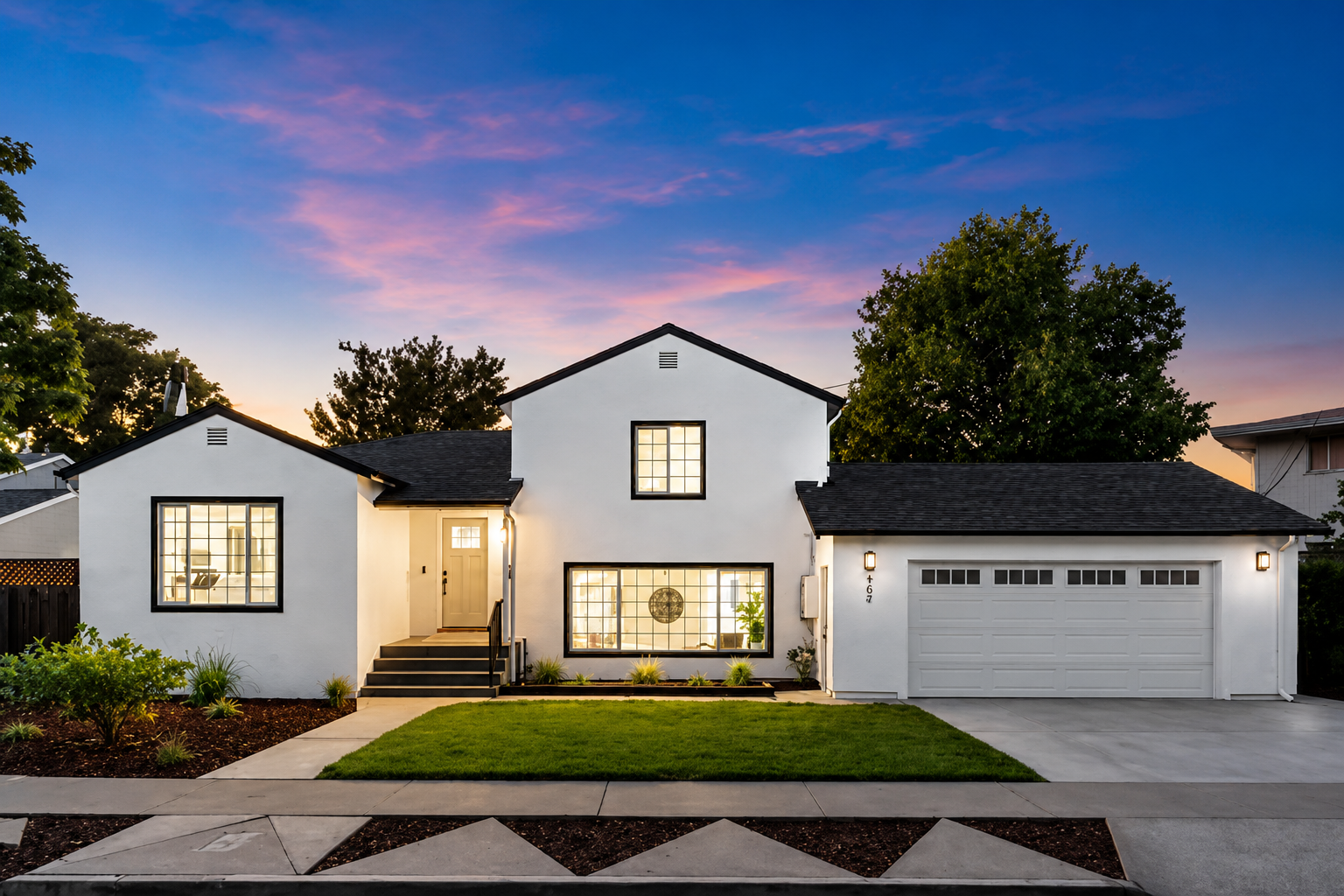
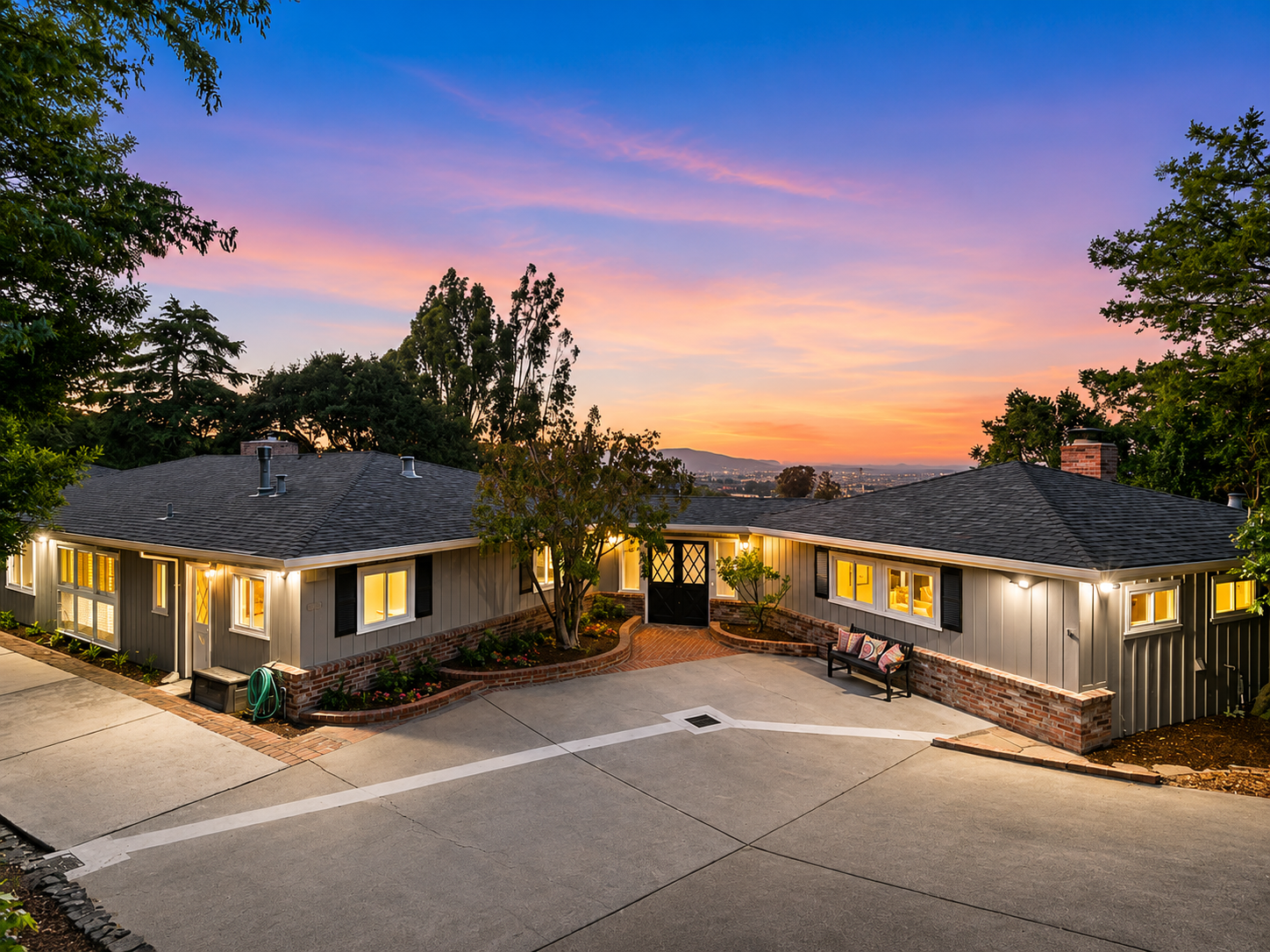
The architectural DNA of Mills Estates is deeply legible. At its clearest, the neighborhood’s ranch homes present as low-slung, horizontally composed houses with attached garages, broad frontage, large picture windows, sliding doors to patios or gardens, and floor plans that separate private bedroom wings from more open living spaces. Preservation guidance for ranch houses identifies exactly these traits—one-story massing, low-pitched roofs, asymmetrical or L-shaped plans, attached garages, glass-heavy elevations, and direct connections to outdoor rooms—as hallmarks of the form.
What distinguishes Burlingame’s best ranch inventory from more generic suburban stock is the way the Peninsula market has curated it over time. In Mills Estates and nearby postwar pockets, ranch houses often sit on parcels with enough depth to support proper front setbacks, functional rear entertaining space, and expansions that do not feel forced. Some properties preserve a purer 1950s or 1960s profile; others layer in mid-century-modern cues, contemporary glazing, open kitchens, higher-end finishes, and more sculptural landscaping. A local Mills Estates guide also notes the presence of numerous Eichler homes in and around the area, which adds another layer of architectural credibility to the broader mid-century conversation.
The public market data reinforces the neighborhood’s typical scale. Homes.com’s Mills Estates market snapshot reports a median single-family sale price of about $3.0 million, an average price of roughly $1,138 per square foot, about 48 home sales over the last 12 months, and average marketing times in the low-30-day range. Realtor.com’s Mills Estates neighborhood page shows a median listing price of $2.475 million, about 7 active homes for sale, and an average market time around 39 days. These figures should be read carefully because methodologies differ across platforms, but together they convey a consistent point: this is a tightly held, high-value neighborhood where ranch-era homes remain central to the inventory mix.
Representative sales show the physical band in which much of the neighborhood operates. Recent transactions include 2705 Arguello Dr at 2,101 square feet, built in 1960, which sold for $3.0 million in October 2025; 1820 Capistrano Way, built in 1964, with 2,100 square feet, which sold for $3.76 million in October 2025; and 1801 Castenada Dr, built in 1957, with 2,070 square feet on a 9,840-square-foot lot, which sold for $2.55 million in December 2025. An older Redfin listing for 2609 Martinez Dr—described as a “classic one story ranch style home” on an 8,928-square-foot lot in a lower Mills Estate location—illustrates the kind of oversized, expansion-friendly parcel that continues to define the neighborhood’s appeal.
That is the core reason ranch homes Burlingame CA continue to attract such a broad buyer pool. Families like the efficient bedroom counts and yard space. Downsizers value the one-level living and neighborhood prestige. Executives and remote workers value the lot size, privacy, and renovation upside. Investors and long-term wealth buyers see the same thing appraisers and developers see: in a supply-constrained Peninsula market, the land under a good ranch house can be almost as compelling as the house itself.
Resident profile and schools
At the city level, Burlingame’s resident profile helps explain why neighborhoods like Mills Estates command such durable demand. Data USA reports a 2024 population of 30,525, a median household income of $174,000, a median property value of $2 million, and a homeownership rate of 48.2%. The same profile shows Burlingame’s largest industries as Professional, Scientific, and Technical Services, Health Care and Social Assistance, and Manufacturing, with especially high wages in Information, Finance and Insurance, and Professional, Scientific, and Technical Services. It also reports that 31.5% of residents are foreign-born, indicating the kind of global professional mix that has long characterized prime Peninsula communities.
That profile should not be mistaken for a tract-level demographic survey of Mills Estates specifically; public neighborhood-level data is thinner than citywide data. But as a market proxy it is highly relevant. Burlingame’s affluence, heavy concentration in professional and knowledge-sector work, and strong international-population share align closely with the typical buyer profile for luxury Peninsula neighborhoods: technology professionals, entrepreneurs, healthcare leaders, finance and legal households, and San Francisco or Silicon Valley migrants seeking larger lots, better schools, and more flexible homes. The migration and commute data also suggest a market increasingly comfortable with hybrid schedules: Data USA says 27.9% of workers in Burlingame worked from home in 2024, while 53.3% drove alone and the average commute was 30.7 minutes.
Schools remain one of Burlingame’s strongest demand drivers. For Mills Estates, the public-school path most commonly associated with the neighborhood in public-facing guides is Franklin Elementary, Burlingame Intermediate School, and Burlingame High School, though buyers should always verify the assignment by exact address through the Burlingame School District and San Mateo Union High School District boundary tools. Franklin is located on Trousdale Drive in the heart of the district footprint; Burlingame Intermediate is the citywide public middle school; and Burlingame High is a California Distinguished School in the SMUHSD system.
On third-party school-rating platforms that many buyers still consult, the public-school reputation is strong. GreatSchools assigns Franklin Elementary, Burlingame Intermediate, and Burlingame High each a 10/10 rating, and Niche ranks Burlingame High #1 among public high schools in San Mateo County with an A+ overall grade. Those ratings are not official accountability measures, but they are meaningful because they influence search behavior, parent perception, and willingness to pay.
Beyond the public system, the area also benefits from a deep private-school ecosystem across Burlingame, Hillsborough, and nearby communities; public neighborhood school-search pages surface options including Mercy High School, The Nueva School, and Our Lady of Angels School, though families should independently confirm admissions, grade spans, and commute practicality. For higher education access, the location is equally strong: Stanford University is on the Peninsula in Stanford, while the University of San Franciscoand San Francisco State University anchor major campuses in San Francisco. Even when those institutions are not a daily commuter destination, their presence adds to Burlingame’s appeal for faculty households, graduate families, and international buyers who prize academic proximity.
Lifestyle and connectivity
Lifestyle is where Mills Estates earns its premium. The neighborhood sits close to some of Burlingame’s most appealing recreational assets, including Mills Canyon, where the city has invested in trail and access improvements, and Cuernavaca Park, a five-acre neighborhood park that city planning materials describe as offering scenic and recreational amenities including a playground, basketball courts, youth fields, off-leash dog areas, and restrooms. The city has also recently completed the Cuernavaca field renovation, reinforcing the quality of local recreation infrastructure.
Daily life extends far beyond the subdivision itself. Official Burlingame materials describe downtown Burlingame Avenue as a vibrant shopping and dining district, while Broadway Burlingame positions itself as a compact, independently minded corridor of boutiques, specialty retail, and neighborhood-serving restaurants. San Mateo County’s market directory and the city’s own sustainability/food page confirm regular farmers-market activity in Burlingame as well. For homeowners, this matters because the neighborhood offers something rare on the Peninsula: a quiet residential setting that is still closely tethered to genuine, walkable commercial districts rather than to a purely bedroom-community pattern.
The connectivity story is just as strong. Burlingame’s General Plan notes that the city has two Caltrain stations and close access to BART via Millbrae. Caltrain’s official station pages confirm Burlingame Station at 290 California Drive and Millbrae’s direct BART-Caltraintransfer function. Burlingame’s economic-development materials explicitly identify the city’s transit and freeway access, and its proximity to SFO, as core competitive advantages. That is one reason the city’s Bayfront continues to attract major employment uses, including Meta Reality Labs, while the Burlingame campus of Mills-Peninsula Medical Center anchors a major healthcare presence on Trousdale Drive.
For regional employment access, Mills Estates sits within a remarkably broad job shed. Official company pages place Salesforce in downtown San Francisco, OpenAI in San Francisco, Visa in Foster City, Oracle in Redwood Shores, Meta in Menlo Park, Snowflake in Menlo Park, Google in Mountain View, Apple in Cupertino, NVIDIA in Santa Clara, and Genentech in South San Francisco. That spread is exactly why Burlingame is so attractive to dual-career households: northbound access serves San Francisco and biotech, southbound access serves Silicon Valley, and hybrid work reduces the need to optimize for a single daily commute.
Market analysis and sales examples
The broader Burlingame luxury homes market remains notably competitive. Redfin reports that over the three months ending May 2026, Burlingame’s median sale price was $3,101,144, up 8.7% year over year, while the median sale price per square foot was $1.55K. Homes sold after an average of 10 days, the city posted a 106.4% sale-to-list ratio, and Redfin’s competitiveness index scored Burlingame at 94 out of 100, with most homes attracting multiple offers and hot homes capable of selling for roughly 16% above list price. This is the context in which ranch homes are trading: not as dated stock, but as scarce, design-flexible assets in one of the Peninsula’s tightest markets.
Realtor.com’s March 2026 local market view tells a similar story from the active-listing side. It characterizes Burlingame as a seller’s market, shows about 38 homes for sale citywide, and reports median marketing times of roughly 19 days citywide and 27 days for ZIP code 94010. Even where inventory has improved modestly from prior lows, it remains thin relative to the depth of demand. In a city where buyers are often competing not only against one another but against future redevelopment value, that scarcity keeps pricing resilient.
The longer arc is equally instructive. Using the FHFA all-transactions house-price index for San Mateo County as the best high-quality public proxy for long-term appreciation, the index rose from 245.43 in 2019 to 288.75 in 2024, a gain of about 17.7% over five years. From 173.64 in 2014 to 288.75 in 2024, the increase was about 66.3% over ten years. County-level index data is not the same thing as a Mills Estates comp set, but it does capture the structural appreciation backdrop that underpins Peninsula real estate and helps explain why land-rich ranch parcels continue to perform as wealth-preservation assets.
At the neighborhood level, Mills Estates continues to read as a premium micro-market. Homes.com reports a median Mills Estates home sale price of roughly $2.65 million, a median single-family sale price of $3.0 million, 0.8 months of supply, and about 33 dayson market over the last 12 months. Local neighborhood commentary from Burlingame Properties adds another useful lens, noting that in 2025 Mills Estates recorded 22 sales, with a median price of $3.076 million and pricing around $1,406 per square foot, described as a strong rebound year for the neighborhood. Methodologies differ across platforms, but both sources support the same conclusion: buyer interest in the area is durable and pricing remains firmly in luxury territory.
Recent transactions illustrate how tightly clustered homes can still produce very different outcomes. 2705 Arguello Dr—a 1960 three-bedroom, two-bath home measuring 2,101 square feet—sold for $3.0 million in October 2025. 1820 Capistrano Way—a 1964 three-bedroom, two-bath home of almost the same size at 2,100 square feet—sold for $3.76 million the same month. 1801 Castenada Dr, a 1957 three-bedroom, two-bath home of 2,070 square feet on a nearly 9,840-square-foot lot, sold for $2.55 million in December 2025. The lesson is not that one street is “best” and another is “worse”; it is that micro-location, lot shape, presentation, renovation quality, privacy, views, and emotional salability can move pricing by hundreds of thousands of dollars even when the bedroom count looks nearly identical on paper.
From a ranch-home strategy perspective, three case-study patterns stand out. First, an updated original usually captures strong end-user demand because it offers instant livability without erasing architectural character; Redfin’s citywide competition data suggests that this is exactly the product type most likely to attract multiple offers quickly. Second, a remodel candidate on a generous lot can be compelling to buyers who want to create value through expansion, ADUs, or high-design repositioning. Third, a fully reimagined luxury ranch or ranch-plus addition can command premium pricing because it solves the common Peninsula buyer brief all at once: style, usability, lot size, and school access.
Why work with The Boyenga Team
For a neighborhood like Mills Estates, representation matters because the buyer is rarely purchasing only square footage. They are purchasing a design opportunity, a planning envelope, a school-and-commute solution, and a lifestyle asset on the San Francisco Peninsula. That makes a design-aware advisor more useful than a purely transactional one. On their own site, Eric and Janelle Boyenga describe themselves as Silicon Valley real estate experts and founding partners of Compass with decades of experience and thousands of homes sold. Their broader team positioning emphasizes strategic marketing, negotiation, and deep local-market knowledge.
That framing is especially relevant for ranch homes. Janelle Boyenga’s Compass biography notes her background in families of engineers, contractors, and designers, as well as her accreditation as a staging professional specializing in home prep and design. The Boyenga Team also explicitly markets to Eichler and mid-century audiences and presents itself as a modern luxury-marketing operation that uses digital tools and Compass platform advantages as part of each client’s strategy. In practical terms, that is the right toolkit for Burlingame ranch property: buyers need help judging renovation upside and sellers need help deciding whether to preserve, refresh, expand, or fully reposition.
For buyers, the value is in knowing how to separate a merely charming ranch from a truly high-potential one—whether that means better orientation, a flatter parcel, a cleaner expansion path, stronger school draw, or a more compelling future resale story. For sellers, the value is in understanding which improvements actually move the needle in a market where buyers will pay for design coherence, move-in readiness, and credible land utility, but not always for every dollar of construction cost. The Boyenga Team’s own branding leans into precisely that blend of market intelligence and real-estate product thinking.