
The Modernist Sanctuary: Joseph Eichler's Architectural Legacy and Contemporary Luxury in Silicon Valley
1. The Narrative Hook & Architectural Identity
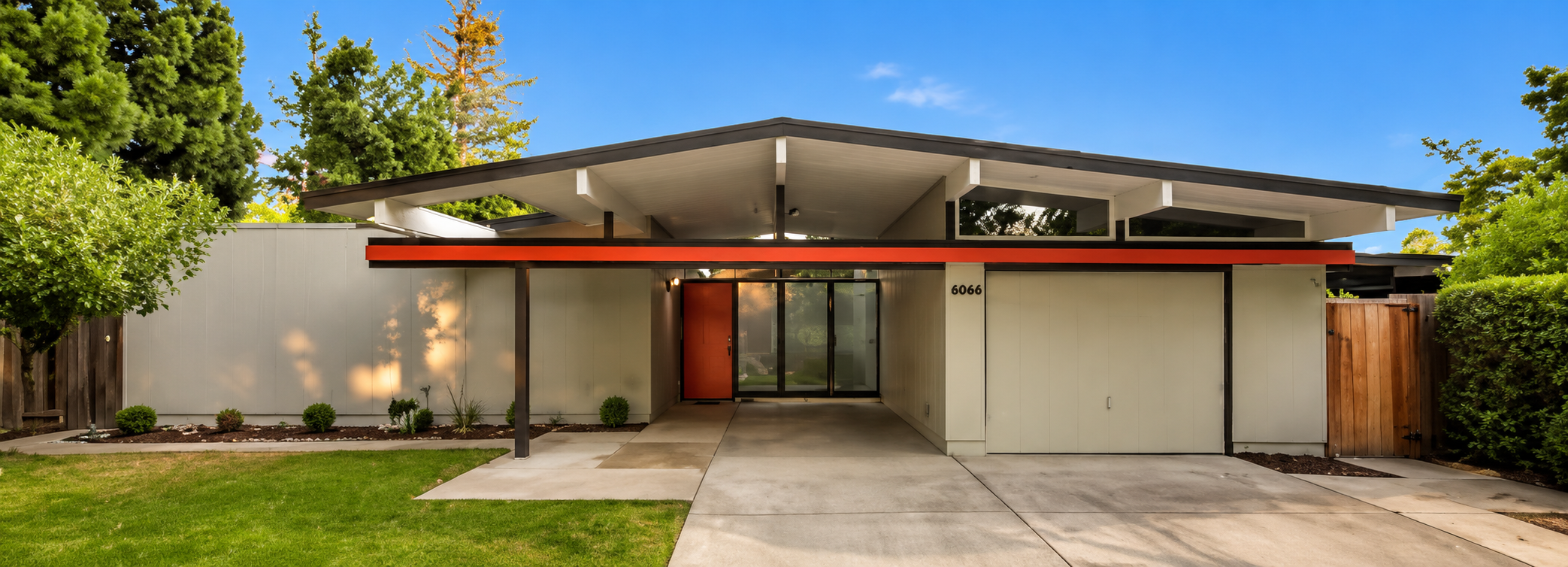
At dusk in the historic enclaves of Willow Glen, the standard vocabulary of suburban American residential design dissolves. Walking down the wide, quiet corridors of Booksin or Fairglen Avenue, one is struck by an intentional, horizontal stillness. There are no towering neo-colonial porticos or heavily ornamented Tudor gables. Instead, the eye is drawn along the sweeping, low-profile lines of vertical-grooved redwood siding, deep overhangs, and minimalist facades that sit in absolute harmony with the surrounding landscape.
As night falls, these structures undergo a dramatic, lantern-like metamorphosis. An abundance of soft interior light filters through continuous bands of clerestory windows and massive, floor-to-ceiling glass panes, revealing the elegant timber post-and-beam skeletons within. This is the world of Joseph Eichler—a realm where architectural geometry, natural materials, and an uninterrupted spatial continuum form the ultimate canvas for elite Silicon Valley living.
In the modern, post-pandemic landscape of Silicon Valley real estate, the luxury buyer’s hierarchy of needs has fundamentally shifted. Affluent technology executives, venture capitalists, and design purists are no longer satisfied with the dense, compartmentalized volumes of traditional tract housing. They demand light, flexibility, and a seamless connection to private outdoor environments.
Joseph Eichler’s visionary mid-century homes—particularly within the historic Fairglen Additions in ZIP Code 95125—deliver exactly this spatial luxury. Originally conceived as "modern homes for ordinary people," these architectural masterpieces have transitioned into highly coveted, multi-million-dollar modern luxury assets.
Navigating this highly specialized, design-centric niche requires an expert voice. As founding partners of Compass and the premier real estate authorities in mid-century modern preservation, Eric and Janelle Boyenga of The Boyenga Team have spent nearly three decades representing these iconic architectural assets. Known across the industry as the "Property Nerds," their analytical, design-forward approach ensures that the historical integrity and long-term capital value of Silicon Valley's Eichler legacy are preserved and optimized.
2. Historical Genesis: From Orchards to California Modernism
The architectural evolution of San Jose is a reflection of the broader structural transformation of Santa Clara County. From the late 19th century through the early 1950s, the region was widely celebrated as the "Valley of Heart's Delight"—a highly productive agricultural basin defined by thousands of acres of stone-fruit orchards and commercial canneries. However, the post-World War II industrial boom sparked an unprecedented population influx, rapidly transforming agricultural holdings into suburban residential tracts to accommodate a highly educated, tech-adjacent workforce.
During this period of intense expansion, Joseph Eichler (1900–1974) emerged as a pioneering force in American merchant building. Unlike his contemporaries who mass-produced conventional, historically derivative Cape Cod and colonial-style homes, Eichler sought to democratize high-quality, progressive modernist design. Inspired by a period during the war when his family rented a Frank Lloyd Wright-designed "Usonian" home in Hillsborough, Eichler founded Eichler Homes, Inc. in 1947. He collaborated with elite modernist architectural firms—principally Anshen & Allen, Jones & Emmons, and Claude Oakland Architect & Associates—to design single-family tract homes that prioritized spatial efficiency, structural honesty, and architectural beauty.
In San Jose, this modernist experiment took hold across seven distinct residential tracts developed between 1952 and 1963, coalescing into five core neighborhoods:
Morepark (1952–1953): An early, historically significant tract representing Eichler’s initial, pre-atrium design explorations in the South Bay.
Fairglen (1957–1959): The foundational Willow Glen development that established Eichler's local design presence.
Fairglen Additions (Units 1, 2, and 3; 1959–1961): The largest contiguous Eichler tract in San Jose, comprising 218 single-family homes built on approximately 40 acres of former orchard land south of Curtner Avenue.
Hudson (1961–1963): A prestigious 90-home pocket of highly refined, late-period Eichler designs characterized by mature streetscapes.
Fairhaven (1961–1963): Located on the northern outskirts of San Jose near the Campbell border, featuring an exceptional collection of highly intact modernist residences.
The development of the Fairglen Additions remains the crown jewel of Eichler’s legacy in San Jose. Built across three phases between 1959 and 1961, the subdivision utilized standardized post-and-beam mass-production techniques on concrete slab foundations, allowing the entire tract to be completed in roughly two years.
Beyond their physical form, these neighborhoods represented a progressive social vision. Long before federal housing mandates outlawed discriminatory practices, Joseph Eichler famously instituted a strict non-discrimination policy, refusing to sell homes in his developments to anyone based on race or religion. This egalitarian ethos fostered a highly integrated, community-minded neighborhood identity that continues to define the social fabric of Willow Glen today.
3. Architectural Anatomy & Spatial Agility
To understand the enduring appeal of Silicon Valley’s Eichler homes is to analyze their rigorous architectural execution. These structures represent a masterful synthesis of structural efficiency and spatial poetry, utilizing a distinct structural logic to maximize both interior volume and exterior connection.
Post-and-Beam Structural Honesty
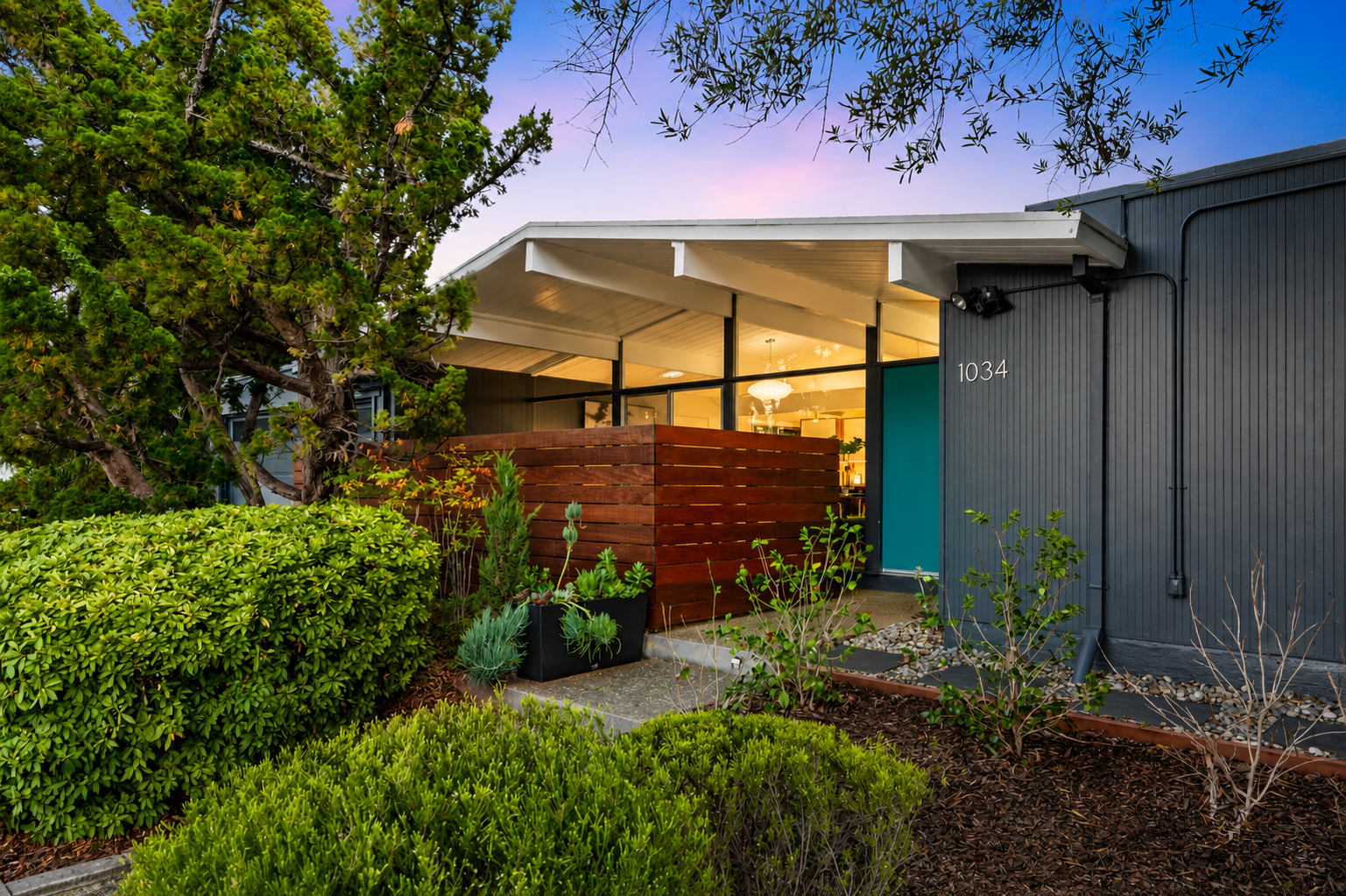
The core of California modern architecture is the heavy timber post-and-beam system. Unlike conventional wood-frame homes that rely on load-bearing interior drywall partitions, Eichler homes utilize solid wood posts to support massive horizontal beams. This structural framework completely eliminates the need for internal load-bearing walls, allowing for expansive, fluid floor plans where the kitchen, dining, and living spaces flow into a single, cohesive volume. Ceilings are formed by the exposed, stained underside of two-inch by eight-inch tongue-and-groove redwood or fir roof decking, highlighting the raw material palette.
The Enclosed Central Atrium
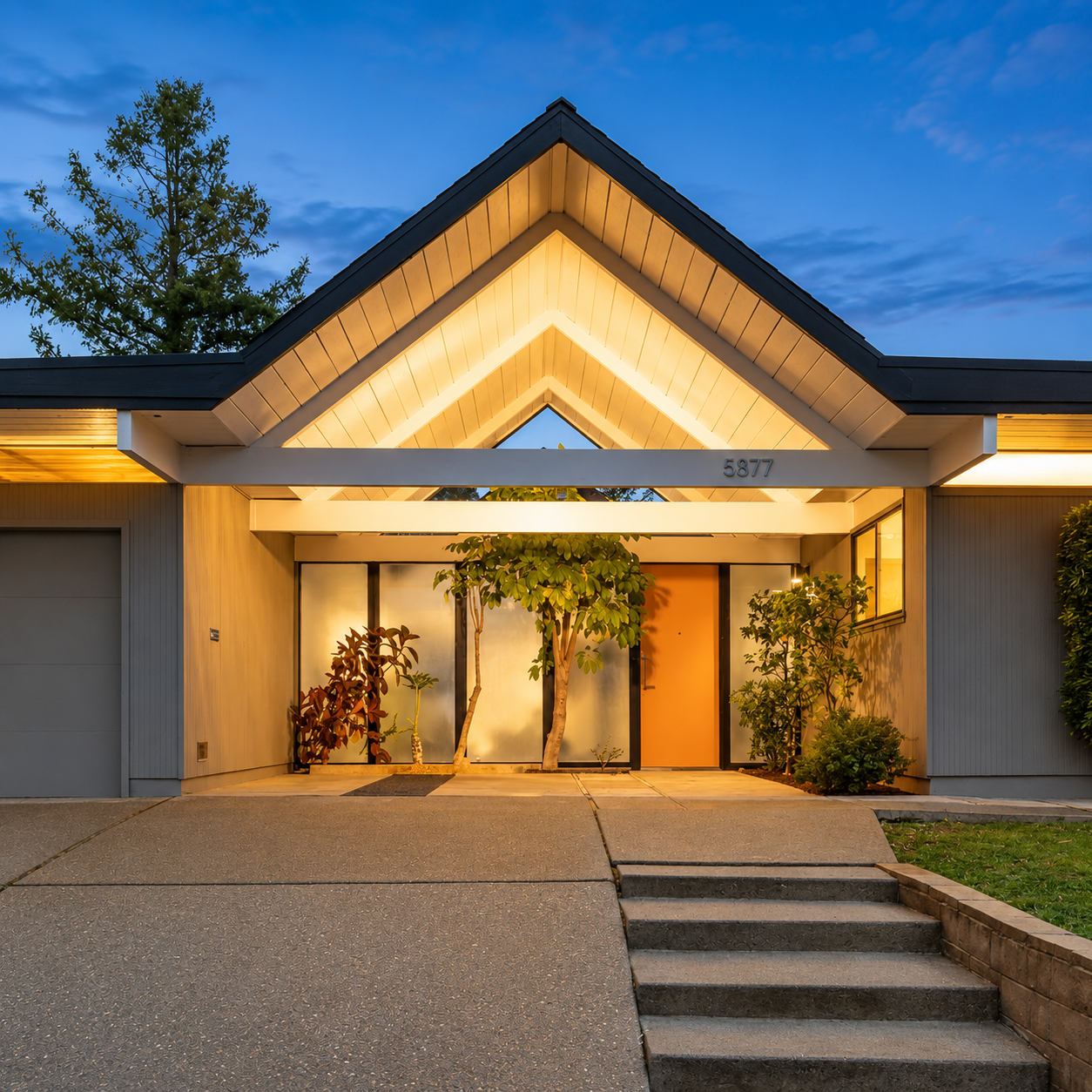
Perhaps the most celebrated of Joseph Eichler's innovations is the open-air central atrium. Typically situated directly past the understated front entrance, the atrium acts as a private, sky-facing courtyard wrapped in glass walls. This architectural mechanism serves several critical functions:
The Volumetric Core: It introduces light and ventilation directly into the absolute center of the single-story footprint.
The Programmatic Organizer: It physically separates the formal living spaces from the private bedroom wings, establishing an elegant visual boundary without relying on dark corridors.
The Microclimate Sanctuary: It creates a highly private, wind-sheltered outdoor terrace ideal for year-round dining, gardening, and relaxation.
Floor-to-Ceiling Glass and Clerestories
Eichler designs utilize expansive walls of glass and sliding doors to visually dissolve the boundary between the interior living space and the surrounding garden. This continuous glazing pattern allows natural daylight to track across the home throughout the day, while strategically placed clerestory windows—tucked directly beneath the deep roof eaves—bring in high-altitude sunlight while preserving complete privacy from neighboring properties.
Hydronic Radiant Slab Heating
Embedded directly within the concrete slab foundation of every original Eichler is a network of copper heating pipes. This hydronic radiant heating system provides incredibly efficient, silent, and even warmth from the ground up, eliminating the need for unsightly baseboards, bulky ductwork, or noisy forced-air vents that would disrupt the minimalist aesthetic.
For the contemporary luxury renovator, this spatial agility is an extraordinary asset. Because the interior walls are non-structural, spaces can be effortlessly reconfigured to accommodate minimalist open-concept layouts, state-of-the-art chef’s kitchens, and dedicated high-tech home offices. Additionally, these low-slung residences occupy generous lots (typically 6,000 to over 10,000 square feet) with oriented setbacks that maximize rear-yard privacy, offering ample space for lush, mid-century-inspired landscaping, custom hardscaping, and modern swimming pools.
4. The Preservation Paradigm & Zoning Evolution
As the value of these architectural masterworks has climbed, so too has the collective commitment to preserving their design integrity. In June 2019, the Fairglen Additions historic district (comprising Units 1, 2, and 3) was officially listed on the National Register of Historic Places. This landmark designation—the first of its kind for an Eichler subdivision in San Jose—served as both a national recognition of the neighborhood’s architectural pedigree and a strategic effort to protect it from out-of-scale development.
Historically, many Eichler neighborhoods struggled with inappropriate, out-of-character alterations. In the 1970s and 1980s, before the historic importance of mid-century modernism was widely understood, some owners added bulky second-story additions or pitched, peaked attic roofs directly over original flat or low-gable rooflines, severely disrupting the cohesive, low-slung rhythm of the streetscapes. In recent years, a strong preservationist movement has taken hold, with several Fairglen residents undertaking the massive expense of removing these peaked additions to restore their homes to their original geometric profiles.
To institutionalize this protection, the City of San Jose, in collaboration with historic preservation consultants, developed the Eichler Neighborhood Objective Design Standards (ODS) (File No. PP24-012). These design standards apply directly to exterior alterations requiring a Single Family House Permit or other planning permits within designated historic districts.
The ODS divide project review into two critical categories:
Objective Design Standards ("Shall / Must"): Mandatory rules governing structural changes, ensuring that any exterior modifications, additions, or window replacements maintain original material patterns, roof slopes (such as the classic $2:12$ low-gable slope), and street-facing siding characteristics.
Optional Design Guidance ("Should / Encourage"): Voluntary recommendations designed to assist homeowners with historically sensitive choices regarding paint color palettes, landscape integration, and interior finishes.
This regulatory framework also addresses the integration of Accessory Dwelling Units (ADUs). Driven by recent California state zoning evolutions, the demand for ADUs has exploded across Silicon Valley. Because Eichlers are highly integrated, unified architectural compositions, adding square footage carelessly can easily destroy their design balance.
Under the specialized Eichler design guidelines, successful ADU projects are designed to be subtle and secondary to the main house. Detached ADUs are typically low-profile, single-story structures tucked discreetly within rear or side yards, mirroring the original vertical grooved siding, flat rooflines, and post-and-beam construction of the main home, thereby preserving the original architectural presentation.
5. Demographic Fabric & the Silicon Valley Tech Elite
The modern demographic profile of Willow Glen's Eichler enclaves is highly sophisticated. These neighborhoods have become premier destinations for high-earning professionals, particularly those driving the innovation economy of Silicon Valley. Key demographics include:
Technology Executives and Software Engineers: Drawn from nearby headquarters of global tech giants, including Apple (Cupertino), Google (Mountain View), NVIDIA (Santa Clara), and Adobe (Downtown San Jose). These buyers possess a natural affinity for the clean lines, structural honesty, and functional efficiency inherent in mid-century design.
Venture Capitalists and Tech Founders: Discerning buyers who view Eichler ownership not merely as a housing solution, but as an intellectual statement of taste and design literacy.
Creative Professionals and Artists: Continuing a historic tradition that began in the early 1960s with the establishment of the legendary Fairglen Art Festival—a regional colossus that drew up to 5,000 visitors to the neighborhood to celebrate local artists and community interaction.
This demographic fabric is fueled by a notable migration pattern. Many affluent buyers are trading dense, highly vertical urban living in San Francisco or the Peninsula for the single-story tranquility, land equity, and deep architectural soul of Willow Glen. They seek an environment where their children can ride bikes on quiet, tree-lined cul-de-sacs, and where neighbors gather for annual block parties and "Joey" awards (celebrating top home and garden improvements, named in honor of Joseph Eichler).
6. Academic Prestige & Local Infrastructure
For families investing in Willow Glen real estate, the academic infrastructure serves as an ironclad anchor of property values. Fairglen is served by the highly regarded San Jose Unified School District (SJUSD), offering a complete public school track with a stellar reputation:
Booksin Elementary School (Grades K–5): Situated along Dry Creek Road just half a mile from the Fairglen tract, Booksin is a highly coveted "Distinguished School". Consistently ranking in the top tier of local schools, Booksin boasts an exceptional $9/10$ rating from GreatSchools, driven by high parental involvement, rigorous early literacy programs, and exceptional standardized test scores.
Willow Glen Middle School (Grades 6–8): Offering a supportive transitional environment with robust honors tracks, competitive extracurricular activities, and advanced STEM programs.
Willow Glen High School (Grades 9–12): Celebrated as the #3 high school in the San Jose Unified School District, Willow Glen High offers a rigorous college-preparatory curriculum, numerous Advanced Placement (AP) courses, and competitive athletic programs.
Beyond the public pipeline, the neighborhood is highly convenient to elite private academies. Within a short commute, families have access to prestigious institutions such as:
The Harker School: A world-renowned K–12 co-educational private school in San Jose famed for its elite academic standards and STEM preparation.
Archbishop Mitty High School & Bellarmine College Preparatory: Top-tier private Catholic high schools known for high academic and athletic achievements.
Stanford University & Santa Clara University: Offering world-class higher education, advanced research opportunities, and intellectual culture right in the South Bay.
Complementing this educational prestige is Willow Glen’s vibrant boutique lifestyle. The historic downtown Lincoln Avenue corridor is just minutes away, offering an upscale commercial village filled with artisanal espresso bars, organic bakeries, boutique clothing shops, and award-winning dining destinations. Residents enjoy fine dining at acclaimed local spots like The Table (celebrated for its farm-to-table seasonal cuisine), Vin Santo (a premier destination for fine Italian wines and rustic cooking), and Aqui Cal-Mex (a local favorite for fresh, healthy coastal Mexican dining).
For outdoor recreation, the community is anchored by expansive green spaces, including Frank Bramhall Park and Willow Street Frank Bramhall Park, which offer manicured lawns, tennis courts, and baseball diamonds within a highly walkable, bike-friendly suburban grid.
7. Commute Geometry & Tech Core Proximity
A key advantage of Willow Glen's geographic positioning is its remarkable proximity to the main arteries of Silicon Valley's technology sector. While the neighborhood offers an idyllic, architectural sanctuary, it remains exceptionally well-connected to major employment hubs.
For professionals commuting by car, transit times to primary corporate campuses are highly manageable:
Apple Park (Cupertino): Approximately 17 to 22 minutes via CA-85 and CA-17.
Googleplex (Mountain View): 25 to 30 minutes traveling north on CA-85 or the scenic I-280 corridor.
Adobe HQ / Zoom HQ (Downtown San Jose): A highly efficient 10 to 12 minutes traveling north via CA-87 or local thoroughfares.
NVIDIA HQ (Santa Clara): Approximately 15 to 20 minutes under normal conditions.
For those seeking transit alternatives, the neighborhood provides excellent connectivity. The Santa Clara Valley Transportation Authority (VTA) operates local bus routes, including the Route 64B, which provides direct service from Almaden and Camden to downtown San Jose and the Diridon Caltrain Station, where commuters can catch rapid northbound trains to Palo Alto, San Francisco, and the Peninsula.
Additionally, the VTA Green Line light rail station at Winchester or nearby Chynoweth allows for car-free commutes across the South Bay. Major transit freeways—including I-280, CA-85, CA-17/880, and CA-87—are all immediately accessible, offering multiple alternate routes to bypass peak hours.
8. Quantitative Market Analysis & Investment Thesis
The market for Silicon Valley Eichler homes represents one of the most resilient, high-appreciation micro-markets in Northern California. Because these homes are in extremely limited supply and highly coveted by architectural purists, they consistently command an immense pricing premium compared to standard, non-architectural single-family homes in San Jose.
As of early 2026, the median sales price for a single-story Eichler home in Willow Glen's Fairglen Additions ranges from $2,150,000 to over $2,450,000, with highly updated models consistently pushing past $2,500,000. This stands in stark contrast to the broader San Jose single-family market, which posted a median home price of approximately $1,690,000 in April 2026.
The pricing dynamic is heavily driven by price-per-square-foot metrics. While standard suburban tract homes in San Jose typically trade between $800 and $950 per square foot, renovated Eichler homes in Fairglen routinely command between $1,300 and over $1,450 per square foot.
To evaluate the long-term capital appreciation of these specialized assets, we apply the compound annual growth rate ($CAGR$) formula:
$$CAGR = \left(\frac{V_{\text{final}}}{V_{\text{initial}}}\right)^{\frac{1}{t}} - 1$$
Let us analyze the historical performance of a standard Fairglen Eichler home located on Fairglen Drive, tracking its transaction history from 1999 to 2025:
1999 Acquisition ($V_{\text{initial}}$): $359,000
2025 Transaction ($V_{\text{final}}$): $2,405,000
Holding Period ($t$): 26 Years (1999 to 2025)
A compounding annual growth rate of 7.6% over a 26-year holding period represents an extraordinary wealth-preservation performance. This appreciation is driven by three core economic variables:
The Land Value Calculus ("Buying the Dirt"): In Silicon Valley, real estate value is anchored heavily in land equity. The generous lot sizes of Willow Glen's Eichler tracts (6,000 to over 10,000 sq. ft.) offer a permanent hedge against inflation and market volatility.
The Pedigree Premium ($V_{\text{pedigree}}$): Buyers are willing to pay a substantial premium for authentic, historically recognized architecture. The National Register listing and the City's ODS protect the aesthetic cohesion of the neighborhood, ensuring that adjacent properties cannot build out-of-scale structures that would degrade surrounding home values.
Renovation and ADU Yield Optimization: Renovated Eichler homes with modern ADUs generate exceptionally high rental returns. High-end detached ADUs can easily command up to $2,800 to $3,200 per month in the corporate executive rental market, adding a predictable rental pipeline and substantially boosting the overall asset's valuation.
9. Editorial Case Studies: Original vs. Transformed
To understand how modernist pedigree translates into market value, we examine two archetypal case studies within the Fairglen Additions neighborhood.
Case Study 1: The Mid-Century Time Capsule
The Property: A highly intact, original-condition 4-bedroom, 2-bathroom flat-roof Eichler model located on Fairorchard Avenue.
The Anatomy: This home was a pristine monument to 1959 design. It featured untouched, original Philippine mahogany wall paneling, a classic brick wood-burning fireplace, original cork tile flooring, and authentic globe pendant lighting. The kitchen retained its original sliding cabinet faces and built-in appliances, while the open central atrium remained unplanted, preserving its clean geometric concrete tiles.
The Market Dynamic: Despite requiring a complete hydrostatic pressure test of the radiant slab heating system and cosmetic upgrades, the property ignited an intense bidding war upon hitting the market. Listed at $1,998,000, it received multiple cash offers with zero contingencies from design purists and luxury developers, ultimately closing at $2,325,000 ($327,000 over asking). The buyers planned a meticulous historical restoration, keeping the original mahogany paneling and structural post-and-beam woodwork intact while retrofitting the infrastructure.
Case Study 2: The High-Design Masterpiece
The Property: A down-to-the-studs, ultra-luxury modern restoration of a low-gable atrium model on Fairglen Drive, reimagined with nearly $500,000 in custom architectural upgrades.
The Transformation: The home’s programmatic flow was preserved, but the materials were elevated to the absolute pinnacle of modern luxury.
The Economics: Last sold in pristine renovated condition, this architectural masterpiece commanded a premium sale price of $2,405,000 ($1,452 per square foot) after just a few days on the market. By early 2026, real-time market estimates value the asset at over $2,510,000, highlighting the immense return on investment generated by architecturally sensitive, high-design renovations.
10. The Boyenga Team Advantage
Navigating the nuanced, highly competitive Silicon Valley mid-century modern real estate market requires far more than transactional representation; it demands a deep strategic advocacy. As the original Silicon Valley real estate team since 1996, founding Compass partners Eric and Janelle Boyenga—the "Property Nerds"—bring an unmatched depth of expertise to the marketing, valuation, and acquisition of Joseph Eichler homes.
For Sellers of premium Eichler estates, the Boyenga Team crafts an elevated, design-centric marketing narrative. Utilizing Janelle Boyenga’s credentials as an Accredited Staging Professional (ASP), the team styles and stages each modernist residence in absolute alignment with its architectural principles—utilizing authentic mid-century furniture, minimalist art, and curated lighting to highlight the post-and-beam construction and the seamless indoor-outdoor flow.
Through the Compass Concierge program, the Boyenga Team manages and fronts the capital for value-enhancing, high-ROI pre-listing preparations—including drywall repair, landscape restoration, and modern exterior painting—with zero fees, zero interest, and absolutely no upfront costs to the seller. This strategic preparation maximizes competitive overbidding and secures top-tier historical valuations.
For Buyers searching for a rare modernist sanctuary, the Boyenga Team leverages their deep, decades-long local connections to source exclusive, off-market inventory. Their analytical "Property Nerd" approach is highly valuable during due diligence; they understand how to identify experimental architectural variants, evaluate original mahogany wood paneling, and guide clients through hydrostatic pressure testing of in-slab radiant heating lines to ensure they are acquiring structurally sound investments.
Whether executing a discreet, high-privacy transaction through Compass Private Exclusives or managing a complex multi-offer bidding war in the highly competitive tech market, Eric and Janelle Boyenga represent the definitive standard of mid-century real estate mastery in Silicon Valley.