
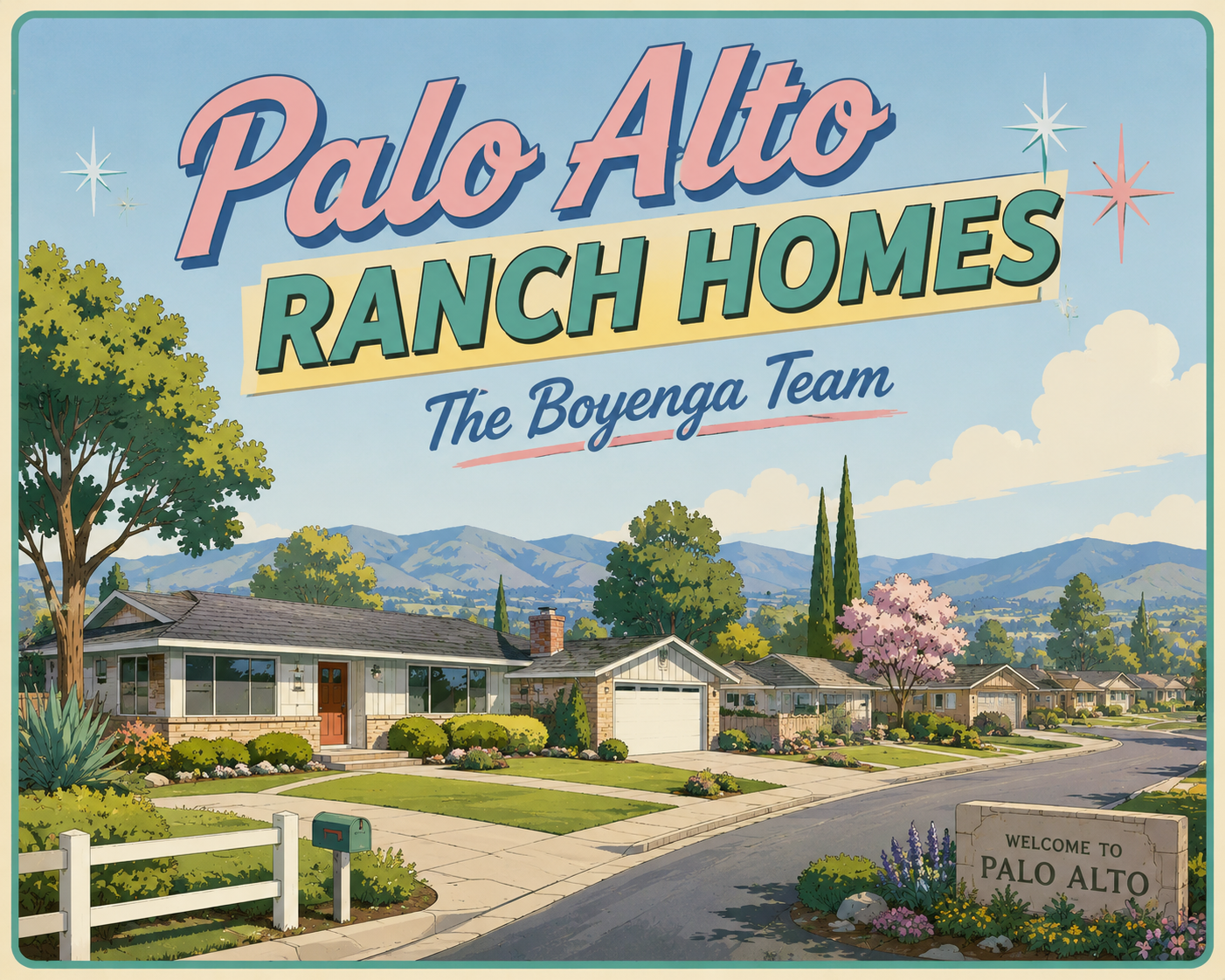
The Quiet Prestige of Leland Manor: Silicon Valley's Premier California Ranch Sanctuary
1. The Narrative Hook & Architectural Identity
At the intersection of Newell Road and Northampton Drive in Palo Alto, the frantic pace of Silicon Valley’s technology-fueled economy fades into a peaceful, historic stillness. Walking down these wide, quiet streets, the immediate sensory experience is defined by a rare visual asset: the absolute absence of overhead telephone poles and power lines. In an innovative marketing masterstroke in 1939, the developers of this enclave laid all electrical and telephone conduits underground, eliminating the visual static of overhead infrastructure and establishing a clean, unobstructed sky canopy that remains a signature luxury marker today. Underneath mature heritage oaks, redwoods, and sweet-smelling magnolia trees, the low-slung, horizontal silhouettes of classic California Ranch estates stretch elegantly across expansive lot frontages.
In the modern Peninsula luxury market, where land is the ultimate scarcity, the single-story California Ranch has undergone a profound re-evaluation. For affluent tech executives, venture capitalists, and design purists, the traditional vertical layout of multi-story homes has lost its appeal. Instead, they seek spatial luxury: sweeping horizontal volumes, high ceilings, and an uninterrupted programmatic flow that dissolves the boundaries between high-end interiors and manicured outdoor gardens.
The California Ranch home in Leland Manor—originally constructed between 1940 and 1960—serves as the perfect architectural canvas for this lifestyle. Possessing rare, expansive lot sizes that typically range from 9,000 to over 10,000 square feet, these properties offer a level of residential privacy and expansion potential that is nearly impossible to find in newer, densely packed Peninsula subdivisions.
To navigate this highly competitive, design-centric real estate landscape, buyers and sellers rely on specialized architectural advocacy. As founding partners at Compass and pioneering real estate strategists since 1996, Eric and Janelle Boyenga of The Boyenga Team represent the definitive authority on Palo Alto's classic mid-century ranch and modernist estates. Known throughout Silicon Valley as the "Property Nerds," their data-driven, analytical methodology and deep passion for architectural preservation ensure that their clients maximize both the cultural and financial equity of these rare residential assets.
2. Historical Genesis: From Wheat Fields to Post-War Suburbia
The land that comprises modern-day Leland Manor is steeped in the rich history of the Santa Clara Valley's agrarian transition. Before the rapid suburbanization of the mid-20th century, the region was part of the expansive Rancho Rinconada del Arroyo de San Francisquito. In the mid-1850s, the property was acquired by brothers Thomas and Henry Seale, prominent San Francisco contractors who utilized the fertile acres to cultivate hay for their livestock. In 1887, a 697-acre portion of the Seale ranch was sold to Timothy Hopkins, assistant to Stanford University founder Leland Stanford, in anticipation of the university's opening and the subsequent creation of the University Park subdivision.
In 1904, Alfred Seale began subdividing the remaining land for residential development, digging a municipal well to meet city code requirements. While adjacent enclaves like Old Palo Alto evolved to attract the early academic and industrial elite, the tract that would become Leland Manor remained a pastoral landscape of fruit orchards and open space until the late 1930s.
In 1939, the visionary real estate development firm Hare, Brewer & Kelley, Inc. launched the construction of Leland Manor. To build momentum for this innovative residential concept, they sponsored a regional contest to name the subdivision and its curving streets, awarding $10 prizes to local residents who suggested historic, English-inspired monikers like Northampton Drive, Southampton Drive, East and West Greenwich Place, and Portal Place.
To showcase the peak of "California Living," the developers selected a prime parcel on Newell Road to erect a showcase model home for the 1939 Golden Gate International Exposition (the San Francisco Exposition). This exhibition residence drew over 25,000 visitors to the neighborhood, introducing the public to an entirely new architectural lexicon defined by long, single-story ranch layouts, integrated garages, and built-in modern conveniences.
Following the conclusion of World War II, the demand for high-end suburban housing in Palo Alto exploded. Prominent building firms like Coastwise stepped in to construct the remaining parcels, erecting nearly 100 sprawling ranch-style homes across Leland Manor and the adjacent Garland Drive tract. These builders, alongside peers like Barrett & Hilp and Stern & Price, effectively transformed Palo Alto's remaining agricultural parcels into cohesive, high-value residential enclaves.
Today, this historic fabric faces a modern evolution. Recent state zoning updates—most notably California Senate Bill 9 (SB-9)—coupled with Palo Alto's rigorous Individual Review (IR) guidelines, have created a delicate tension between architectural preservation and modern modernization.
Because original Leland Manor estates sit on unusually large parcels, they represent prime targets for high-end contemporary rebuilds and the integration of detached accessory dwelling units (ADUs). Navigating these municipal guidelines requires precise architectural planning, ensuring that new structural footprints and luxury ADUs complement rather than disrupt the low-slung, horizontal rhythm of the historic streetscapes.
3. Architectural Anatomy & Spatial Agility
The architectural language of Leland Manor’s ranch homes is a testament to the mid-century modern philosophy of "comfortable California living". Inspired by historic Mexican adobe ranchos and Spanish colonial haciendas, and refined by modernist design principles, these residences prioritize functional simplicity, geometric restraint, and ground-level connectivity.
The core anatomical characteristics of these estates include:
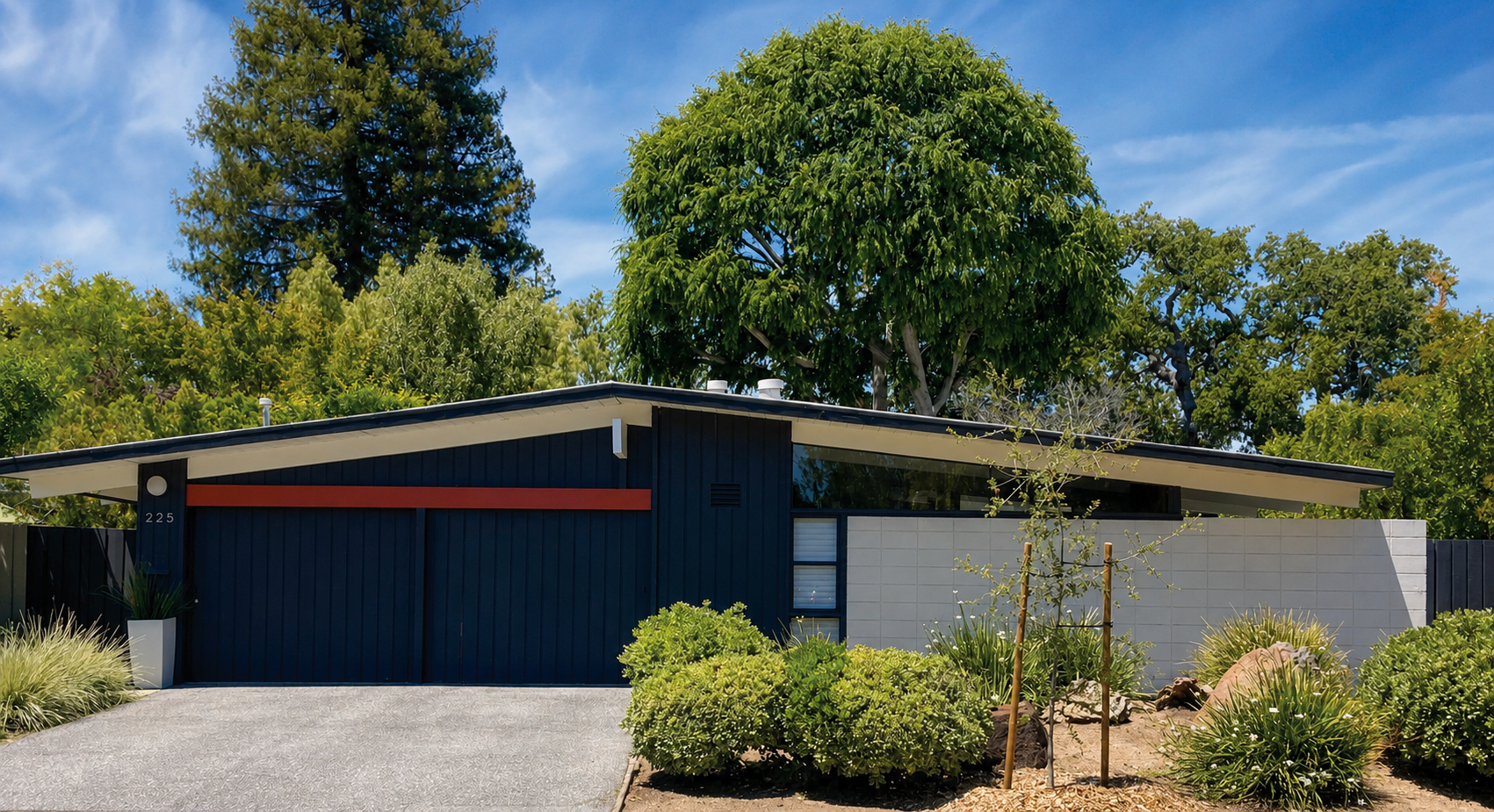
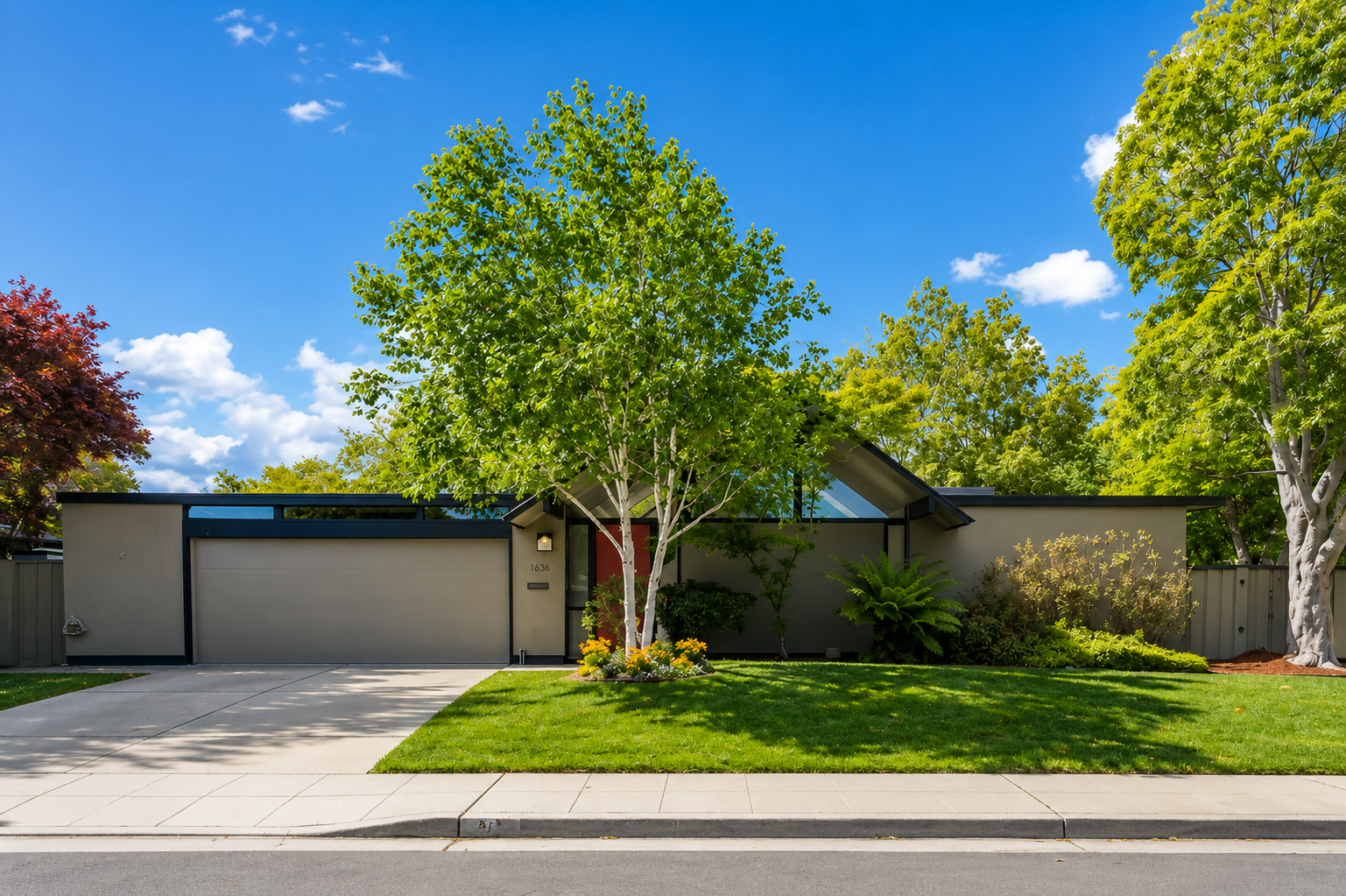
The Low-Profile Silhouette: Homes are characterized by asymmetrical, low-pitched hipped or gabled rooflines with deep overhanging eaves. This design hugs the landscape, visually integrating the structure with the flat, leafy terrain.
The Sprawling "L" or "U" Shaped Footprint: The homes wrap around central outdoor patios, courtyards, or rear loggias. This geometric organization allows the primary living zones to maintain direct visual and physical connections to the gardens, turning the house inward and away from public view.
The Blank Street-Facing Façade: In contrast to traditional homes that feature open front porches, the street-facing elevations of Leland Manor ranches are remarkably private, featuring solid wood siding, minimal glazing, and integrated carports or garages. This "spartan façade" serves as a protective barrier, making the eventual transition into the glass-walled interiors feel incredibly dramatic.
Structural Material Honesty: Inside, the homes showcase natural materials, including vertical redwood or cedar siding, exposed post-and-beam ceilings, and prominent flagstone or brick wood-burning fireplaces that serve as the focal point of the formal living spaces. This organic palette matches the work of legendary local architects like Birge Clark, who famously integrated Arizona flagstone facades and wrought-iron details into his customized ranch designs.
For the contemporary luxury renovator, the spatial agility of the Leland Manor ranch layout is an extraordinary asset. Unlike traditional houses with rigid, load-bearing interior plaster walls, these post-and-beam structures rely on a perimeter skeleton.
Interior partitions are almost entirely non-load-bearing, allowing architects to effortlessly remove walls to create sweeping open-concept layouts, gourmet kitchens, and integrated smart home automation hubs without compromising structural integrity.
Furthermore, because the homes are built entirely slab-on-grade at ground level, they offer a highly accessible, "universal design" layout that allows affluent homeowners to comfortably age-in-place while enjoying a seamless visual continuum into their private backyards.
4. Demographic Fabric & The Silicon Valley Buyer Profile
Palo Alto represents the undisputed intellectual and venture capital core of Silicon Valley, and the demographic fabric of Leland Manor reflects this reality. Occupying a highly exclusive 0.4 square miles with a population of approximately 2,000 residents, this intimate neighborhood is home to some of the most influential minds in technology, finance, and academia.
The primary demographic segments driving demand in the neighborhood include:
Venture Capitalists and Private Equity Partners: Professionals managing elite funds on nearby Sand Hill Road who prioritize a quiet, low-profile residential sanctuary that is highly secure and free from public intrusion.
Tech Founders and Executive Leadership: High-net-worth individuals from global tech leaders like Meta, Google, Apple, and Zoom who value the neighborhood’s central proximity, historical architectural soul, and elite school districts.
Stanford University Faculty and Researchers: Continuing a historic tradition that began when the university opened in 1891, prominent academics and researchers utilize the neighborhood's close proximity to the campus to balance their work and family lives.
In recent years, local real estate trends have been heavily influenced by a distinct migration pattern. Affluent buyers are actively trading dense, highly vertical urban townhomes in San Francisco for the single-story tranquility, massive land equity, and private backyard sanctuaries of Palo Alto’s ranch enclaves.
These buyers are highly analytical; they recognize that acquiring a classic single-family ranch home in Leland Manor is not merely a lifestyle upgrade, but a highly strategic financial asset that provides an ironclad hedge against market volatility.
5. Academic Prestige & Local Infrastructure
For families investing in Palo Alto real estate, the world-class public education system is the ultimate driver of long-term real estate demand and property values. Leland Manor is positioned within the highly coveted Palo Alto Unified School District (PAUSD), offering students a seamless, top-tier academic pipeline:
Walter Hays Elementary School (Grades K–5): Situated along Middlefield Road directly adjacent to the neighborhood, Walter Hays is a highly regarded "Distinguished School". Boasting an overall "A" grade from Niche, the school is celebrated for its low student-teacher ratio, highly supportive environment, and active parent community.
Ellen Fletcher Middle School (Grades 6–8): Famed for its rigorous college-preparatory and STEM-focused curriculum, preparing students for high-level coursework.
Palo Alto High School (Grades 9–12): Affectionately known as "Paly," this legendary institution ranks as the #10 Best Public High School in California. Boasting a perfect "A+" Niche grade, Paly offers an elite academic environment, including a nationally recognized, award-winning student journalism program, advanced scientific research labs, and highly competitive varsity athletic teams.
Beyond the stellar public school track, residents have immediate access to prestigious private academies within the neighborhood and surrounding areas, including the highly regarded Stratford School on North California Avenue, Hwa Chin School, Castilleja School, and the elite co-educational Harker School in nearby San Jose.
This exceptional educational matrix is anchored by immediate proximity to Stanford University, which infuses the entire community with a rich, intellectual culture, world-class athletic facilities, and distinguished guest lecture series.
6. The Lifestyle Aesthetic: Curation & Culture
The lifestyle in Leland Manor is defined by a sophisticated blend of tranquil suburban living, immediate natural beauty, and walkable urban convenience. Unlike newer, master-planned developments that feel sterile and disconnected, this historic neighborhood is highly integrated with the broader cultural landscape of Palo Alto.
Daily life revolves around a variety of local, high-end landmarks:
The Elizabeth F. Gamble Garden: A spectacular, historic three-acre horticultural estate bequeathed to the city in 1985. Located just a short stroll away on Waverley Street, the property features beautifully manicured formal gardens, historic tea houses, and year-round community outreach programs.
Eleanor Pardee Park: Spanning 10.5 acres, this lush park acts as the community's backyard, featuring playgrounds, shaded oak groves, and open grass lawns perfect for casual family picnics and weekend recreation.
Rinconada Park: Located directly adjacent to the neighborhood, this beloved city park houses a public swimming pool, tennis courts, a children's theater, and the Palo Alto Junior Museum and Zoo.
Lincoln Avenue and Downtown Corridors: Residents are within a short bike ride of Midtown Shopping Center for daily essentials and boutique cafes, as well as the bustling commercial districts of California Avenue and University Avenue, famed for their upscale retail storefronts, artisanal espresso bars, and organic farmers markets.
7. Commute Geometry & Tech Core Proximity
Leland Manor's central geographic positioning is one of its most compelling assets, offering tech executives and venture capitalists a highly convenient commute to Silicon Valley’s main employment and investment hubs. Bounded by critical Peninsula transit arteries, residents enjoy multiple alternate routes to bypass daily peak-hour congestion.
Commute routes and travel times by car from the neighborhood include:
Stanford Research Park & Sand Hill Road: A scenic 8 to 12 minutes traveling west via Page Mill Road or Oregon Expressway, placing venture capital offices and research labs within immediate reach.
Googleplex (Mountain View): Approximately 12 to 15 minutes traveling south via US-101 or Middlefield Road.
Meta HQ (Menlo Park): 10 to 12 minutes traveling north via Middlefield Road or the historic willow-lined streets of Central Menlo Park.
Apple Park (Cupertino): 18 to 22 minutes traveling south on the Interstate 280 corridor.
Downtown San Jose (Adobe / Zoom): 20 to 25 minutes traveling south via US-101.
For those prioritizing public transportation, the neighborhood is incredibly convenient. The California Avenue Caltrain Station is just minutes away, offering rapid, northbound baby bullet train service directly to San Francisco, and southbound service to San Jose.
Additionally, the Santa Clara Valley Transportation Authority (VTA) operates direct local bus routes, including the specialized Express 101 and Express 102 transit lines, connecting the Camden and South San Jose corridors straight to the Stanford Research Park, ensuring effortless Peninsula-wide accessibility.
8. Quantitative Market Analysis & Investment Thesis
The real estate market in Palo Alto's ZIP Codes 94301 and 94303 represents one of the most exclusive and resilient wealth-preservation micro-markets in the United States. Because land in Palo Alto is finite and demand is permanently sustained by the region's elite school districts and tech wealth, these properties consistently command an immense pricing premium.
As of early 2026, the median sales price for a single-family home in Leland Manor stands at approximately $4,800,000, with highly updated custom ranch properties easily pushing past $5,200,000 to over $6,000,000.
This premium is heavily reflected in price-per-square-foot dynamics. While the broader San Jose metro area posts an average price-per-square-foot of $844, renovated ranch homes in Leland Manor consistently trade between $1,900 and over $2,100 per square foot, highlighting the extraordinary concentration of wealth and value in this specific enclave.
Let us analyze the actual historical performance of a representative two-story custom ranch home located on South Court Street, tracking its long-term market value from its acquisition in July 1998 to its current market valuation in early 2026:
An annualized compounding return of 6.6% over a 28-year holding period represents an exceptional investment performance, especially when considering that this return is based on the underlying land value of a highly private single-family lot.
This financial thesis is driven by three core market forces:
"Buying the Dirt" (Land-to-Structure Ratio): In Palo Alto, the vast majority of a property’s total value is anchored in the physical land. Leland Manor's generous lot sizes (often exceeding 9,500 sq. ft.) offer a massive, inflation-proof land asset that provides an ironclad hedge against short-term economic fluctuations.
Low Inventory Velocity: The neighborhood is exceptionally stable, with many families holding onto their homes for 40 years or more, keeping active listings at near-zero levels. In March 2026, Palo Alto operated with under 1.5 months of active inventory, ensuring intense buyer competition and consistent upward pressure on prices.
Renovation and ADU Value Optimization: Because the single-story post-and-beam ranch layout is highly adaptable to modern additions and detached ADUs, investors can easily expand the home's liveable footprint without having to pay the massive construction premium of a complete teardown and rebuild.
9. Editorial Case Studies: Original vs. Transformed
To visualize the incredible design potential and financial return inherent in Leland Manor's mid-century housing stock, we look at two archetypal residential profiles within the neighborhood.
Case Study 1: The Mid-Century Time Capsule
The Property: An original-condition 4-bedroom, 2-bathroom single-story ranch home constructed in 1948 by Coastwise.
The Anatomy: This home was a pristine monument to post-war design, featuring untouched redwood vertical tongue-and-groove siding, a classic brick wood-burning fireplace, and original hardwood flooring. The kitchen retained its original mid-century layout, while the large 9,300-square-foot lot featured mature walnut and apricot trees, left over from the valley’s historic agricultural era.
The Market Dynamic: Listed at $2,698,000 to attract interest, the property sparked an intense bidding war among three venture capitalists and a luxury custom builder. Because the property featured an intact, highly private horizontal footprint with zero structural overhead wires, the buyers recognized it as the ultimate blank canvas. It ultimately closed for $3,250,000 (all-cash, no contingencies). The winning buyer planned a meticulous, historically sensitive modern restoration, retrofitting the in-slab radiant heating and expanding the rear glass walls toward a new, custom-designed swimming pool.
Case Study 2: The High-Design Masterpiece
The Property: A down-to-the-studs, ultra-luxury modern ranch restoration of a classic L-shaped estate on Waverley Street, reimagined with over $650,000 in custom architectural enhancements.
The Transformation: While preserving the original low-profile horizontal silhouette and exposed ceiling beams, the interior floor plan was transformed into a state-of-the-art open-concept smart home.
The Economics: Offered as a highly exclusive, off-market private listing, this architectural masterpiece commanded a record-breaking sale price of $4,888,000, demonstrating the immense financial equity unlocked when mid-century modernist pedigree is seamlessly integrated with 21st-century luxury technology.
10. The Boyenga Team Advantage
Navigating Palo Alto's highly competitive, low-inventory luxury estate market requires far more than standard transactional real estate representation. It demands a deep strategic advocacy, an intimate understanding of architectural history, and a mastery of predictive market analytics. As founding partners of Compass Silicon Valley and the original pioneers of the modern real estate team concept since 1996, Eric and Janelle Boyenga—the "Property Nerds"—have spent nearly three decades representing the Peninsula’s most architecturally significant residences.
For Sellers of premium California Ranch and modernist homes, the Boyenga Team crafts a highly curated, design-forward marketing campaign. Leveraging Janelle Boyenga’s credentials as an Accredited Staging Professional (ASP) and her background in design, the team styles each residence to highlight its spatial luxury, exposed timber frames, and seamless indoor-outdoor flow.
Through the Compass Concierge program, the Boyenga Team manages and covers the upfront costs of high-impact pre-listing preparations—including professional staging, custom painting, landscape restoration, and modern lighting—with zero fees, zero interest, and $0 upfront cost to the seller, driving maximum competitive overbidding and record-breaking sales prices.
For Buyers seeking a rare, private residential sanctuary in ZIP Codes 94301 and 94303, the Boyenga Team leverages their deep network of local connections and advanced proprietary technology to locate exclusive, off-market inventory and private exclusives before they ever reach the public market.
Their analytical "Property Nerd" perspective is invaluable during the due diligence process; they assist buyers in evaluating historic construction details, navigating Palo Alto's complex Individual Review guidelines, and coordinating hydrostatic pressure tests of radiant slab heating systems to ensure their clients are acquiring sound, long-term investments.
Whether coordinating a discreet, high-privacy transaction for a prominent founder through Compass Private Exclusives or successfully managing a complex, multi-million-dollar estate transition for a family trust, Eric and Janelle Boyenga represent the gold standard of luxury real estate representation in Silicon Valley.