

Eichler Homes in Mountain View: Monta Loma and Bell Meadows, a Design-Led Guide for Silicon Valley Buyers
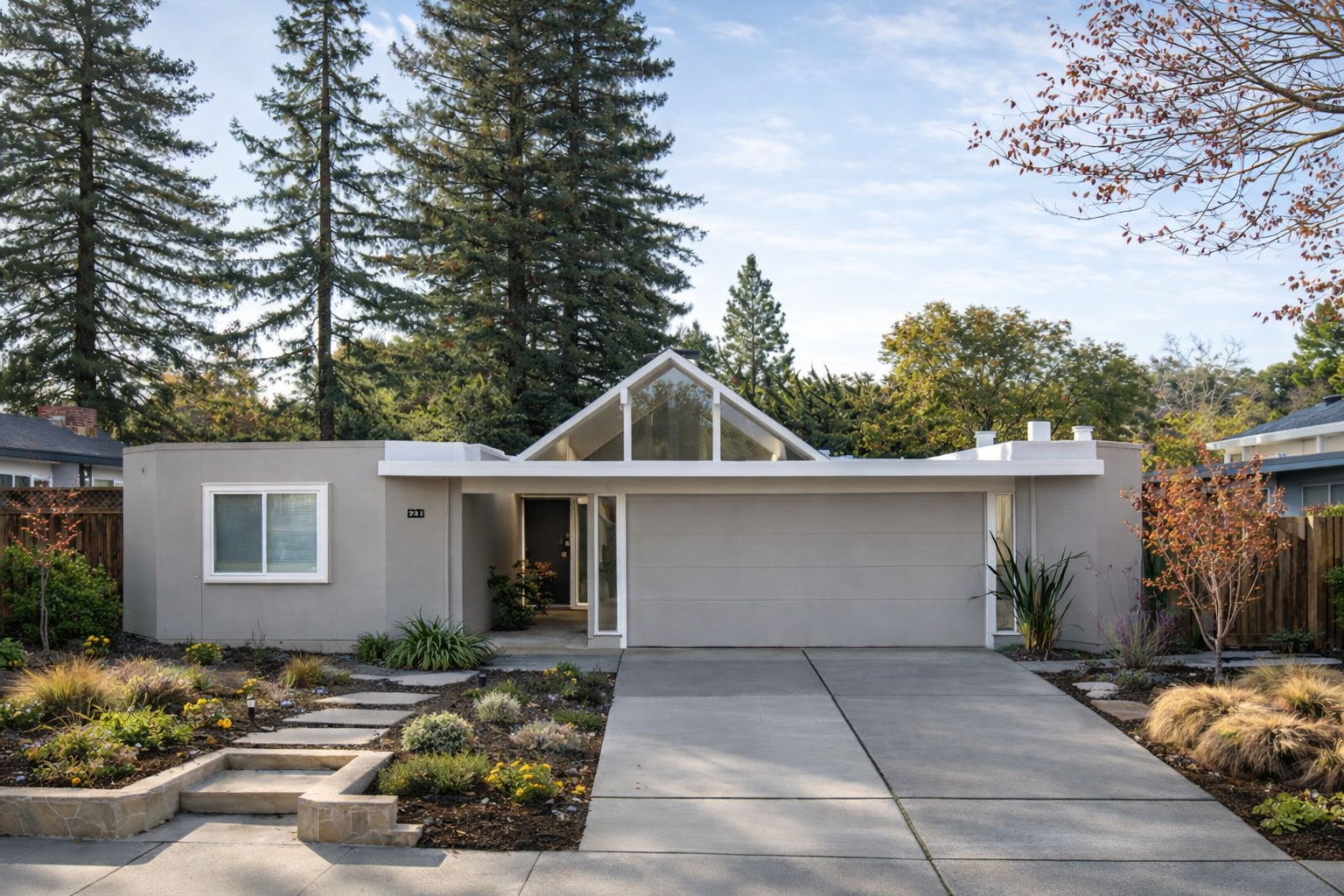
Introduction: why Mountain View’s Eichler neighborhoods still feel like the future
There are Silicon Valley neighborhoods that sell on proximity. And then there are neighborhoods that sell on conviction—the feeling that the home itself is an idea worth collecting. Mountain View’s Eichler enclaves sit firmly in the second category. In the most competitive corridors of Silicon Valley real estate, these Mid-Century Modern communities remain quietly magnetic: low-slung rooflines that read as architectural understatement, interior volumes that feel larger than the numbers suggest, and a choreography of light that makes even a Tuesday morning look editorial.
What makes Eichler homes in Mountain View especially compelling is the “two-act” legacy the city holds. In the mid-1950s, the Monta Loma / Fairview tract delivers the classic, efficient California Modern plan—high-functioning, bright, and socially forward in concept. Then, nearly two decades later, Bell Meadows represents late-era evolution: larger footprints, atrium-leaning plans, and design decisions that anticipate how modern families actually use space. Few cities offer such a clear window into Eichler’s early and late design language within one zip-code orbit.
For affluent homebuyers and architecture devotees alike, the lifestyle appeal is equally legible. Mountain View couples a globally significant job market with a polished, walkable downtown core anchored by Castro Street and a civic campus that includes the Mountain View Center for the Performing Arts and the Mountain View Public Library. Add Caltrain access, an established park system, and the city’s deeply international talent base, and you get a place that feels both grounded and globally connected.
In that context, Eichlers are not “quirky old houses.” They are design-forward assets—often commanding an architectural premium because they offer what new construction frequently cannot: authentic post-and-beam structure, indoor-outdoor geometry, and an iconic California Modern vocabulary that reads as both collectible and livable.
This is precisely where The Boyenga Team’s specialization becomes more than marketing—it becomes meaningful. Backed by Compass, Eric Boyenga and Janelle Boyenga are positioned as Silicon Valley real estate experts and founding partners, with a track record built around strategic marketing, negotiation, and local market fluency. For buyers seeking architecturally significant homes—or sellers of Eichler properties aiming to maximize value—an Eichler-specific lens matters, because these homes trade on design literacy as much as on location.
History: how Monta Loma and Bell Meadows became Mountain View’s Eichler addresses
To understand the appeal of mid-century modern homes in Mountain View, it helps to understand the land and the moment that produced them. Monta Loma is formally described as the portion of Mountain View bounded by West Middlefield, Rengstorff, Central Expressway, and San Antonio—an area now known for a mix of condos, apartments, and single-family homes. The neighborhood’s own association characterizes it as one of the city’s oldest neighborhoods and one of its most coveted—specifically because of its concentration of 1950s-era California Modern houses, including Eichlers.
Long before tract development, local sources note indigenous occupation and an Ohlone-era shell mound in the Monta Loma area, near today’s Central Expressway and San Antonio Road corridor. This layered history—precolonial landscape to orchard era to postwar suburbia—matters because it explains why the neighborhood’s modernism feels less like a style choice and more like a historic phase of the Peninsula’s evolution.
In the post–World War II housing boom, Joseph Eichler emerged as one of the most influential developer-advocates for bringing modern architecture to middle-class buyers at scale. His work is inseparable from the architects he enlisted. The partnership of A. Quincy Jones and Frederick Emmons—often referenced as the firm Jones & Emmons—helped translate modernist principles into repeatable, buildable systems, and their designs are widely associated with thousands of Eichler-developed houses. (Earlier in Eichler’s timeline, he also worked with Anshen & Allen. )
Mountain View’s mid-century “Act One” is the Fairview tract within Monta Loma. Multiple sources place the build period in the mid-1950s and identify it as a substantial Eichler tract. On the count, sources vary depending on boundary definitions and how “Monta Loma” is mapped; a frequently cited estimate is approximately 185 homes in the Fairview tract. The Monta Loma neighborhood association, describing local home styles, emphasizes both the scale (“over 200 homes”) and the remarkable consistency of the classic model: three-bedroom, two-bath houses, almost all at 1,116 square feet.
Just as important is what else Monta Loma became. It is not a single-builder museum; it is a rare, contiguous concentration of multiple mid-century builders in conversation with each other. Eichler Network’s deep dive on the neighborhood notes that Monta Loma functions as a single entity but includes three tracts from three developers: the Eichler tract (originally “Fairview”), a section of Mackay homes, and “Mardell Manor.” The neighborhood association similarly documents the presence of other California Modern builders, including John Calder Mackay (often credited with another “over 200” flat-roof 3/2 homes in 1955–56) and the Mardell Building Company. This is why the buyer experience here is unusually rich: you can compare “true” Eichlers with contemporary California Modern cousins block by block, and understand the nuance rather than buying a vague aesthetic.
Eichler’s social history is not icing; it is part of the brand DNA that continues to influence buyer interest today. Multiple reputable accounts emphasize Eichler’s non-discrimination stance in home sales and his 1958 resignation from the National Association of Home Builders when the organization would not support a nondiscrimination policy—a remarkable posture in a mid-century housing industry shaped by exclusion and redlining. The result is that owning an Eichler is, for many, not only an aesthetic preference but also participation in a historically progressive chapter of California suburbia.
“Act Two” arrives with Bell Meadows, a later-era tract built in the early 1970s. A local Mountain View mid-century guide describes Bell Meadows as a smaller tract of 53 Eichlers built in 1972–73, associated with Claude Oakland. Other summaries likewise frame the later tract as a low-50s count and tie it to Oakland’s work for Eichler, with larger plans and frequent atrium/gallery models. The key point for buyers is not the exact count—it is the difference in design intent: Bell Meadows is the larger, later, more family-scaled expression of the Eichler experiment in Mountain View.
Over the decades, these neighborhoods have evolved in ways that mirror the broader Bay Area’s shifting priorities: preservation, modernization, schools, and land-use policy. On the community side, the Monta Loma Neighborhood Association describes itself as an active neighborhood organization and has recently engaged with policy discussions affecting the San Antonio Caltrain corridor—an example of how mid-century neighborhoods are now, once again, at the center of growth debates. On the city side, Mountain View has moved forward on projects that shape everyday quality of life—such as advancing plans for a 0.45-acre “mini-park” in the Monta Loma area at 538 Thompson Avenue and 2231 West Middlefield Road, following property acquisitions approved in 2022 and 2024.
Zoning and housing policy have become part of the modernization story as well. The City of Mountain View maintains a dedicated permitting guide for accessory dwelling units (ADUs), including requirements tied to JADUs and city code references. At the state level, California’s SB 9—effective January 1, 2022—creates a streamlined pathway for certain two-unit projects and urban lot splits, with ministerial review requirements embedded in the statute and widely summarized by planning agencies. And in early 2026, a local report notes Mountain View grappling with the impacts of a state housing law related to transit-oriented development (“SB 79”), illustrating the high-stakes intersection of transit proximity, neighborhood character, and redevelopment pressure.
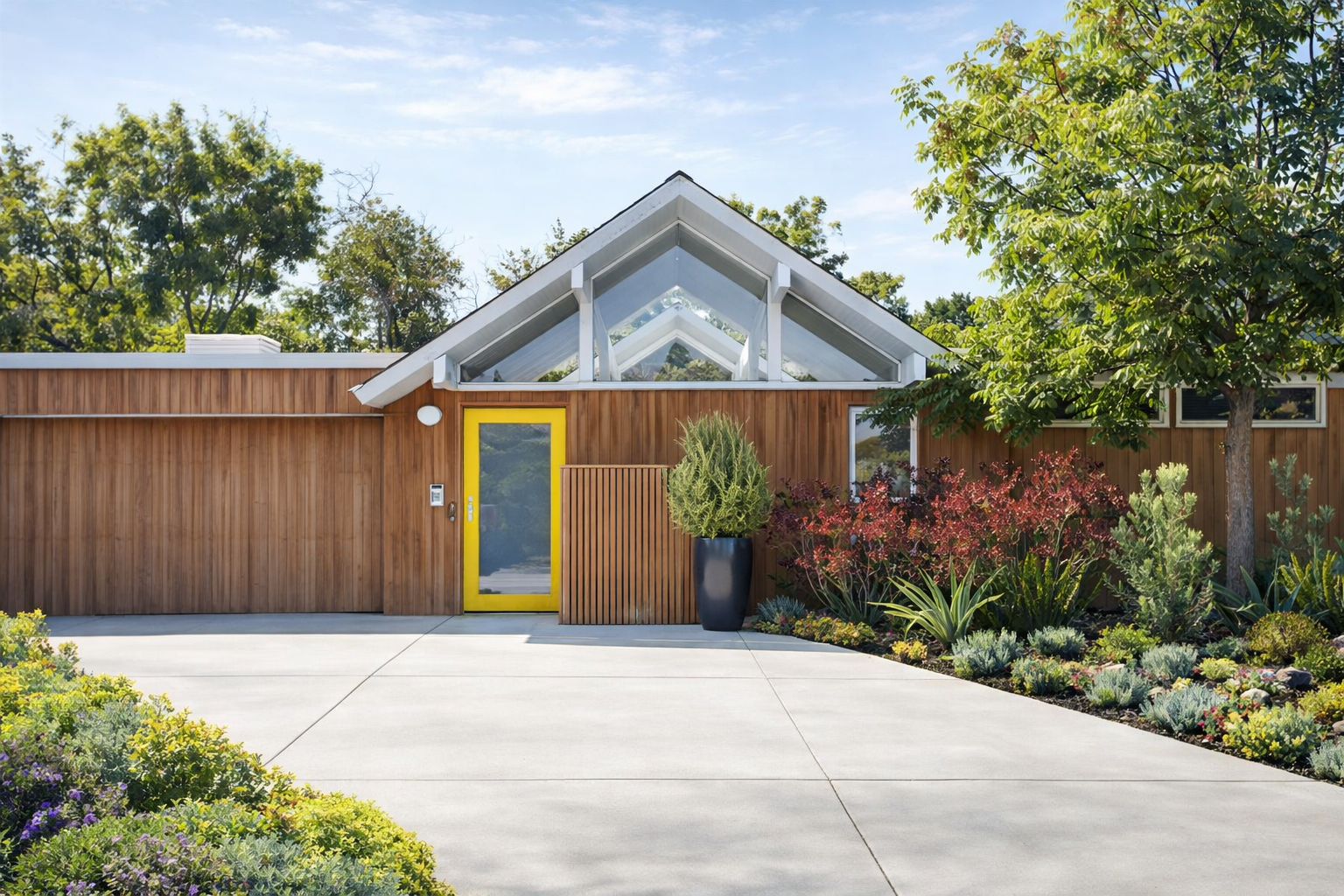
Architecture and housing inventory: what “Eichler” means in Mountain View, in material terms
Eichler’s lasting relevance is structural, not superficial. The feeling people describe—“bright,” “open,” “calm”—comes from a specific design toolkit: exposed structure, disciplined geometry, and an intentional erasure of the boundary between interior and garden. Those themes are repeatedly emphasized in historical and architectural discussions of Eichlers, including the centrality of the atrium as a design milestone and the broader ethos of modernism made accessible.
At a high level, the elements affluent buyers tend to pay for—especially in design-forward homes—cluster into a few signature moves:
Post-and-beam logic (often expressed as clean spans and expressive ceiling structure), walls of glass that reframe the backyard as a “second living room,” slab foundations that enabled radiant heating systems, and the evolution of atrium-based plans that create privacy without sacrificing light. As one Eichler Network feature puts it, the atrium became the defining “hole in the house,” a popular feature with a traceable design lineage rather than a decorative gimmick.
Mountain View’s inventory is best understood by tract, because each tract has a “house language.”
The Monta Loma / Fairview tract is the classic, compact expression. The neighborhood association’s home-style guide is unusually specific: Eichler was active in Monta Loma in 1954, building “over 200 homes” in the Fairview tract; they are three-bedroom, two-bath homes, “almost all 1,116 sq. ft.” Other summaries place the Fairview count closer to ~185 homes and similarly describe these as smaller, efficient plans designed by Jones & Emmons. In luxury marketing terms, this is the tract where buyers are often paying for composition: how the glass, ceiling, and yard line up, and how well a renovation respects the original proportions rather than simply adding finishes.
Bell Meadows, by contrast, reads as late-era confidence. A Mountain View mid-century guide describes 53 homes built in 1972–73, again connected to Claude Oakland, and notes roof variants and design experimentation common to Eichler’s 1970s work. A tract overview frames the later Mountain View Eichlers as larger (often averaging around the 1,900–2,000 sq. ft. range), with enclosed atriums more common than in the earliest mid-’50s expression. For buyers who want an atrium-centric entry sequence and more generous bedroom proportions, Bell Meadows often aligns more naturally with contemporary living patterns than the smaller Fairview models—without losing the mid-century soul.
Just beyond the Eichler lane, Monta Loma’s “California Modern” depth becomes a differentiator for Mountain View real estate. The Eichler Network profile and the neighborhood association both emphasize the presence of other mid-century builders—Mackay and Mardell—whose homes share certain modernist cues while differing in construction approach and details. The Monta Loma home-style guide even notes that Mackay built “over 200” flattop 3/2 homes in 1955–56, with many around 1,104 square feet and some larger variants—meaning the area offers a broad mid-century palette, not a single-note theme.
Lot sizes, too, tend to mirror the tract personality. In the Monta Loma Eichlers, 5,000–6,000 square foot lots appear frequently in listing collateral (for example, a representative 1954 Eichler listing site in Monta Loma cites a 5,000 sq. ft. lot for a 1,116 sq. ft. home). In later-era tracts, tract summaries and neighborhood guides often highlight larger lots as part of the appeal, particularly on cul-de-sacs, even when the exact parcel sizes vary home by home.
For today’s affluent buyers, the appeal of Eichlers in Mountain View tends to concentrate around three value propositions:
First, architectural integrity: these are not “mid-century inspired” houses; they are (when preserved) true mid-century modern constructions with a recognizable lineage. Second, lifestyle engineering: the indoor-outdoor plan, especially when carefully renovated, functions exceptionally well for remote work, entertaining, and the California climate. Third, scarcity and identity: these neighborhoods are not being replicated at scale as new construction, which can intensify demand among design-conscious buyers looking for architectural homes in Silicon Valley.
Demographics and education landscape: the buyer profile and the schools that anchor demand
Mountain View’s Eichler neighborhoods are design-led, but they are not design-only. They sit inside one of the most economically and culturally distinctive labor markets in the United States, and that context shapes both buyer demand and remodeling behavior.
At a city level, Mountain View reports a population of 86,513 as of the April 2020 Census, along with a demographic profile that is notably global: according to the 2024 ACS 1-year estimates cited by the city, nearly half of residents (49.5%) speak a language other than English at home, 42.9% are foreign born, and 57% of those foreign-born residents were born in Asia. Educational attainment is similarly high: the city notes 95% high school graduation and 75% bachelor’s degree or higher.
Income statistics provide another lens into the buyer pool for luxury homes in Mountain View and the ongoing market for architecturally significant housing. The U.S. Census BureauQuickFacts profile lists Mountain View’s median household income (2020–2024, in 2024 dollars) at $189,917, with per capita income of $112,591. In the north-Mountain View / Monta Loma zip code context (94043), a Census Reporter profile shows a median household income of $203,298 and a median owner-occupied home value of about $1,641,100 (ACS 2024 5-year). That combination—high incomes plus expensive housing stock—helps explain why many Eichler renovations in the area are not cosmetic only; they are often comprehensive design and systems investments, meant to align the home’s performance with the buyer’s expectations.
Homeownership patterns also influence neighborhood feel. Data aggregators drawing from ACS estimate that Mountain View has a substantial renter population, with owner-occupied housing around the high-30% range in recent years—consistent with a city that includes significant multifamily inventory alongside high-value single-family pockets. For Eichler enclaves, that typically translates into a dual identity: a broader city that is dynamic and mobile, and specific tracts where long-term owners, design stewards, and new tech-industry buyers intersect.
Schools are a major driver of buyer demand in any Silicon Valley market, and Mountain View is no exception. For high school, Mountain View is served by the Mountain View–Los Altos Union High School District, which assigns students to neighborhood schools based on residence and provides an official address-based “Attendance Street Search” for verification.
For K–8, the Monta Loma area is commonly described as part of the Mountain View Whisman School District, with neighborhood guides frequently citing Monta Loma Elementary School and Crittenden Middle School as the typical pathway—while noting that boundary reviews and housing growth can trigger district-level conversations about redrawing attendance areas over time. At the high school level, many Monta Loma guides point to Los Altos High School as a common assignment for the area, but the most reliable approach for any buyer is to confirm via the district’s address lookup, precisely because boundaries can change.
Private school demand also shows up in the “Eichler buyer profile,” particularly among executives and globally mobile families looking for continuity and smaller cohorts. Neighborhood guides for Monta Loma cite Gideon Hausner Jewish Day School among the private options families consider nearby.
The practical takeaway for buyers evaluating Monta Loma real estate or Bell Meadows real estate is straightforward: in Mountain View, schools contribute to value stability, but the correct assignment must be checked address-by-address using district tools, especially in a city actively planning for housing growth and infrastructure.
Lifestyle: parks, trails, dining, and the cadence of Mountain View living
The lifestyle story here is not “quiet suburbia.” It is a curated balance: residential calm with immediate access to movement, culture, and everyday convenience.
For Monta Loma residents, neighborhood amenities are both local and city-scale. The city’s facility listing for Monta Loma School/Park highlights basic, highly usable infrastructure—open lawn space, athletic features, picnic tables, playground, and restrooms—alongside a key operational note: the school area is closed to the public when in session, reinforcing the shared civic nature of the space. For larger, more destination-style recreation, Rengstorff Park stands out, with the city listing amenities that range from athletic fields and basketball courts to tennis, pickleball, a skate park, and walking paths.
The aquatic component is not a minor detail; it is a lifestyle anchor that matters to families and fitness-focused professionals. The city describes the Rengstorff Park Aquatics Centeras a major upgrade from the original 1959 facility, including a 25-meter x 25-yard lap pool, a recreation pool with slide and interactive water features, and updated locker facilities.
For walkers, runners, cyclists, and commuters who prefer movement to traffic, the trail network is a meaningful differentiator. The city’s trails information notes that Mountain View manages more than 10.5 miles of paved (Class 1) trails along corridors including Stevens Creek and Permanente Creek, providing recreation and commuting options. The Stevens Creek Trail is a particularly important corridor in that network, frequently used as both recreation and a non-car mobility spine.
Food culture and weekly ritual also add value—especially for buyers relocating into Silicon Valley who want a neighborhood that feels like a place, not just a basecamp. Mountain View’s official farmers market page describes a year-round Sunday market from 9:00 a.m. to 1:00 p.m. at the Downtown Caltrain station parking area. A market operator profile describes the Mountain View Farmers' Market as hosting 80+ farmers and vendors—an unusually robust amenity that reads like a lifestyle brand in itself.
Downtown, the experience becomes more urban and social. A city overview of Mountain View’s downtown emphasizes restaurants, cafes, and cultural institutions clustered around the civic plaza—and even notes the presence of Chez TJ near the core. For many design-forward buyers, that proximity to a lively downtown is part of the value: an Eichler’s calm interior life paired with a short hop to dining, events, and public space.
Finally, it’s worth noting that “lifestyle” also includes what a city chooses to invest in next. Mountain View has advanced plans for a small new park in the Monta Loma area, with a multi-year design timeline and construction horizon—an example of how established neighborhoods can see incremental quality-of-life gains even as broader housing pressures rise.
Commuting and employer access: Caltrain, transit, and the region’s biggest campuses
Mountain View’s status in Silicon Valley real estate is inseparable from how it connects—to jobs, to airports, to San Francisco, to Stanford, and to the broader Peninsula.
Rail access is a central advantage, especially for buyers who value flexible commuting. Caltrain provides station infrastructure at both San Antonio Station (190 Showers Drive) and Mountain View Station (600 W. Evelyn Ave.), with amenities that include bike facilities and ticketing. For the Monta Loma area specifically, the San Antonio station is often the practical choice, given its adjacency to the San Antonio corridor.
The city’s own transportation page summarizes the multimodal reality: Mountain View is served by Caltrain, VTA bus and light rail, MVgo shuttles, and the Mountain View Community Shuttle, with schedules managed by the respective agencies. For light rail, Santa Clara Valley Transportation Authority lists the Orange Line as running between Mountain View and Alum Rock, with Mountain View Station as an endpoint and a sequence of intermediate stations that serve major employment areas.
Employer access is, of course, the headline. The global gravity of Mountain View is not abstract: Google lists major Mountain View locations including the Googleplex at 1600 Amphitheatre Parkway and Bay View at 100 Bay View Drive—both within the city. For many Monta Loma Eichler buyers, that proximity is a foundational value proposition: a tranquil mid-century neighborhood lifestyle within a short commute to one of the world’s most influential campuses.
Beyond Mountain View, the broader “commute map” reads like a Silicon Valley index. Apple Park sits in nearby Cupertino (One Apple Park Way). Meta operates its Menlo Park campus at 1 Hacker Way (a location detailed in City of Menlo Park planning materials). NVIDIA lists its corporate location at 2788 San Tomas Expressway in Santa Clara. Adobeis associated with a major San Jose address at 345 Park Avenue via state labor market information. Cisco Systems lists corporate headquarters and legal mailing addresses in San Jose. Netflix lists corporate contact information at 121 Albright Way in Los Gatos. And Stanford University anchors the adjacent academic ecosystem, with Stanford itself citing a main campus address of 450 Jane Stanford Way.
Even community colleges integrate into the commute grid: the regional transit network explicitly includes routes referencing Foothill College and De Anza College in VTA route listings—an operational sign of how education and employment interlock across the Peninsula.
Real estate market analysis and sales examples: pricing, premiums, and long-term value
Mountain View’s broader market provides the baseline, and the Eichler tracts provide the nuance.
As of February 2026, Redfin reports a median sale price in Mountain View of $1,822,500, with homes selling after an average of 8 days on market (and 38 homes sold that month). That combination—high prices and fast velocity—aligns with Mountain View’s reputation as a highly liquid, high-demand Silicon Valley real estate market.
From a second data lens, Zillow reports the “average home value” in Mountain View at $1,998,422, updated February 28, 2026, with homes going to pending in around 13 days (and a modest -0.3% one-year change in the index at that point). Differences between Redfin’s median sold price and Zillow’s value index are normal: they reflect distinct methodologies and the difference between closed transactions and model-based valuation.
Within Monta Loma specifically, Redfin’s neighborhood trend snapshot shows a February 2026 median sale price of $1,737,000, with homes selling after about 9 days on market (based on a very small number of monthly sales, which can amplify volatility). That volatility is one reason Eichler specialization matters: within the same “Monta Loma” label, you may be mixing single-family Eichlers with condos, and mixing true Eichlers with other California Modern builders.
Sales examples: what buyers have recently paid for Mountain View Eichlers
A premium real estate buyer wants proof, not adjectives. Recent public transactions illustrate how the market prices design, condition, and tract identity.
In the Monta Loma / Fairview tract, a representative sale at 2443 Thaddeus Drive (3 bed, 2 bath, 1,137 sq. ft.) closed for $2,290,000 on October 17, 2024. That’s roughly $2,013 per square foot, a level that signals how strongly the market values an iconic mid-century footprint—especially in a tract where the “classic” model is relatively compact.
In 2025, sales in the same neighborhood continued to demonstrate both demand and competitive bidding dynamics. 2440 Alvin Street (4 bed, 2 bath, 1,320 sq. ft.) sold for $2,500,000 on October 22, 2025. Listing history places it at $2,288,000 prior to closing, a roughly 9.3% premium over list, which is consistent with strong buyer competition for well-positioned, design-led inventory. Another 1954-era sale, 2474 Alvin Street (3 bed, 2 bath, 1,116 sq. ft.) closed for $2,435,000 on November 24, 2025—an implied $2,182 per square foot outcome and another example of a meaningful premium over the $2,250,000 list price in that campaign.
In Bell Meadows, the pricing pattern differs: larger homes often trade at a lower $/sq. ft. than smaller Monta Loma models, even when the absolute price is higher—an outcome driven by size scaling, lot, and renovation specificity. A Bell Meadows sale at 944 Trophy Drive (4 bed, 2 bath, 2,030 sq. ft.) closed at $3,000,000 on May 15, 2024. That’s roughly $1,478 per square foot, illustrating the common appraisal reality that bigger Eichlers can offer “more house” at a lower $/ft number while still commanding a high absolute price because of tract status and land value. A second Bell Meadows example, 969 Eichler Drive (2,595 sq. ft.) sold for $3,535,000 on June 16, 2025. Here, the $/sq. ft. outcome is about $1,362, and the recorded history also shows market cycles: the same property reportedly sold in 2022 for $3,800,000 before the 2025 sale, an example of how even highly desirable architectural homes can reflect broader rate and demand conditions.
Pricing dynamics: why Eichlers can command an “architectural premium”
The “premium” is rarely about nostalgia. It is about replacement cost and irreplaceable design.
First, the product is scarce: Mountain View’s Eichler inventory is limited compared with nearby cities that have larger concentrations, and within Mountain View the inventory is concentrated in two tracts. Second, the design language is legible to the market: the atrium concept, the indoor-outdoor glass wall, and the modernist plan logic have become culturally mainstream, which widens the buyer pool beyond niche collectors. Third, a well-executed Eichler renovation tends to be instantly “understandable” on the internet: glass, light, and architectural lines photograph as luxury, which can expand buyer competition and compress days-on-market.
The investment conversation must also acknowledge policy and land-use trajectory. Mountain View’s ADU guidance, the statewide SB 9 framework, and ongoing state-level transit-oriented development pressures mean that parcel utility and zoning flexibility are increasingly part of valuation discussions—even in mid-century neighborhoods that buyers historically treated as “stable and finished.” In affluent submarkets, that can cut two ways: it can create optionality (ADUs, multigenerational planning) while also increasing the importance of design-sensitive addition strategies that preserve architectural integrity.
Finally, the region’s long-run pricing context is undeniable. The Federal Housing Finance Agency all-transactions House Price Index for the San Jose–Sunnyvale–Santa Clara metro was updated in February 2026 and shows a Q4 2025 index level of 561.97 (1995:Q1=100), reinforcing the long-term appreciation profile of the broader market Mountain View sits within—even as year-to-year movements fluctuate.
The Boyenga Team advantage: design-forward guidance for buying and selling Eichlers
Eichlers reward fluency. The buyer who wins the home is often the buyer who understands what is structural versus what is stylistic, what can be changed without breaking the design, and what must be protected because it is the design.
That is why The Boyenga Team’s positioning as Eichler and mid-century modern specialists matters in practice. Eric and Janelle Boyenga are presented as Silicon Valley real estate experts and founding partners of Compass, with decades of experience, a high volume of transactions, and a reputation built around strategic marketing and negotiation. Their Compass profile also provides professional identifiers and reinforces their role as a formal team within the brokerage ecosystem.
For buyers, an Eichler-specific approach typically shows up in three ways. First, it’s about targeting: distinguishing a true Fairview tract Eichler from nearby California Modern lookalikes, and then aligning floor plan realities with lifestyle goals (atrium-centric living, work-from-home needs, or future ADU considerations). Second, it’s about due diligence with design literacy: understanding how original systems (especially slab/radiant infrastructure and extensive glazing) intersect with renovation scope, permitting pathways, and resale expectations in a Mountain View context. Third, it’s about access: in design-forward niches, the best homes can trade quickly, privately, or with shortened marketing cycles—so relationships and off-market awareness can be as important as the public feed.
For sellers, the “Eichler problem” and the “Eichler opportunity” are the same: the buyer is not just buying square footage; they are buying a story of architecture. The marketing has to signal authenticity, stewardship, and modern usability—without drifting into generic staging language that erases the home’s identity. A team grounded in luxury, design-forward real estate can help translate the home’s architectural vocabulary into the kind of narrative-and-visual package that performs across the Compass ecosystem and the broader high-intent buyer universe.
In a market as efficient and competitive as Mountain View—where median days on market can be measured in single digits—execution matters. Eichlers amplify that truth: when a home is a design object as much as a residence, the strategist who understands both architecture and Silicon Valley buyer psychology is not a luxury. It is leverage.