
Portola Valley Eichler Homes – Silicon Valley’s Mid-Century Modern Gem
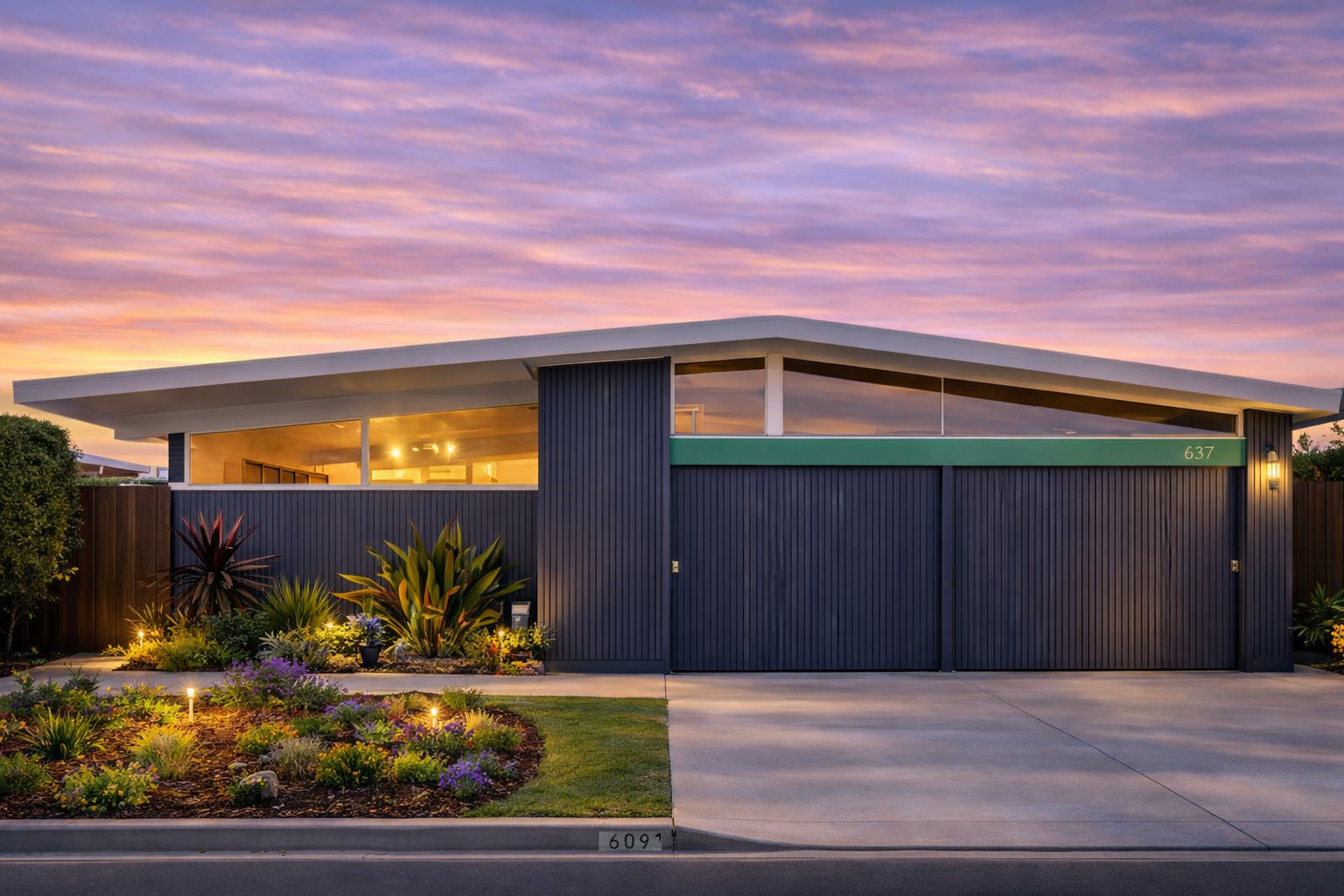
Nestled among the redwood-draped hills west of Silicon Valley’s tech corridor, Portola Valley offers a lifestyle unlike any other Bay Area community. This semi-rural enclave is renowned for its exclusive, country-like atmosphere: quiet, tree-lined lanes, sprawling open space, and world-class schools. Amid this prestigious setting lies an extraordinary mid-century treasure: a tiny enclave of Eichler homes. These distinctive houses — built by visionary developer Joseph Eichler in the 1950s — are celebrated for their clean lines, indoor-outdoor flow, and architectural innovation. In Portola Valley, Eichlers occupy oversized lots and often unique two-story forms, making them even more remarkable. Because only 25 Eichler homes were ever built here (in the Ladera area in 1951), they are exceptionally rare and coveted. For Silicon Valley buyers who value design heritage, these Eichler homes are not just a nod to the past but prized cultural and real estate assets. The fusion of iconic mid-century style with Portola Valley’s pastoral charm creates a lifestyle unlike any other: residents live every day in a modernist haven amidst redwoods and meadows.
For discerning buyers and architecture enthusiasts, Portola Valley Eichlers are a cut above ordinary homes. These properties demand experts who understand their unique value. That’s where The Boyenga Team comes in. Silicon Valley Realtors Eric and Janelle Boyenga specialize in Eichler and mid-century modern real estate. They guide clients to these rare homes and tell the story of their design, ensuring Portola Valley Eichlers find owners who appreciate their legacy. (Indeed, the Boyenga Team has become synonymous with Eichler expertise.) In the sections that follow, we explore Portola Valley’s Eichler homes in depth: their history, distinctive architecture, community context, local demographics, lifestyle amenities, real estate market trends, and what sets The Boyenga Team apart as the definitive agents for Eichler homebuyers and sellers in this exclusive market.
Historical Overview of the Portola Valley Eichler Neighborhood
Portola Valley’s Eichler homes have a storied origin: they are the very first tract development built by Joseph Eichler (1949–51). Tucked in the Ladera community (technically unincorporated Portola Valley), this was a small, experimental project with just 25 homes. Completed in 1951, the Ladera Eichler tract was Eichler’s initial collaboration with famed Los Angeles architects A. Quincy Jones and Frederick Emmons. Unlike his later large suburban tracts, Ladera’s sloping, semi-rural lots inspired Eichler and Jones/Emmons to create customized designs – some of the first two-story and split-level plans the company ever produced. In other words, Portola Valley’s Eichlers were a cutting-edge prototype: these homes introduced new forms (vaulted ceilings, high windows, private balconies) to adapt Eichler’s philosophy to a hillside landscape. Though Eichler built far more homes in Palo Alto, Sunnyvale, and elsewhere, the Ladera tract remains a unique milestone – his inaugural Bay Area development.
Over the decades, the Ladera Eichlers have remained a hidden jewel. Many original owners and preservation-minded buyers have carefully maintained or restored them. A few have undergone tasteful renovations that respect the homes’ mid-century DNA (for example, updating kitchens while preserving atrium spaces and wood finishes). Nevertheless, Portola Valley’s sky-high land values and desirable location have introduced new pressures. Unlike Eichler neighborhoods where teardown is rare, here each Eichler lot is coveted for redevelopment. In recent years there have been notable “teardown” sales, where an Eichler was demolished to build a much larger modern mansion. At the same time, a countertrend has emerged: architecture enthusiasts who specifically seek out these Eichlers. Local agents (including The Boyenga Team) often market them as “artistic legacy homes,” appealing to buyers who will preserve their defining features. This dynamic tension between preservation and redevelopment has, in fact, shaped the last 20 years of the Ladera market.
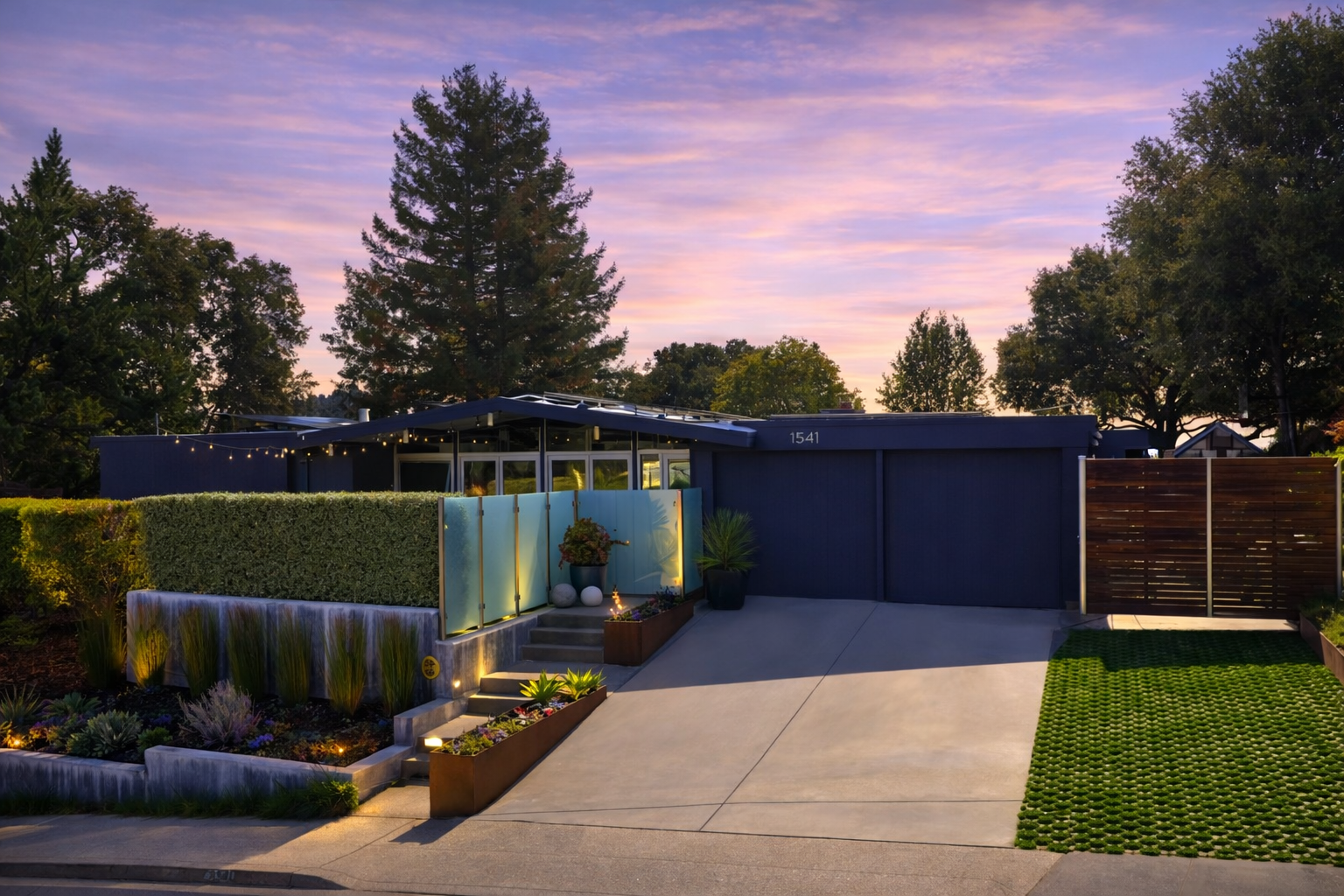
Throughout, Portola Valley itself has prized its rural character and open space. In contrast to denser Bay Area suburbs, the town has enforced low-density zoning, large minimum lot sizes, and strict design guidelines. The Ladera neighborhood reflects that: it has winding, tree-lined roads instead of city grids, and each Eichler is set back among mature oaks and redwoods. There is no homeowners association for the tract (Ladera has a voluntary Ladera Association for common amenities), but there is a strong community culture of architectural awareness. In fact, several local tours and Eichler Network events have featured these homes, cementing their status as cultural landmarks. Residents share pride in their mid-century modern heritage – Portola Valley Eichlers are often described as “architectural treasures” that epitomize design-driven, Silicon Valley living.
Notable among the Ladera Eichler homeowners over time are designers, tech pioneers, and Bay Area influencers drawn to modernist aesthetics (for example, one of Eichler’s early buyers was a prominent physicist at SLAC). The very rarity of these homes – out of about 11,000 Eichlers in California, only 25 are here – makes them a topic of local lore. Their place in Eichler history is solidified by references in architectural guides: the San Mateo Highlands tract and Portola Valley’s Ladera often appear in Eichler retrospectives as examples of Eichler’s ambition to blend modernism with California’s natural terrain. In summary, Portola Valley’s Eichler neighborhood began as a small, visionary experiment by Joseph Eichler and has since become an iconic footnote in both Eichler’s story and the town’s story.
Architectural Highlights and Housing Inventory
Portola Valley Eichler homes embody the hallmarks of California Modern — a philosophy Eichler and his architects championed. Signature elements include post-and-beam construction, which uses exposed wood beams and posts (often stained mahogany) to free the interior from load-bearing walls. This permits extraordinarily open floor plans and high, vaulted ceilings. Another defining feature is walls of glass: expansive sliding glass doors and clerestory windows bring natural light in from every side. Often these glass walls open onto a central atrium or courtyard, which serves as a private outdoor “room.” In fact, the Ladera Eichlers were designed around these atriums or inner patios, reinforcing the seamless indoor-outdoor flow. Combine these with radiant slab heating (hot water pipes under the concrete floors) and you have a home built for comfort and modern living. Eichlers were also known for minimal interior walls: living, dining, and kitchen areas merge into one continuous space. A portico or deep overhang on the flat roof shades the interiors and creates outdoor living areas. These features make Eichler homes feel expansive and integrated with nature.
The flat roof and sweeping glass walls of Eichler design are on display in this example (a San Mateo Highlands Eichler, by the same architects who built in Portola Valley). Notice how the broad overhang and clerestory windows let sunlight spill into the interior. Portola Valley’s Eichlers share these traits, but with site-specific twists. Because the Ladera lots were hillside parcels, Jones & Emmons (Eichler’s architects) experimented with two-story split-level plans in Portola Valley. Some Ladera homes feature a stepped floor plan – for example, a living room up one level and bedrooms down another – adapting to the slope. The use of vaulted ceilings and expanded square footage was also tailored to the grand lots. In short, while a typical Palo Alto Eichler might be a 4/2 model of ~2,000 sq ft, Ladera Eichlers can reach up to ~3,300 sq ft with 3–5 bedrooms (and as many as 3.5 bathrooms). They often include bonus rooms or loft areas made possible by two levels.
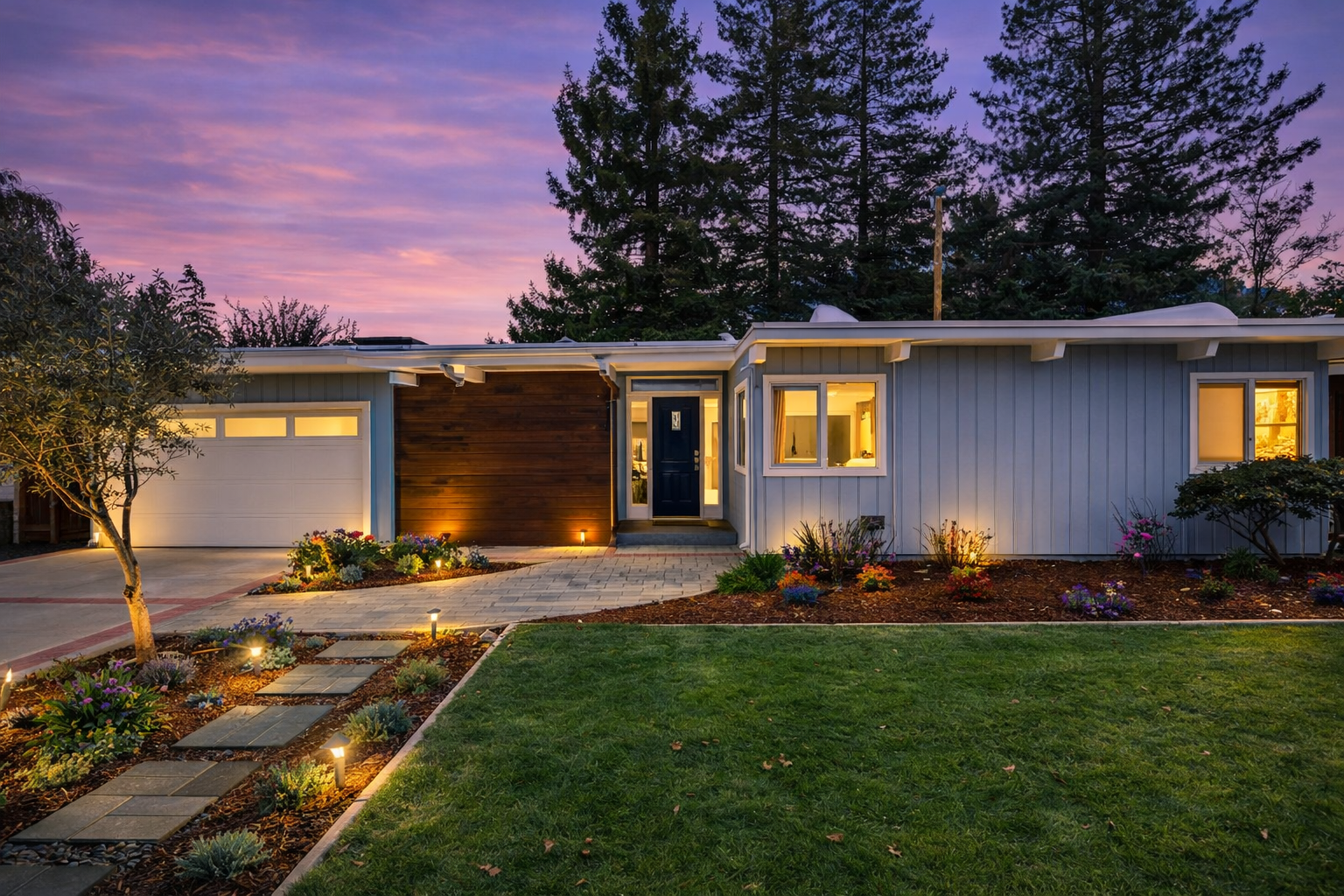
Beyond interiors, the site design of Portola Valley Eichlers is equally notable. The lots are vast for Eichler standards: the town’s commitment to open space meant Ladera parcels were generally at least 0.25–0.5 acres. Indeed, as one guide notes, a typical Palo Alto Eichler lot (6,000–8,000 sq ft) is small compared to Portola’s; here, lots are “a quarter-acre or more”. This generous land allows each Eichler to stand alone, surrounded by mature landscaping, privacy fences, or natural foliage. Owners often incorporate detached studios or guest cottages, large patios, and even swimming pools – amenities rarely seen in denser Eichler tracts. The large lot size is integral to the Eichler ethos in Portola Valley: it intensifies the indoor-outdoor connection. With tall glass doors opening to broad decks or gardens, residents truly live among the oak trees and hills. One paragraph from an Eichler analysis sums it up: “Expansive floor-to-ceiling windows and sliding glass doors seamlessly connect the interior living spaces to the surrounding natural environment… For a Portola Valley Eichler homeowner, the boundary between inside and outside blurs”. In other words, the architecture was designed to make nature part of daily life.
In terms of inventory, the Ladera Eichlers are the entire Eichler presence in Portola Valley – just one small neighborhood of 25 homes. (There are no other Eichler tracts within the town or nearby.) This means availability is extremely limited. When one comes on market, it truly stands out. Of these 25, roughly half remain in their original single-story form, and the rest are the unique two-story designs. Most have 3–4 bedrooms, though some of the larger ones had 5. The original plans often featured an atrium or “forecourt” entry courtyard (for example, 2-bedroom and 3-bedroom atrium models), whereas the two-story designs were custom to fit the grade. For comparison, an Eichler of this era in a larger tract would typically range 1,600–2,200 sq ft on smaller lots, but Portola’s exceed 2,000–3,300+ sq ft. In short, Portola Valley Eichler homes occupy a premium segment even among Eichlers – combining all the classic modernist features with extra scale and site.
Of course, Portola Valley also offers other home styles. In neighboring areas and on larger lots in PV, one finds expansive ranch houses and new luxury estates (often Spanish or contemporary in style). These tend to be much larger and more traditional than the Eichlers. The contrast is stark: where a typical Portola Valley mansion might boast six bedrooms and 5,000+ sq ft of ornate living space, an Eichler feels simple and streamlined. And yet Eichler buyers often view that simplicity as a strength – a breath of fresh air after the bulkiness of many modern developments. In other words, the Eichler’s appeal is not about having more rooms but having better lines: it offers a design-driven lifestyle.
The architectural attributes above explain why Eichler homes in Portola Valley appeal so strongly to today’s buyers and enthusiasts. In a market where almost every other house is either a historic colonial or a new “McMansion,” an Eichler stands out as an artistic statement. Its open floor plan suits modern living and remote work, while its walls of glass keep the home light-filled and connected to nature. Technology executives and creative professionals in Silicon Valley are especially drawn to Eichlers for these reasons. They see owning one not only as a comfortable residence but as an investment in a rare piece of design legacy – a “collector’s item in the world of modern architecture”.
Demographic and Socioeconomic Profile
Portola Valley is one of the least populous and wealthiest towns in Silicon Valley. The total population is only around 6,600. It has an older median age (about 56 years) and many residents who are well into their professional careers or retired. Families are present but smaller in number compared to suburban areas – there are roughly 2,625 households with an average size of about 2.5 people. Most households are married couples, often with children or multi-generational families.
Economically, Portola Valley is extremely affluent. One data source reports an average individual income of about $176,000, and the average household income is on the order of $482,000 (with a median around $250,000). These figures place it at the top of the Bay Area’s wealth scale. The high incomes reflect the professional makeup: many residents are executives, startup founders, or senior engineers in the tech industry. Given its proximity to Stanford, a number of Stanford professors, researchers, and business people also live in Portola Valley. Homeownership is dominant: about 84% of homes are owner-occupied, a figure much higher than surrounding cities. The few renters or vacant properties (around 6%) are usually small condos or guest cottages.
Educationally, Portola Valley is an extremely well-educated community. Over 78% of adults hold at least a bachelor’s degree, and nearly half have a graduate degree (48.6%). This is consistent with the affluent, tech-centric profile. The town attracts both domestic and international talent. While the majority of residents are White, there is a sizable Asian-American population as well (reflecting the tech workforce). It is culturally diverse relative to similar small towns. The combination of high education and income means residents are well-equipped to value architectural design, further boosting Eichler appeal.
One trend has been an influx of new wealth: over the past decade, more entrepreneurs and tech executives have relocated from San Francisco and Silicon Valley cores to places like Portola Valley for quality of life. Families often mention moving here for the schools and environment. Because Eichler homes are so rare, buyers typically come specifically seeking mid-century modern style. Thus the neighborhood draws two demographic groups: (1) preservation-minded design enthusiasts, often architects or creative professionals, who will pay a premium for original Eichler features; and (2) weathy developers and executives seeking an exclusive estate location, some of whom see an Eichler lot as a future building site. This split underscores the town’s overall socioeconomics: extremely high wealth and education attract both cultural connoisseurs and ambitious investors. Despite these pressures, the community has retained a “like-minded, intellectual” vibe. Neighbors in Portola Valley tend to share values of environmental stewardship, privacy, and appreciation for good design.
School Districts and Education Landscape
Portola Valley is famed for its exceptional schools, which is a major reason families choose to live here. The town has its own elementary/middle district – the Portola Valley Elementary School District – serving Ormondale Elementary (K–3) and Corte Madera School (4–8). These two small campuses (with just over 500 students combined) are consistently ranked among California’s top public schools. For high school, Portola Valley feeds into the Sequoia Union High School District (SUHSD), one of the highest-performing districts in the state. In SUHSD, Portola students typically attend either Menlo-Atherton High School or Woodside High School. Both are strong public high schools: Menlo-Atherton often ranks highly for academics and athletics, and Woodside High has a reputation for a rigorous curriculum. (Portola Valley is actually split – some areas feed Gunn High School in Los Altos-Mountain View, but the majority go to SUHSD.)
The quality of these schools cannot be overstated. Portola Valley Elementary District students routinely score near the top on state assessments. Ormondale, for instance, has an award-winning music program and small class sizes. Local parents frequently tout the schools as a key asset. This outstanding public education contributes directly to property values: homes in good school zones reliably sell for more. In Portola Valley, Eichler buyers often have children and seek these educational advantages. As the Boyenga Eichler guide notes, families view the district as “highly-rated” and a “top choice” for education.
Beyond public schools, the Portola Valley area offers elite private education. Within Portola Valley itself is Woodside Priory School, a prestigious college-prep school (grades 6–12) set on a scenic hillside campus. Other nearby private options include Sacred Heart Preparatory (Atherton), The Nueva School (Hillsborough/Palo Alto), Orensanz Foundation, and Castilleja School (Palo Alto, for girls). Closer to home, Sequoia Union School District also runs charter schools, including Heritage Oaks and Redwood City Charter. And a short drive away are the top universities of Stanford, Santa Clara University, and community colleges like Foothill and De Anza.
In a nutshell, Portola Valley offers top-tier education from K-12. The public schools are among the Bay Area’s best, and several nationally recognized private schools are in the vicinity. This educational ecosystem makes the area extremely attractive to buyers. For Eichler homes in particular, where families tend to have children, proximity to great schools is a huge selling point. Listing agents always highlight the school district quality: it reassures buyers that their lifestyle choice includes the best possible schooling for their kids.
Neighborhood Attractions and Lifestyle
Living in Portola Valley means embracing a truly outdoors-oriented, community-focused lifestyle. The town’s semi-rural setting offers unparalleled access to parks and natural preserves. Just a few minutes’ drive from Ladera are iconic open spaces: Windy Hill Open Space Preserve (over 1,000 acres of rolling ridges and Skyline Trail hikes) and Arastradero Preserve (extensive trails along Alpine Road). Residents also enjoy Coal Mine Ridge’s hiking and mountain biking, and in winter, vistas of the coastal fog from Vista Point. These natural amenities encourage daily recreation: morning runs on silent roads, cycling through oak woodlands, and bird-watching right from one’s backyard.
Within the town is Wunderlich Park (1,300 acres with hiking trails through a canyon), and each neighborhood has small parks/playgrounds (for example, Corte Madera field and Ford Field by Ormondale). The Ladera area itself has a modest community center with tennis courts and a year-round outdoor pool (part of the Ladera Community Center). This kind of communal amenity is ideal for families – summer swim days and weekend tennis become neighborhood traditions.
The downtown/small-business scene in Portola Valley is quiet but charming. Alpine Road forms a thin commercial strip known as Redwood Village and Portola Center. There are a handful of restaurants and cafes (e.g. Journeyman, Blue Oaks Grille), a butcher shop, a bakery, and a few boutiques. Redwood Village also has a branch of Oracle Market grocery. Many residents make weekly trips to nearby Woodside, Menlo Park, or Palo Alto for a bigger selection of dining and shopping. But the slower pace here is part of the appeal: farmers markets in Los Altos, Menlo Park, and Atherton are a short drive away for local produce.
Cultural venues are modest but accessible. The Sequoia Theatre in Redwood City or the Fox Theatre in Palo Alto are the nearest live-music venues. The Woodside Store (on the way back from Stanford) is a local gathering spot. Nearby Menlo Park and Atherton host art festivals and wine walks. The real “culture” of Portola Valley, however, tends to be outdoors and educational: community lectures at schools, the Portola Valley Library programs, and events at the Town Center.
This lifestyle suits a range of people. For families, Portola Valley offers a safe, nurturing environment. Children can roam local parks, bike on quiet streets, and attend some of the top schools in California. Because lot sizes are large, many homes (including Eichlers) have space for pools and big yards where kids play. There is a strong sense of community – neighbors form car pools, playgroups, and volunteer together on forest and safety committees.
For remote professionals and entrepreneurs, Portola Valley provides a retreat. It’s an easy drive (or bike) to Stanford and a short commute to big tech employers, yet at day’s end one returns to a tranquil sanctuary. Many Eichler owners convert part of their homes into home offices or studios, enjoying the peaceful views while they work. High-speed internet and relative quiet make it conducive to remote work, while the natural surroundings help alleviate burnout.
For architecture and design enthusiasts, the lifestyle has a unique appeal. Weekly community events often feature the Eichler houses: there are Eichler home tours, mid-century car shows, and design-centric lectures (sometimes hosted by the Eichler Network). These events foster an active community of like-minded owners who appreciate their homes’ heritage. The shared pride in living in an Eichler often translates into friendships across the neighborhood.
In short, Portola Valley Eichler residents enjoy a blend of rustic tranquility and cultural sophistication. They have direct access to great outdoors – hiking, horseback riding (many homes have stables), and stargazing on clear nights – while also being part of an educated, tight-knit community that values art, design, and nature. This combination of lifestyle benefits is a major reason why Eichler homes here remain so desirable.
Commuting and Tech Employer Access
Despite its secluded feel, Portola Valley is not remote. It lies just west of Interstate 280, making Silicon Valley’s tech centers easily reachable. By car, Stanford University in Palo Alto is about 15–20 minutes away (via Alpine Road or I-280). Menlo Park (home of Facebook/Meta) is about 20 minutes, and Palo Alto (various tech firms, Apple offices, Google) is 20–25 minutes. Cupertino (Apple Park) and Mountain View (Google, Microsoft, Intuit) are roughly 30–35 minutes via 280/85. Even San Jose’s tech campuses (NVIDIA, Cisco) are within a 40–45 minute drive via 280-101. Commuting to San Francisco (via 280) is about an hour or so, doable for occasional trips.
There is limited public transit directly in Portola Valley. The nearest Caltrain station is at Menlo Park or Redwood City (roughly 10–15 minutes away) for commuters to SF or San Jose. Several VTA bus routes serve neighboring communities, but most Portola residents drive. That said, the major commuter corridors (Alpine Road, I-280, I-85, US-101) are all easily accessible from Portola Valley. This connectivity is why tech executives feel comfortable living out of town: they can enjoy the peace of Portola Valley and still have a reasonable commute to any Silicon Valley workplace. It also makes the town relatively appealing compared to more isolated areas.
For remote workers, the tech connections are a bonus but not a necessity; they often have the luxury of going directly to their home offices. Others may drive into the office occasionally, using the evening to return to a tranquil home. In short, Portola Valley’s location offers the perfect balance: one quickly reaches Stanford and the Peninsula’s tech hubs, but lives in a setting that feels miles from the daily grind.
Real Estate Market Analysis
Portola Valley real estate is among the most expensive in the United States. With its scenic land and top schools, the market operates at the very high end. According to Redfin, the median home sale price in Portola Valley was about $5.1 million in early 2026. That makes Portola Valley comparable to nearby Atherton and Woodside. Even as prices dipped slightly (-30% year-over-year) in early 2026, these numbers underscore the town’s exceptional wealth. The price per square foot is around $1,560 (as of Feb 2026), reflecting both large lot values and high finishes. Homes here spend a bit longer on market – around 60 days on average – which is slower than extremely competitive cities, but given the luxury pricing this is still relatively quick. Only a handful of houses sell each month (4 homes sold in Feb 2026), so market dynamics can fluctuate drastically with each sale. Overall, demand is stable: affluent buyers know Portola Valley is a perennial top choice, and new inventory is scarce.
Eichler homes specifically occupy a niche within this market. They benefit from the overall strength of Portola Valley real estate but also bring their own premiums. Typically, Eichler homes here will list at a higher absolute price than Eichlers in, say, Sunnyvale, but often below a brand-new custom mansion on the same block. In practice, an Eichler in Ladera might start in the high $3 millions for a modest 3-bed home, up to $4–4.5M for a larger updated 5-bed. By comparison, brand new McMansions on adjacent streets routinely go for $6M–$8M. Thus, Eichlers are often seen as a “value alternative” for buyers who want the land and location but appreciate historic design. The Boyenga Market Report for Portola notes that Portola Valley Eichlers often compete head-to-head with new custom homes, since buyers in this area can swing either way.
Recent sales illustrate these trends. For example, one 3,354 sq.ft. Eichler in Ladera (5 bed/3.5 bath) was listed around $3,995,000 in 2026. Even older, 2-bedroom Eichlers have sold in the $2.5M–$3M range when completely updated. Because they are scarce, Eichlers often move at a premium. As one local analysis states, “Portola Valley Eichler home values… command a higher price point due to their exclusivity, land value, and zip code prestige”. In other words, a Portola Eichler’s per-square-foot price is typically on par with a Palo Alto Eichler, but the lot price pushes the total higher.
Over the last 5–10 years, Portola Valley home values have generally trended upward (though with typical real estate cycles). Long-term, prices have risen due to limited supply and constant demand from tech wealth. Eichlers, due to their architectural cachet, often outpace normal appreciation. In a booming market, a well-restored Eichler might sell for tens of percent above its original purchase. Even in slower times, their scarcity keeps them competitive. For instance, Redfin’s data for Portola shows sales often exceeding list price in hot conditions. While broad economic factors (interest rates, stock market) have some impact, Portola Eichlers remain resilient because truly comparable alternatives are rare. In effect, owning one is seen as owning a collectible piece of Silicon Valley real estate.
Investors looking at Portola Valley Eichlers note this stability. It’s unlikely a Portola Eichler will ever drop to half its value (as might happen in weaker markets). The lot and location alone hold value. And if the house is torn down, the land is still worth several million for new construction – which means Eichlers have a built-in floor. On the flip side, if preserved, they may appreciate faster than typical homes of the same size because their buyer pool is so focused. Overall, Eichlers here carry what some agents call a “legacy premium”: buyers pay for the idea of owning a historic modernist home in an elite town. From an investment standpoint, they combine the upside of a trophy property with the intrinsic value of raw land.
Case Studies and Sales Examples
Because Eichler homes are so few in Portola Valley, each sale tends to make news. Here are some representative examples of how they perform:
Siesta Court Eichler (5 beds, 3.5 baths, ~3,300 sq ft): In mid-2026, a remodeled two-story Eichler on Siesta Court listed for $3,995,000. With sleek new kitchen and glass-enclosed atrium, it drew multiple offers within weeks. Its final sale price (expected around $4.0M) showcased a strong buyer appetite: the large lot and design features appealed to both an architecturally minded couple and a high-end developer.
Ladera Eichler (3 bed, 2 bath, ~1,800 sq ft): A smaller Ladera Eichler, updated and on market at $2.65M, sold at $2.9M in 2025. This sale exemplified the “premium for design” effect: a similar-size non-Eichler home nearby (with conventional architecture) might have closed around $2.2M.
Teardown example: In 2024, an original but dated 2-bedroom Eichler on a 0.4-acre lot sold for $4.25M – then was immediately demolished. The buyer planned a custom estate in its place. This highlights Portola’s high land value. The lot alone was worth millions. Even though the Eichler was old, the sale price set a benchmark for Ladera land.
Off-market sale: A fully restored Eichler with period wood paneling quietly changed hands at $3.2M in late 2025 (broker-only). The sellers had an exclusive engagement with a design-focused buyer. Such off-market deals underscore the role of specialist agents (like Boyenga) in connecting the right niche buyers to these homes without public listing.
These examples show several things. First, architectural significance drives price. The top sale prices came from homes with intact Eichler character and quality upgrades. Second, competition is keen; even comparatively small Eichlers spark bidding wars. And third, location commands respect: a great lot size in Ladera can push prices into the multi-millions even before considering the home itself. In all cases, the presence of Eichler design made these homes stand out – often catching the eye of interior design magazines and Eichler enthusiasts. Agents note that a listed Eichler in Portola rarely stays unsold: as [129] describes, many Eichler buyers “are drawn to the aesthetic of mid-century modernism”and will pay extra to avoid a “generic new build”. Thus each Eichler sale in Portola is a highly competitive event, typically with multiple offers above asking, reflecting both buyer enthusiasm and the limited inventory.
The Boyenga Team Advantage
When a Portola Valley Eichler home comes on market, it’s not an ordinary real estate transaction – it’s an event. Sellers want the maximum value for their architectural gem, and buyers need the right guidance to appreciate what they’re buying. This is where The Boyenga Team at Compass excels. Eric and Janelle Boyenga are Silicon Valley real estate veterans and longtime Eichler aficionados. They are universally recognized as the Bay Area’s premier Eichler specialists. Their track record is impressive: hundreds of Eichler transactions across Peninsula and South Bay, and billions in sales volume. As noted, they even helped author the Eichler buying guide cited above and are active in the Eichler Network and community.
Silicon Valley Real Estate Experts: The Boyenga Team knows the local luxury market like no one else. They study neighborhood trends (Portola Valley, Atherton, Palo Alto, etc.) daily, and they have in-depth knowledge of Portola Valley’s micro-market. This means they can accurately price an Eichler home in context (accounting for its mid-century features, lot size, and town comparables). They also understand buyer motivations in Silicon Valley – whether a client is a tech executive, a design-minded entrepreneur, or a family relocating for schools – and they tailor the search process accordingly. For instance, they might highlight Ladera’s serene amenities to a remote worker, or emphasize indoor-outdoor living to an architect.
Eichler and Mid-Century Modern Specialists: Unlike a generalist agent, the Boyengas truly speak Eichler. They know the difference between an Anshen & Allen Eichler and a Claude Oakland design, and they can discuss Joseph Eichler’s vision in knowledgeable detail. When marketing a seller’s home, they literally sell the story – describing the atrium, the exposed beams, the radiant floors – so buyers feel the emotional appeal of the architecture. Similarly, when advising buyers, they can interpret renovation plans through an Eichler lens (e.g. whether a new faucet is “period-appropriate” or if a potential change disrupts the flow). They even leverage tools like Compass’s 3D Tours and targeted social media campaigns that emphasize mid-century design imagery. In short, they “make it clear that Eichler homes are a breed apart,” focusing on lifestyle and legacy, not just square footage.
Luxury, Design-Forward Marketing: The Boyenga Team utilizes Compass’s luxury marketing machine to give Eichler sellers an edge. This includes professional staging (often partnering with mid-century style decorators), high-end photography (drone shots of the oak trees around the house), and custom print materials that highlight the home’s period details. They leverage Compass Concierge – a program that pre-funds home improvements – to sponsor strategic updates (such as refinishing original hardwood floors or giving the atrium a facelift) so that an Eichler can show at its best without burdening the seller upfront. Their marketing also taps into exclusive channels: they maintain an email network of Eichler collectors and Architecture Digest–type publications, ensuring that when a Portola Eichler is listed, it gets in front of buyers who get it.
Off-Market and Network Access: Because Eichlers rarely go on the open market, the Boyenga Team’s Rolodex is particularly valuable. They often alert their circle (past clients, colleagues, local architects) about potential Eichler listings before they hit MLS. Sometimes they even orchestrate private sales – matching a seller with a vetted buyer who has been waiting. This discretion is appealing to many luxury sellers. Essentially, the Boyengas know where the “Eichler buyers” are, even if those buyers are not actively searching. Their connections with design professionals also mean their clients might learn of renovation leads or Eichler-friendly lenders that a typical agent wouldn’t provide.
Proven Results: The Boyenga Team’s reputation is built on success stories. Colleagues and clients describe them as “passionate”, “architecturally informed”, and highly strategic. Many agents in Portola Valley will refer Eichler listings to the Boyengas specifically. Indeed, The Boyenga Team’s website proudly mentions their track record of guiding countless Eichler buyers and sellers and being affiliated with the Eichler Network. They know, for example, that a well-preserved Eichler in Portola is likely to fetch top dollar if its story is properly told. Past clients attest that the Boyengas “maximize value” by targeting the right audience – something that is critical when stakes are high in this market.
In short, when dealing with Portola Valley Eichler real estate, The Boyenga Team provides unmatched expertise. They combine Silicon Valley luxury knowledge with Eichler specialization. As the market analysis above shows, Portola Eichlers are rare, valuable assets; selling them successfully requires a nuanced approach that only seasoned specialists can deliver. The Boyenga Team ensures that buyers can find these architectural gems, and sellers can fully capitalize on their mid-century modern legacy – all while leveraging the full resources of Compass’s luxury marketing platform. In a market defined by design pedigree and exclusivity, Eric and Janelle Boyenga are the partners who can truly bridge the gap between art and commerce.