

Saratoga’s Rare Eichler Enclave: A Mid-Century Modern Rarity in Silicon Valley Luxury Real Estate
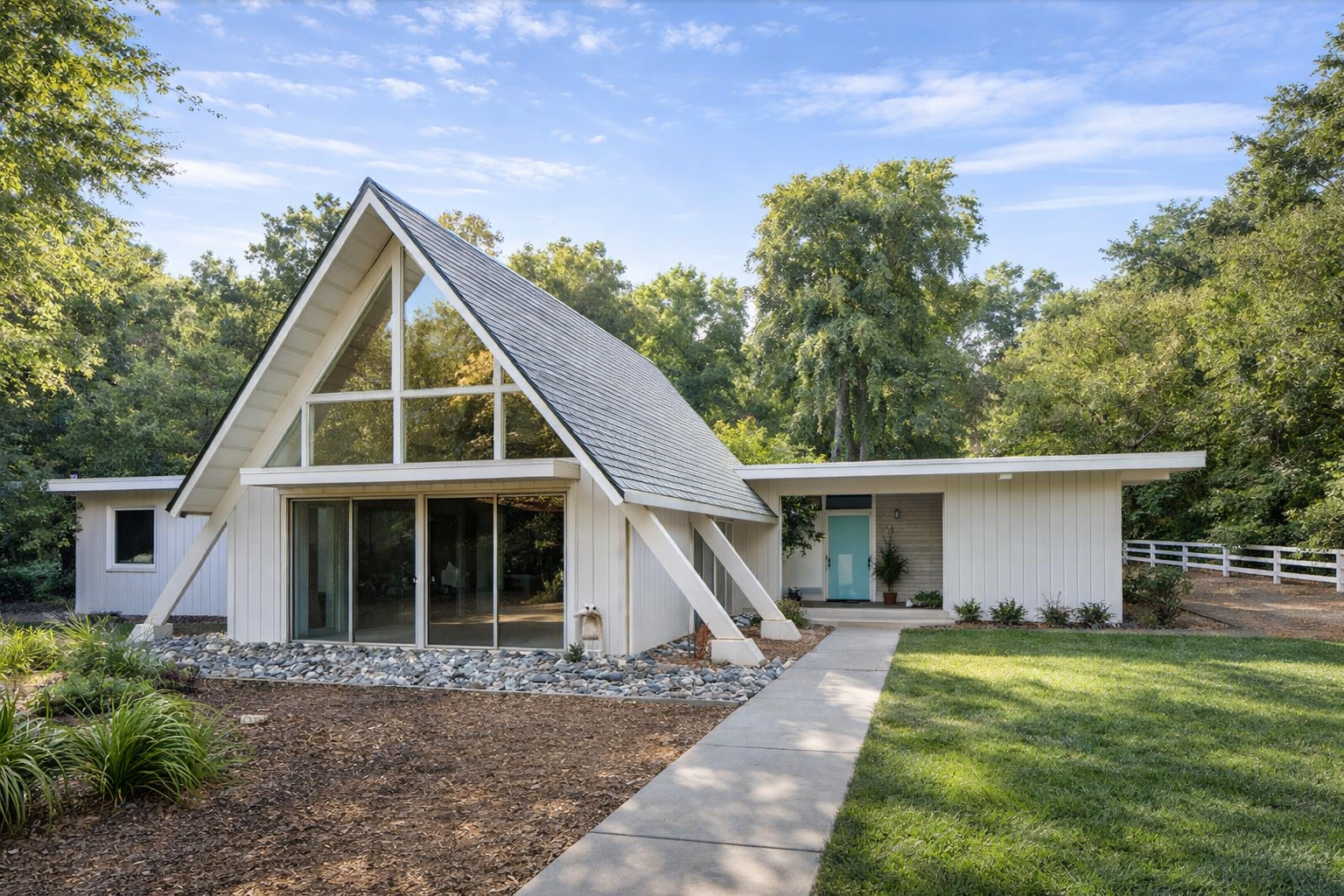
Saratoga’s rare Eichler moment
In a town celebrated for vineyard hillsides, legacy estates, and a distinctly “green” sense of California prosperity, the presence of Eichler homes feels almost paradoxical—in the best possible way. Saratoga’s modernist inventory is famously scarce, and tucked just off Cox Avenue is a compact, design-forward pocket that stands as one of the city’s most architecturally meaningful residential chapters: the tract marketed as “Eichler Homes of Saratoga.”
What makes this neighborhood special isn’t only the unmistakable mid-century modernvocabulary—glass, beams, atriums, and strong horizontality. It’s the fact that this is one of the last and one of the smallest Eichler communities in the region. The development was planned for 47 homes, but the final outcome was far rarer: Joe Eichler ultimately built only 35 homes here (roughly three dozen), a nuanced detail that helps explain why Saratoga Eichlers can feel like “unicorn” listings in Silicon Valley real estate.
In a luxury market where “rare” is often used loosely, Saratoga Eichler homes earn the word honestly. When the inventory is 35 homes total—and many owners stay for decades—availability becomes not a seasonal fluctuation, but a structural condition of the neighborhood.
This is also a lifestyle neighborhood. The tract’s scale supports real neighborliness—block parties, informal stewardship, and the kind of continuity that makes design preservation feel less like regulation and more like shared pride. For Silicon Valley professionals who want architectural significance without giving up Saratoga’s school reputation, village ambience, and West Valley access, it’s an unusually complete package.
As The Boyenga Team often emphasizes, the most compelling Eichler transactions are not purely about square footage—they’re about provenance, intention, and the emotional value of living inside a coherent design philosophy. In a market that rewards design-forward homes, mid-century modern homes in Saratoga remain a distinctive—and increasingly difficult-to-replicate—asset class.
From orchard town to modernist enclave
Saratoga’s evolution, and why mid-century modern “fits” here
Saratoga’s civic DNA has long balanced natural beauty with deliberate self-definition. Official city history describes Saratoga’s post–World War II evolution into a residential community—and notes that residents incorporated in 1956 in part to establish local governance rather than be annexed. That postwar era—exactly when modernism became America’s dominant architectural language—set the stage for a small but meaningful mid-century building wave in the city.
The town’s identity also carries deep agricultural and landscape heritage. Saratoga’s own materials on its Heritage Orchard describe a transformation from frontier/industrial roots to an agricultural hub with orchards and vineyards, followed by another shift toward a residential community. That multi-era layering—orchard town, then suburb, now global luxury market—helps explain why the best Saratoga neighborhoods tend to feel curatedrather than merely “built out.”
The Eichler vision, and why it still reads as “luxury”
Joseph Eichler’s development legacy is often summarized as “mid-century modern tract housing,” but that undersells the ambition. National preservation and design media have repeatedly highlighted Eichler’s role in popularizing modern architecture at scale—bringing glass-and-beam modernism into daily family life, and doing so with a social conscience that included fair-housing advocacy in an industry that often resisted it.
Design-wise, Eichler’s ethos aligns cleanly with what today’s affluent buyers pay premiums for: strong indoor–outdoor flow, light as a primary material, and plans that prioritize lived experience rather than ornament. In other words, what was once radical modernism now reads as quietly inevitable—especially in Silicon Valley, where buyers often value clarity, performance, and intentionality.
Building the Eichler Homes of Saratoga
The Eichler Homes of Saratoga neighborhood was built in 1964 and 1965, at the late peak of Eichler’s Bay Area production. The tract’s branding is telling: Eichler’s romantic tract names elsewhere are famous, yet here the development was straightforwardly named “Eichler Homes of Saratoga”—a rare case where the marketing identity foregrounded the builder’s own name.
The community’s boundaries and internal geography show up repeatedly in both historic documentation and neighborhood profiles: De Havilland Drive functions as a perimeter curve; the Eichlers are concentrated on De Havilland and Shubert drives and Columbine Court, just off Cox Avenue.
Architecturally, the tract is tied primarily to Claude Oakland’s designs, with period materials also noting additional designers involved in the development’s marketing and production ecosystem. The resulting inventory is not “cookie-cutter” in the pejorative sense; rather, it’s a coherent design language expressed through multiple plan types—some of them unusually grand by Eichler standards.
Preservation, regulation, and a modern landmark lifestyle
One of the most compelling Saratoga-specific stories is how preservation has unfolded here: with visible pride, but relatively little conflict compared with some other high-priced Eichler areas. In the late 2010s, local officials evaluated integrity at both macro and micro scales—down to original hardware details—when considering historic recognition.
A signature milestone: the home at 19277 Shubert Drive was designated historic by the city, with documentation stating it met criteria reflecting Saratoga’s cultural/architectural history and was considered eligible for the California Register of Historic Resources. Importantly for homeowners, inventory/landmark pathways intersect with California’s Mills Act framework, which can offer property-tax relief through an income-approach valuation method in exchange for preserving historic character.
In Saratoga, preservation attention has extended beyond houses to the neighborhood’s entry sequence: four circular concrete planters—part of the tract’s original landscape conception—were added to the city’s heritage inventory and described in historic reporting with unusually specific design detail (dimensions, materials, and aggregate finish). The landscape design is attributed to modernist landscape architect Robert Royston and his firm (then Royston, Hanamoto, Mayes and Beck), reinforcing that this neighborhood was conceived as a holistic environment, not just a set of houses.
At the same time, this remains a living neighborhood rather than a museum district. Residents have described it as lacking formal architectural controls or a historic-district overlay for the entire tract—yet still maintaining a remarkably consistent streetscape through community norms, city review for certain changes, and mutual respect for the original design intent.
Architecture and housing inventory
What a Saratoga Eichler looks like—beyond the buzzwords
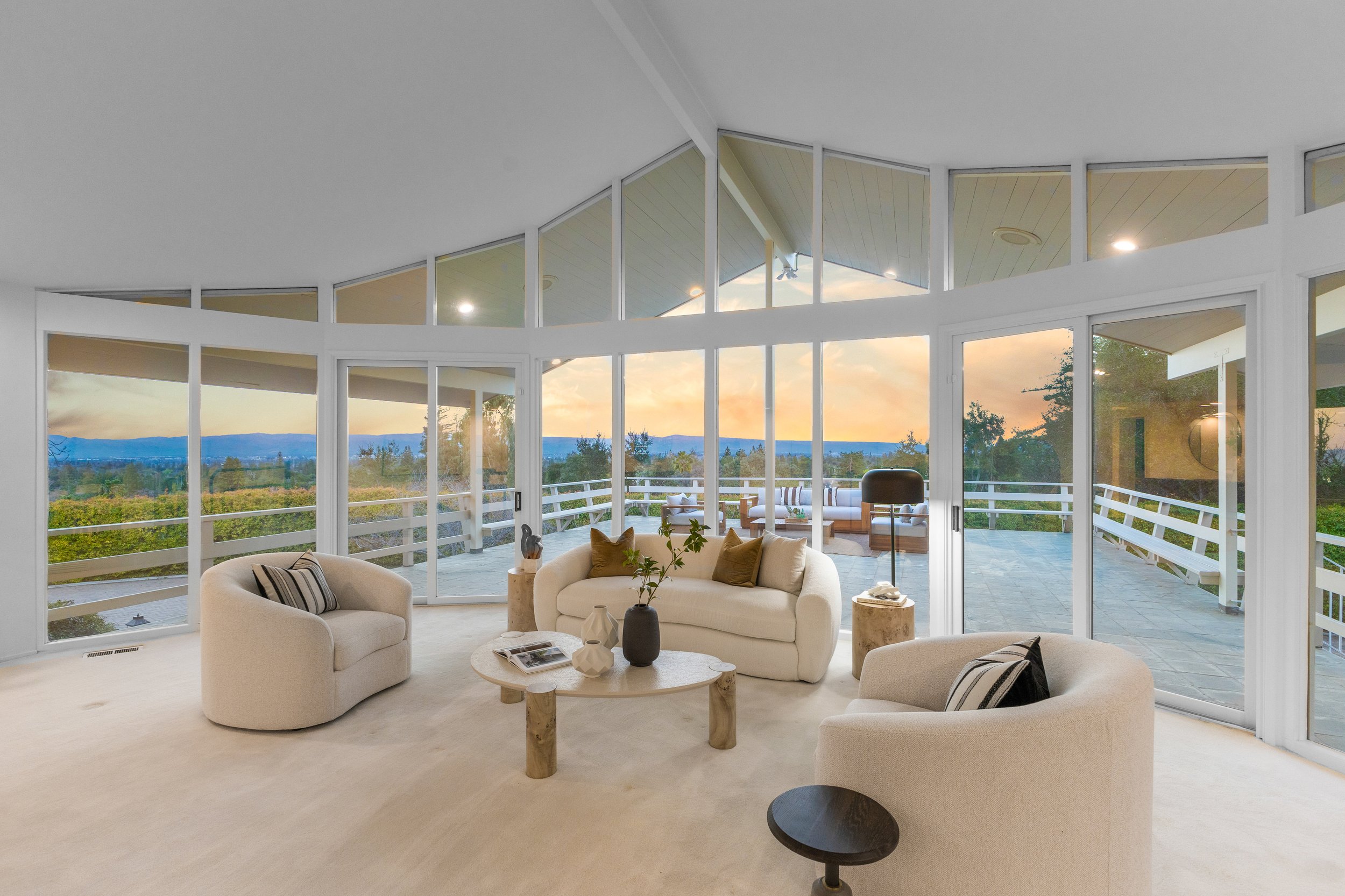
Eichler homes are frequently summarized with a short list of features, but Saratoga’s versions reward a more architectural reading. The tract includes some of the larger and grander Eichler plans, with many homes around 2,400 square feet—an important point in a market where mid-century buyers often want the design and the functional scale for modern life.
Across the neighborhood, the defining spatial move is not “open concept” in the current trend sense—it’s structured openness: wings and galleries, glazing as circulation, and the atrium as a regulating device for light, privacy, and internal orientation.
Key design characteristics, repeatedly documented in Saratoga’s own historic inventories and neighborhood reporting, include:
Post-and-beam logic expressed as visible structure and bold roof geometry
Floor-to-ceiling glass and “walls of glass” that treat daylight as a core building material
Atriums and courtyards that stage indoor–outdoor living without sacrificing privacy
Radiant-floor heating, a classic Eichler hallmark that still shapes renovation decisions today
Low-slung horizontality paired, in some models, with dramatic peaked volume (especially “gallery” concepts)
Plan types that matter in Saratoga: gallery and “interior-surrounded” atriums
Two plan ideas show up again and again in tract narratives—and they help explain why Saratoga Eichlers feel especially livable to modern buyers.
One is the gallery model: Eichler’s own brochure language described a long central volume—an “ideal” entertaining spine—with at least one documented gallery reading as a 52-foot-long space under warm tongue-and-groove ceiling, simultaneously expansive and intimate.
The other is a rarer atrium configuration: an atrium not at the entry, but fully surrounded by interior rooms, functioning as an internal light court rather than a threshold. Multiple Saratoga homes share this unusual plan, and it’s explicitly documented in city-related historic reporting summarized by neighborhood profiles. This is the kind of design move that reads instantly “architect-designed” to buyers who know modernism—and it’s difficult to replicate convincingly in new construction without veering into pastiche.
Typical sizes, lots, and layouts
Because this is a small tract, “typical” should be understood as a range rather than a single template. Still, multiple neighborhood profiles converge on a clear pattern: upscale four-bedroom floor plans in the neighborhood commonly sit in the ~2,100–2,800 square-foot band, often on lots around ~11,500 square feet.
Some lots are even larger—12,000 square feet or more—and a notable number are pie-shaped, a geometry that supports privacy and generous landscaping (and helps explain why the neighborhood can absorb change without immediately feeling crowded).
In today’s market language, you’ll often see these homes described as 4/2 or 4/3 variations, with the real differentiator being not the bedroom count but the experiential “center” of the house: atrium-centered living versus gallery-centered living.
Remodel culture: preservation-forward, not frozen in time
Saratoga Eichlers have not resisted renovation; they’ve simply tended to renovate in a way that respects the street-facing composition and the logic of the original design.
Neighborhood reporting documents a variety of modification strategies (and the cultural attitudes around them): skylighting an atrium while maintaining visual openness; interior reconfigurations behind intact facades; and, in at least one case, a previous owner converting an outdoor courtyard zone into an indoor lap pool—an ambitious change that still leverages the plan’s entertaining “spine.”
Real-world listings reinforce what modernist buyers already suspect: the “best” Saratoga Eichler renovations read less like stylistic makeovers and more like performance upgrades—kitchens and baths updated for current expectations, glazing improved, and exterior–interior flow sharpened rather than cluttered.
People and schools: the socioeconomic and educational landscape
A high-achievement, high-commitment homeowner base
At the city level, Saratoga is a classic high-homeownership, high-education Silicon Valley community. The U.S. Census Bureau reports a July 1, 2024 population estimate of 30,486 (with the April 2020 Census count at 31,051), situating Saratoga as a relatively small, tightly held market where marginal inventory changes can move pricing quickly.
Key indicators underscore why Saratoga real estate demand remains structurally strong:
Owner-occupied housing rate of 86.4% (2020–2024)
Median household income reported as $250,000+ (2020–2024) with per-capita income $124,686
Educational attainment with 81.1% holding a bachelor’s degree or higher and 97.1% high school graduate or higher
International and multilingual character, including 46.3% foreign-born and 50.8% speaking a language other than English at home
On the planning side, Saratoga’s General Plan Update housing analysis further characterizes the city as predominantly owner-occupied (84.6% in ACS 2015–2019 tabulations cited in the document), with a household-income distribution heavily skewed to higher-income tiers (noting 73.5% of households above 100% of area median income).
For affluent buyers, this matters: high owner-occupancy and long tenure tend to reduce “churn,” reinforcing stability, neighborhood stewardship, and scarcity—especially in micro-inventories like Saratoga’s Eichler tract.
Professional demographics with a Silicon Valley silhouette
Saratoga’s planning analysis reports resident employment concentrated in Financial & Professional Services (33.1%), with additional major shares in Manufacturing/Wholesale/Transportation (23.1%) and Health and Educational Services (21.9%). The report also characterizes the city as a net exporter of workers (job-to-resident ratio of 0.58 in the cited ACS-based analysis), which aligns with Saratoga’s identity as a premium residential community feeding into broader Silicon Valley job nodes.
Neighborhood oral history adds texture: long-time residents recall an early population of engineers and technically oriented professionals, alongside a notably international mix for the era—families connected to Europe and Japan, for example—suggesting that even early on, the tract attracted globally minded households drawn to modern design.
Schools: the demand engine behind Saratoga luxury real estate
School quality is one of the most durable demand drivers in Saratoga real estate. In hedonic pricing research traditions, school quality is routinely treated as a standard explanatory variable—explicitly referenced as one of the factors that such models often measure when evaluating housing value impacts.
For the Eichler Homes of Saratoga area, school assignment depends on the exact address and can change over time, but several institutions recur consistently in neighborhood references and district materials.
Public districts and core schools include:
Saratoga Union School District serves grades TK–8 and operates three elementary schools plus one middle school.
Redwood Middle School serves grades 6–8 for students residing within district boundaries, with the district stating it has only one middle school and does not “overflow” students to other districts.
Argonaut Elementary School is one of the district’s elementary schools; GreatSchools shows an 8/10 rating at the time of retrieval.
Los Gatos-Saratoga Joint Union High School District provides the public high school pathway for many Saratoga addresses.
Saratoga High School is rated 10/10 on GreatSchools at the time of retrieval.
In addition to ratings, the district itself highlights recognition: the Saratoga Union School District site notes “Redwood Middle School 2026 CA Distinguished School.”
Private-school options in the broader West Valley / Peninsula orbit are also a factor for many luxury buyers. Notable nearby choices include The Harker School (PK–12). Bellarmine College Preparatory (all-boys Jesuit high school). Sacred Heart Schools, Atherton (PK–12). Castilleja School (girls, grades 6–12).
Higher education: a quiet advantage for professionals and families
Saratoga’s proximity to higher education—both practical and prestige-driven—matters for community life and long-term real estate value narrative. West Valley College traces its institutional origins to a district established in 1963, with early classes in 1964 and later campus development in Saratoga.
For research and global academic gravity, Stanford University explicitly positions itself “in the heart of…Silicon Valley” and notes its location between major regional cities. And for another major nearby institution, San Jose State University states its founding year as 1857 and frames its early mission as teacher education—an enduring local anchor in a region defined by mobility.
Lifestyle, recreation, and Silicon Valley access
A neighborhood culture built on participation
One reason Saratoga’s Eichlers have remained visually intact is the social infrastructure. Neighborhood reporting describes a continuity of ownership, a resurgence of family activity after periods with fewer children, and community rituals such as annual block parties and informal neighbor support.
Community safety organization has also been described in practical, modern terms: a neighborhood watch program with cameras monitoring the tract’s entrances, supported voluntarily by residents, reflecting a high-trust approach to shared responsibility rather than gated isolation.
Notable residents have included civic figures such as Rishi Kumar, described as living in the neighborhood (though not in an Eichler) and participating in community initiatives.
Culture, nature, and the “Saratoga weekend”
Saratoga’s lifestyle appeal is unusually complete for a small city: arts, landscape, and a village-scale social scene.
A cornerstone cultural landscape is Montalvo Arts Center. The National Park Service describes Villa Montalvo’s origins, including its early-20th-century construction and the broader landscaped grounds. Montalvo’s own materials emphasize its function as a public arts center with programming and a historic setting—an amenity type that reads as “luxury lifestyle” without needing to be exclusive.
For another Saratoga icon, the National Park Service highlights the hilltop draw of Paul Masson Mountain Winery and its ongoing role as a summer concert destination above Silicon Valley.
Meanwhile, within day-to-day neighborhood life, the Saratoga Eichler tract’s own reporting points to a familiar rhythm: Saratoga Village as a “mountain village”–feeling downtown with multiple tasting rooms, plus the social magnet of the farmers market at West Valley College, framed as a place where neighbors routinely run into one another.
For the market itself, third-party operator information notes a Saratoga Certified Farmers’ Market held at West Valley College on Saturdays with 50+ vendors.
Everyday livability for remote workers and design-forward households
Eichler homes have become unusually compatible with modern work patterns because the architecture was designed, from the start, to mediate privacy and openness. The atrium can function as a light-filled “pause” space between calls; the gallery becomes a presentation-ready volume; and the glazing/landscape relationship makes long hours at home feel less compressed.
Even when owners modernize—new kitchens, additional glazing performance, refreshed landscaping—the most successful renovations tend to amplify what was already there: light, proportion, and clean material logic.
Commuting: the West Valley corridor advantage
Saratoga’s commute profile is shaped by practical transportation realities and by its role as a net exporter of workers. The Census Bureau reports a mean travel time to work of 25.1 minutes (2020–2024), an important context point for Silicon Valley professionals balancing high-intensity employment with residential calm.
Within the Eichler tract, one historical change stands out: the opening of Highway 85. Neighborhood accounts describe how what had once been a quiet right-of-way became an active corridor with cars flowing in 1994—introducing audible hum, while also materially improving commute options for residents.
For today’s buyers, the story is simple: Saratoga provides access to Silicon Valley’s major employer geography while retaining a residential, village-oriented identity—an uncommon duality in Bay Area real estate.
Saratoga real estate market and the Eichler premium
Baseline Saratoga market conditions
As of February 2026, Redfin reports a Saratoga median sale price around $3.48M (with “last month” summary stating roughly $3.5M), up year-over-year, and a median of 13 days on market, with homes receiving about 2 offers on average.
The same source reports a median sale price per square foot of about $1.28K (with year-over-year movement noted).
Meanwhile, Zillow reports “typical home values” for Saratoga around $4.08M with data through February 28, 2026, and indicates median days to pending around 30 days (with metric availability caveats).
And Realtor.com reports a median listing price for Saratoga around $3.54M and a median listing price per square foot around $1,404 (with inventory and days-on-market figures varying by snapshot).
The takeaway for luxury buyers: Saratoga is not merely expensive—it is structurally supply-constrained. High owner-occupancy and long tenure underpin scarcity, and that scarcity shapes all submarkets inside the city.
Long-term appreciation context
Saratoga’s own Housing Needs Assessment (General Plan Update material) provides an unusually clear long-range framing: it cites a typical home value of $2,996,100 as of 2020 and describes that figure as a 174% increase since 2001 (when typical home value is cited as $1,093,440).
The same document notes very low vacancy (3.8% as of 2019) and emphasizes that most housing stock was constructed prior to 1979, reinforcing the broader “built-out” conditions that elevate competition for well-located, design-significant homes.
Why Eichler homes often command premium pricing in Saratoga
In many Silicon Valley cities, Eichlers are one beloved category among many. In Saratoga, the math changes because the Eichler category is microscopically small.
Three drivers reinforce architectural premium pricing here:
First is true scarcity. The tract is about 35 Eichler homes total—planned larger, realized smaller—and that alone can make “Eichler homes for sale in Saratoga” a low-frequency event compared with neighboring cities with far larger mid-century inventories.
Second is functional luxury. Saratoga’s Eichlers are repeatedly described as larger-than-average within the broader Eichler oeuvre, with more dramatic plans and larger lots than many buyers assume when they think “Eichler.”
Third is signal value: the market interprets preserved design as quality. Preservation economics literature and program guidance routinely connect historic designation and preservation frameworks with value outcomes—whether through tax policy incentives (Mills Act valuation methods) or through investment protection effects in designated areas. In other words, when a property class is recognized as “worth keeping,” buyers often price that recognition in—especially in design-literate markets.
Saratoga’s tangible preservation steps—historic inventory additions, landmark designations, and even recognizing the entry planters—make the neighborhood’s design identity feel reinforced rather than fragile.
Micro-market competitiveness: what the neighborhood data implies
Neighborhood-level snapshots underline how quickly turnover can happen when a listing does appear. For example, the Saratoga Woods neighborhood page (which encompasses the area name used in some market mapping) is described as “very competitive,” with homes going pending quickly and selling meaningfully above list price on average.
Because the Eichler inventory is so small, even a single high-profile sale can reset buyer expectations—especially when the home is properly remodeled and marketed to design-forward buyers.
Sales vignettes and The Boyenga Team advantage
Representative Saratoga Eichler sales that illustrate demand
While individual sales never “define” a neighborhood, Saratoga’s tiny Eichler inventory makes recent examples especially instructive.
A late-2024 Eichler sale on Columbine Court
19300 Columbine Ct (built 1965) sold for $3.68M in November 2024, with a reported price per square foot of $1,597 on Realtor.com’s record view. In a tract where supply is inherently capped, that kind of pricing is less about hype and more about a consistent buyer pool competing for a recognizable, architecturally coherent product.
A 2025 “contemporary Eichler design” sale on De Havilland
19269 De Havilland Dr (built 1965) sold for $4.1M in August 2025. Redfin’s listing record explicitly framed it as an “incredibly popular contemporary Eichler design” with “breathtaking walls of glass,” and the pricing shows how Saratoga-level location and school demand can amplify mid-century architectural value when the home is presented correctly.
A design-forward remodel narrative translating into a $4M+ result
19224 De Havilland Dr (built 1964) last sold for $4.15M in 2021 according to Realtor.com’s property record view. Third-party property narrative also attributes a from-the-ground-up remodel completed in 2017 to an architecture-focused modernization strategy—exactly the kind of renovation lineage that tends to attract the strongest Eichler demand.
Together, these examples support a consistent thesis: in Saratoga, buyers do not treat Eichlers as “cute mid-century.” They treat them as luxury design-forward homes—and they bid accordingly.
Notable residents and cultural significance
Beyond the Eichler tract itself, Saratoga’s mid-century story intersects with Silicon Valley innovation. The city’s landmark designation materials for 19174 DeHavilland Drive associate the residence with Lee T. Boysel, described as an electrical engineer and inventor and founder of Four Phase Systems, with work originating in the home’s garage and contributing to advances used in the computer industry. This kind of narrative—design modernism intersecting with the region’s tech formation—adds cultural “weight” to mid-century properties in Saratoga.
The Boyenga Team advantage for Eichler and mid-century modern homes in Saratoga
In a micro-inventory market, expertise is less about seeing what’s listed and more about understanding what’s possible: identifying unoptimized design potential, tracking stewardship patterns, and positioning modern architecture to the right buyer audience.
The Boyenga Team explicitly positions itself as Silicon Valley real estate experts and Eichler/mid-century modern specialists, framing Saratoga’s tract as a small, 35-home development built in 1964–1965 and highlighting the design themes that define the neighborhood’s appeal.
That specialization matters in practice for two reasons:
First, for buyers: matching a buyer to the correct plan type (gallery vs. atrium models), the right site geometry (pie-shaped lots, orientation), and the right renovation tolerance (preservation-forward vs. fully modernized) is often the difference between a good purchase and a forever home—especially when listings move fast.
Second, for sellers: the resale premium in mid-century modern homes is frequently unlocked through disciplined storytelling—architectural lineage, integrity, and well-documented improvements—plus distribution that reaches design-forward buyers. Compass’s own market-report ecosystem emphasizes deep trend analysis and presentation of market dynamics across the Bay Area, providing a platform context that luxury marketing teams often leverage.
The team’s stated approach also aligns with what recent Saratoga Eichler sales demonstrate: when a home is properly renovated, properly framed, and properly marketed, the buyer response can be both fast and aggressive—even in a high base-price environment.
Within that framework, Eric Boyenga and Janelle Boyenga are positioned as leaders in luxury, design-forward real estate who help buyers pursue architecturally significant homes and help sellers maximize Eichler value through platforms and strategies aligned with today’s Silicon Valley luxury market.