
Killarney Farms Neighborhood in Santa Clara
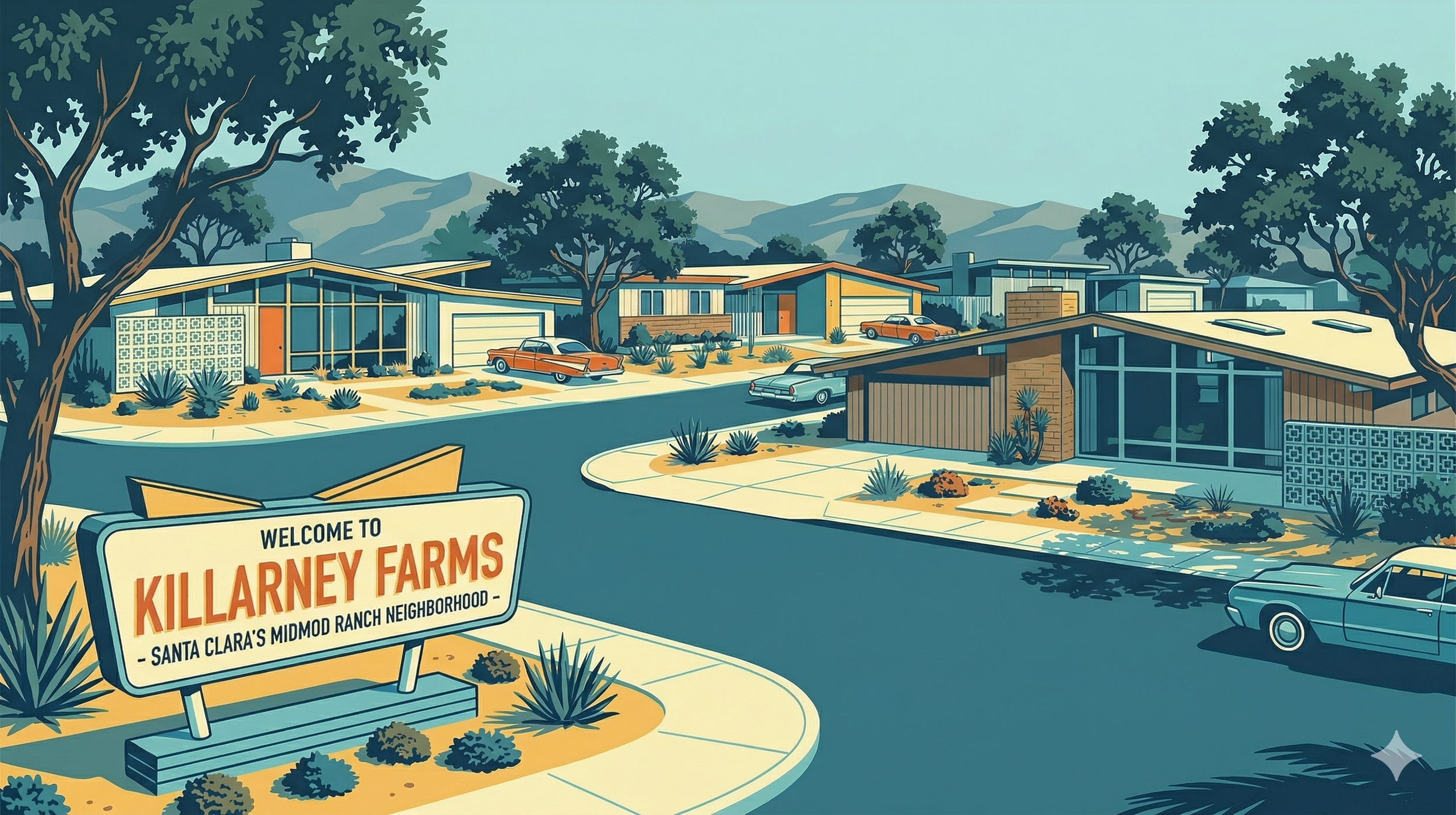
Killarney Farms is a mid‑century residential neighborhood (commonly discussed as two related tracts—“North” and “South”) in Santa Clara. Despite the “Farms” name, the area is not an operating agricultural property today; it is predominantly single‑family residential housing stock typical of post‑World War II suburban growth in the Santa Clara Valley.
The best-documented “founding” milestones for Killarney Farms as a neighborhood are the initial construction era for Killarney Farms North (commonly dated to 1957) and the later creation of a second, nearby Killarney Farms South (commonly dated to 1961), both attributed in local real estate histories to Lacey and White, Inc..
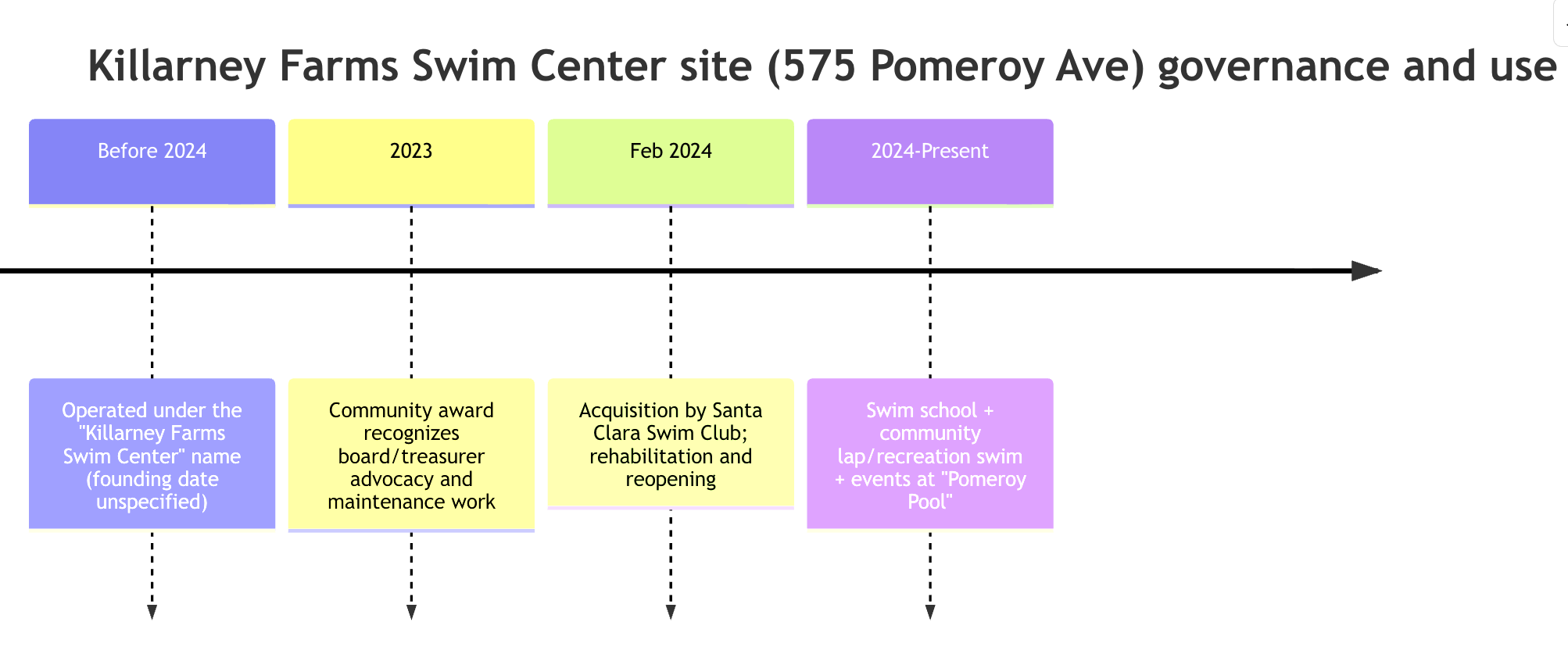
A defining community institution long associated with Killarney Farms South is the neighborhood pool at 575 Pomeroy Ave, historically known as Killarney Farms Swim Center. In early 2024, the facility was acquired and rehabilitated to serve as a permanent swim-school site for Santa Clara Swim Club, and it continues to host community lap/recreation swim and events.
Economically, Killarney Farms (often grouped analytically with nearby Briarwood) is characterized in third‑party neighborhood analytics as high-value residential real estate, with many homes described as built in the mid‑20th century.
Neighborhood identity and boundaries
Killarney Farms is referenced in public real estate records as a subdivision name attached to recorded tracts in Santa Clara County (e.g., “TRACT 1871 KILLARNEY FARMS” and “TRACT 1874 KILLARNEY FARMS,” each tied to specific map book/page references). These tract references function as the most concrete “land records” identifiers readily visible from public-facing property record summaries.
Two commonly described components appear in local neighborhood write-ups:
Killarney Farms North is described as being west of Calabazas Boulevard and in the Monroe Street/Cabrillo Avenue area, while Killarney Farms South is described as a separate but related development in the Pruneridge Avenue/Homestead Road/Pomeroy Avenue area.
From orchards to tract housing
Agricultural landscape before subdivision
While specific, parcel-level documentation of the exact crops on the precise Killarney Farms footprint prior to subdivision was not found in the publicly indexed sources reviewed, Killarney Farms sits within the broader historic agricultural landscape of the Santa Clara Valley—widely known for orchard production (“Valley of Heart’s Delight”) in the late 19th century through the mid‑20th century. A locally focused orchard history summary explains that orchard acreage peaked at roughly ~100,000 acres and that, by the mid‑1950s, orchards rapidly gave way to housing tracts, highways, and industry.
This regional context is important to interpreting the neighborhood’s name: “Killarney Farms” reflects a mid‑century branding pattern in which newly built subdivisions often retained “farm/orchard” naming even as land was converted to suburban housing. (This is an inference anchored in the documented regional shift from orchards to tracts, but not a direct quote about the naming decision for Killarney Farms specifically.)
Tract housing context
Killarney Farms’ late‑1950s/early‑1960s buildout aligns with the statewide tract‑housing era (1945–1973) documented in California Department of Transportation cultural/historical context materials on postwar subdivision patterns.
Built environment and architecture
Land use, lots, and zoning
Property record summaries for Killarney Farms homes show conventional single-family residential zoning and lot configurations consistent with mid‑century subdivision design. For example, a Killarney Farms (Tract 1871) record lists a 6,000 sq. ft. lot (0.1377 acres) and identifies the home as “Single Family Residential,” built in 1957, with zoning listed as single-family residential.
Local neighborhood summaries (non-governmental but detailed) likewise describe Killarney Farms as predominantly single-family houses on ~6,000 sq. ft. lots, with a range of floor plans; they also estimate the scale of each sub-area (roughly ~430 houses in North and ~570 in South). These figures should be treated as approximations rather than official counts unless cross-verified against tract/parcel totals.
Approximate acreage (neighborhood-scale)
Because an authoritative “neighborhood acreage” figure is not typically presented in a single official record for informal neighborhood names—and a tract-boundary GIS calculation was not retrieved in the accessible sources—the total acreage for Killarney Farms as a neighborhood is unspecified.
A transparent approximation can be made from cited inputs: if ~6,000 sq. ft. is a typical lot size and the neighborhood contains on the order of hundreds of lots, the gross residential-lot area alone would be on the order of tens of acres per sub-area (exclusive of streets, rights-of-way, and the pool parcel). This is an inference based on the lot-size and housing-count statements cited above, not an official measurement.
Architectural characteristics
Killarney Farms homes are repeatedly characterized (in public record summaries) as wood construction and mid‑century forms such as L‑shaped plans; one Killarney Farms public record excerpt explicitly lists “Building Style Type: L‑Shape,” “Construction Type: Wood,” and a tract legal description referencing the recorded Killarney Farms map book and lot.
Local neighborhood histories add additional architectural/color commentary (e.g., multiple floor plan variants and the presence of some two‑story models), but these details are best treated as descriptive secondary sources rather than archival determinations.
Killarney Farms — Key Attribute Comparison
Dominant Land Use
Historical: Pre-mid-1950s Santa Clara Valley was heavily orchard-based (specific crops on this site not documented)
Current: Fully built-out residential neighborhood
Neighborhood “Founding” (North)
Historical: Commonly cited construction around 1957 by a single developer
Current: Mature residential tract with ongoing resale and renovation activity
Neighborhood “Founding” (South)
Historical: Commonly cited development around 1961 by the same developer
Current: Built-out neighborhood including the historic pool site
Developer / Builder Attribution
Historical: Lacey and White, Inc. (widely credited in local neighborhood histories)
Current: Not applicable — homes are individually owned
Tract / Map References (Public Records)
Historical: Includes “TRACT 1871 … BOOK 85 PAGE 17” and “TRACT 1874 … BOOK 101 PAGE 44”
Current: Same tract identifiers remain embedded in legal parcel descriptions
Typical Lot Size
Historical: ~6,000 sq. ft. typical (based on tract records and mid-century planning norms)
Current: Still ~6,000 sq. ft. on average, with some variation from expansions or lot adjustments
Typical Building Form / Materials
Historical: Mid-century single-family homes; wood construction; common L-shaped layouts
Current: Original housing stock remains but often remodeled, expanded, or modernized
Signature Community Facility
Historical: Killarney Farms Swim Center (founding date not clearly documented)
Current: Operates at 575 Pomeroy Ave as a swim school/community facility under Santa Clara Swim Club
Documented Community Recognition
Historical: No formal early recognition identified in reviewed sources
Current: City-recognized community volunteers tied to the swim center (2023)
Present-Day Market Position (Third-Party Analytics)
Historical: Housing stock largely built between 1940–1969
Current: Median home value ~ $2,188,553 (Killarney Farms/Briarwood); rental rates above CA averages
Community amenities and institutions
Neighborhood pool, programs, and events
A recurring focal point for Killarney Farms South is the pool facility at 575 Pomeroy Avenue. A major recent milestone is its acquisition (February 2024) and rehabilitation as the permanent location of the Santa Clara Swim Club Swim School, with ongoing community lap swim, recreation swim, and special events programming described in a local aquatics foundation report.
The Santa Clara Swim Club’s own public-facing information for “The Pomeroy Pool” describes 575 Pomeroy Ave as the home of its swim school and explicitly lists programming such as learn‑to‑swim, public lap swim, seasonal public recreation swim, birthday parties, and corporate events.
The City’s broader aquatics programming framework also emphasizes community-serving swim lessons/fitness/lap swim time, noting collaboration with partner organizations for shared facility use—contextually consistent with the pool’s current operations model (though the city page is not a specific “Killarney Farms” document).
Community role and notable people
Killarney Farms’ pool community has had visible civic engagement. At the City’s 2023 State of the City event, the District 4 Community Award recognized swim center-associated community members for advocacy and stewardship, explicitly naming Kelly Ernst, Jonathan Ernst, Spencer Davis, and Carol Bryson for efforts to maintain and fund the facility for community use.
In the contemporary period, the pool site has also served as a venue for civic events, such as a 2024 city council candidate forum hosted by Santa Clara Aquatics Foundation at the same address, reflecting the site’s role as a neighborhood-scale gathering point beyond recreation.
Ownership, governance, and current status
Ownership and management timeline
At the neighborhood scale, “ownership” transitions are best understood as (a) pre-subdivision agricultural landholdings (owners not identified in the reviewed sources), (b) subdivision development and lot sales during the tract-housing era, and (c) the long-running pattern of individual homeowner ownership and renovation typical of established postwar neighborhoods.
For the aquatic facility specifically, the available sources document a clear modern transition: the pool was “formerly known as Killarney Farms Swim Center” and was acquired in February 2024, rehabilitated, and reopened as the permanent swim school location for the Santa Clara Swim Club.
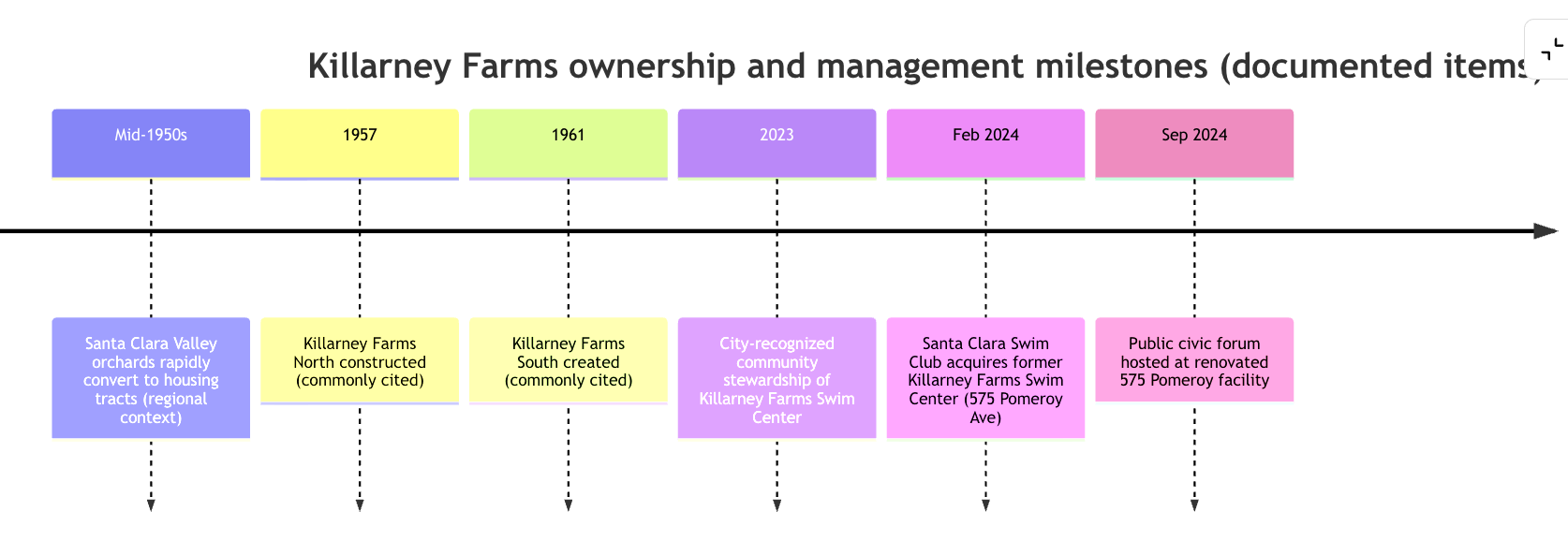
(“1957” and “1961” dates above reflect the commonly cited development timing in local neighborhood histories; “2023–2024” milestones are documented in civic/aquatics reporting.)
Conservation and environmental practices
No neighborhood-specific conservation program (e.g., a formal land trust, conservation easement, or designated ecological preserve) was identified for Killarney Farms in the reviewed official and archival sources; therefore, Killarney Farms’ conservation/environmental practices are unspecified at the neighborhood-brand level.
Historically, the best-supported environmental “throughline” is the large-scale conversion of orchard landscapes to housing tracts across the Santa Clara Valley in the mid‑20th century, which frames Killarney Farms as part of a wider land-use transformation rather than a conservation project.
Current status
Killarney Farms is a mature, built-out residential area. Current public descriptions emphasize that housing stock is largely established and mid‑century, with the neighborhood (often grouped with Briarwood for analytics) characterized as an “urban neighborhood” with high real estate values.
The most material near-term “status change” documented in recent years is the operational shift at the 575 Pomeroy aquatic facility: the former Killarney Farms Swim Center is now functioning as the Santa Clara Swim Club Swim School (“Pomeroy Pool”) with expanded program offerings and community swim access; this change is corroborated both by the aquatics foundation’s acquisition summary and the swim club’s published programming description.
Represented by Eric Boyenga and Janelle Boyenga of Compass, the Boyenga Team brings a refined, data-driven approach to Silicon Valley real estate—blending market intelligence with elevated presentation and strategic negotiation.
As Luxury Home Experts, their approach goes beyond simply listing homes. They engineer outcomes.
From pre-market positioning and targeted exposure strategies to precision pricing and high-level negotiation, Eric and Janelle guide clients through every step with clarity and confidence. Their experience across mid-century neighborhoods like Killarney Farms—and the broader luxury market—allows them to identify opportunities others miss and protect value at every stage of the transaction.
Whether representing buyers or sellers, their focus remains the same:
maximize value, minimize risk, and deliver a seamless, results-driven experience.