
Koreatown / El Camino Corridor, Santa Clara: A Property Nerds Neighborhood Spotlight
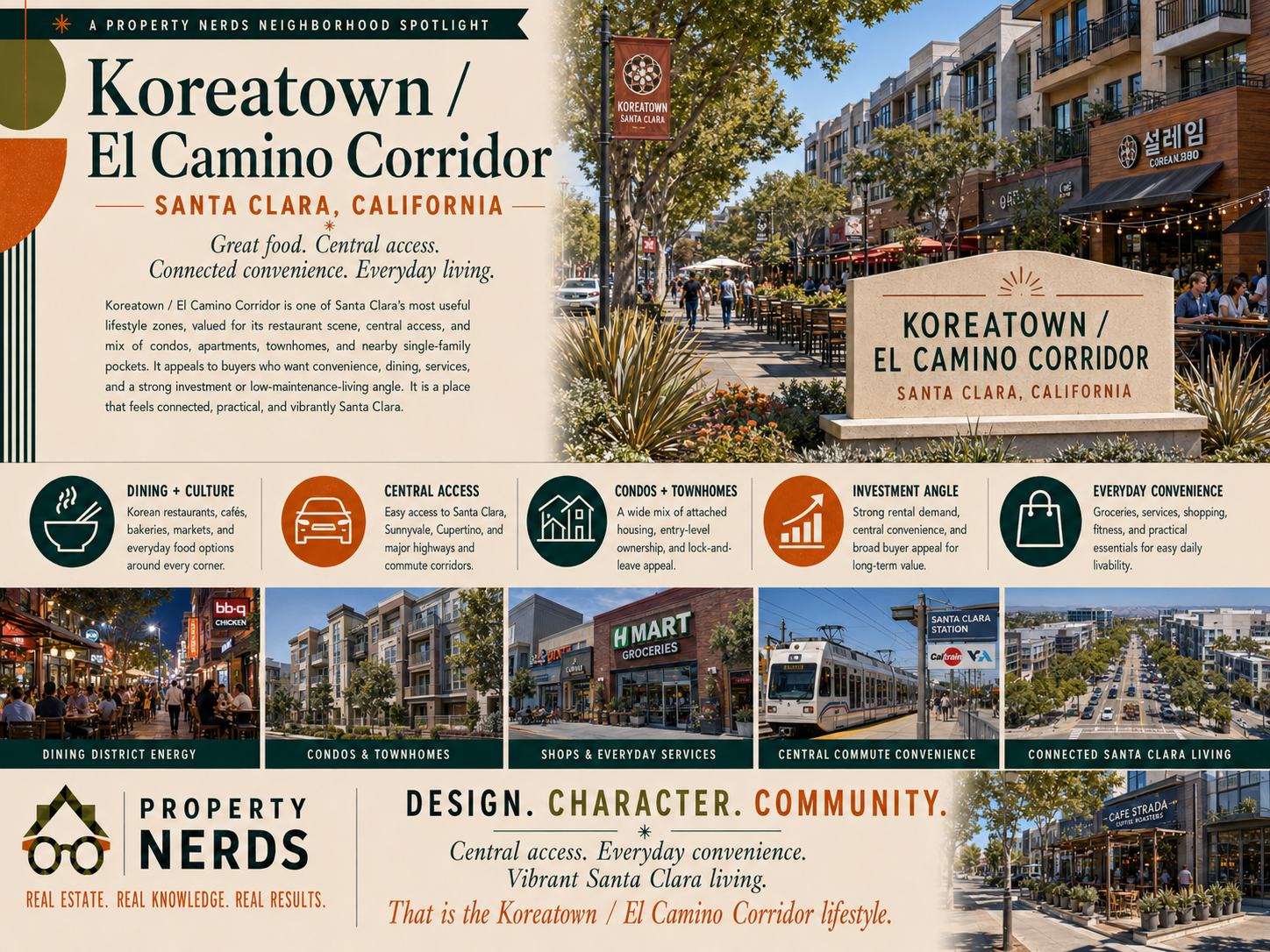
Koreatown / El Camino Corridor is one of Santa Clara’s most important lifestyle corridors — even if it does not behave like a “classic neighborhood” in the single-family-home sense.
This is not Old Quad’s historic bungalow-and-Victorian charm. It is not Rivermark’s newer master-planned community. It is not Central Park / Westwood Oaks’ ranch-home and park-centered lifestyle. It is not Santa Clara Woods’ established suburban calm.
Koreatown / El Camino Corridor is different.
It is a restaurant corridor. A service corridor. A transit corridor. A rental corridor. A condo and townhome corridor. A daily-life corridor. A place where Santa Clara’s residential, commercial, cultural, and commute patterns overlap.
For buyers who want central access, restaurant density, services nearby, transit routes, lower-maintenance housing, and potential investment logic, the El Camino Real corridor deserves a serious look.
Very Property Nerds. Very next-gen. Very “corridors are not neighborhoods, but they absolutely shape value.”
The Koreatown / El Camino Corridor Vibe
Koreatown / El Camino Corridor has a more urban, mixed-use, commercial-residential feel than many of Santa Clara’s quieter single-family neighborhoods.
This is not a tucked-away residential pocket. It is a working corridor. El Camino Real has always been one of Santa Clara’s major movement routes, and along it you find restaurants, markets, services, apartments, condos, townhomes, hotels, small businesses, retail centers, and nearby single-family streets.
The Koreatown identity adds an important cultural and lifestyle layer. Buyers and renters who value restaurant access, international markets, cafes, services, and a more active daily environment may find this area appealing.
The neighborhood feel changes quickly by exact address. A condo facing a busy stretch of El Camino Real is a very different living experience from a townhome tucked just off the corridor or a single-family home a few blocks away. That is why this area requires micro-location analysis.
The Property Nerds rule: corridor real estate is block-by-block, building-by-building, and exposure-by-exposure.
Why Buyers Like Koreatown / El Camino Corridor
Buyers are drawn to Koreatown / El Camino Corridor because it offers access and activity.
The strongest buyer drivers include:
Restaurant access
Korean dining and cultural identity
El Camino Real services
Central Santa Clara location
Transit-corridor convenience
Condos, townhomes, apartments, and nearby single-family homes
Potential lower-maintenance ownership
Investor appeal depending on property type and rental rules
Commute access to Santa Clara, Sunnyvale, San Jose, Cupertino, and Mountain View
Shopping and daily errands nearby
Santa Clara utility and ownership advantages
Rental demand from tech workers, students, and central-location renters
This area can be especially attractive to buyers who do not need the quietest street or largest yard. They may prefer walkable or drive-easy access to food, services, transit, and commute routes. They may want a condo or townhome that keeps maintenance manageable. They may be investors looking for central location and tenant demand.
The Next-Gen Agent read: Koreatown / El Camino Corridor is an access-and-amenity play.
It is not about suburban seclusion. It is about being close to the action.
The Housing Stock
The El Camino Real corridor offers a different housing profile from Santa Clara’s classic ranch-home neighborhoods.
Buyers may encounter:
Condominiums
Townhomes
Apartments
Mixed-use residential properties
Smaller residential communities
Older single-family homes nearby
Duplexes or small multifamily properties
Investor-oriented residential assets
Lower-maintenance housing options
Homes with central Santa Clara access
Properties with rental-demand potential
This is a product-type-sensitive area.
A condo on El Camino Real is not the same strategy as a townhouse one block off the corridor. A nearby single-family home may attract a different buyer pool than an apartment-style condo. A duplex may be valued more for rental performance than owner-occupant lifestyle.
From a Property Nerds perspective, buyers should first define what they are buying:
Lifestyle condo?
Lock-and-leave townhome?
Single-family home near the corridor?
Rental property?
Duplex?
Long-term land play?
Value alternative to quieter neighborhoods?
The answer changes everything.
Condos and Townhomes
Condos and townhomes are especially relevant in Koreatown / El Camino Corridor.
For buyers who want central Santa Clara access without the cost or maintenance of a detached single-family home, this area can offer useful options.
Condo and townhome buyers should evaluate:
HOA dues
HOA reserves
Insurance structure
Exterior maintenance responsibility
Roof and building envelope responsibility
Parking and guest parking
Storage
EV charging access
Noise exposure
Window quality
Unit orientation
Rental restrictions
Short-term rental restrictions
Pet rules
Special assessments
Litigation
Owner-occupancy ratios
Financing eligibility
Community management quality
Long-term resale audience
The Property Nerds rule: in corridor housing, the building matters as much as the location.
A well-positioned unit in a strong HOA can be a smart purchase. A noisy unit with weak reserves, poor parking, or restrictive rules may not perform the same way.
Apartment and Rental Demand Logic
The El Camino Real corridor may appeal to investors because of its central location, restaurant access, services, transit routes, and proximity to major employment centers.
Potential renter profiles may include:
Tech workers
Santa Clara University-connected renters
Service-industry workers
Relocation renters
Corporate renters
Students or young professionals
Households wanting central access without single-family-home pricing
Renters who prioritize restaurants, transit, and commute convenience
But investment appeal depends on numbers and rules, not vibes.
Investors should evaluate:
Actual rent comps
Tenant demand by unit type
Lease structure
Vacancy assumptions
Turnover costs
Insurance
Financing costs
Property taxes
HOA rental restrictions, if applicable
Local rental regulations
Maintenance reserves
Parking
Noise exposure
Unit condition
Capital expenditure needs
Exit strategy
The Next-Gen Agent read: a corridor can create demand, but underwriting creates the investment.
Restaurant and Lifestyle Access
The biggest lifestyle advantage of Koreatown / El Camino Corridor is access to restaurants and services.
For buyers who value food, convenience, and everyday energy, this area can be much more compelling than quieter neighborhoods where every errand requires a separate drive.
Lifestyle drivers may include:
Korean restaurants
Cafes
Markets
Bakeries
Casual dining
Retail services
Fitness and wellness options
Medical and dental offices
Auto services
Everyday errands
Nearby shopping corridors
This is the kind of area where buyers may trade quiet for convenience.
That trade-off can be smart if it matches the buyer’s lifestyle.
The Property Nerds takeaway: lifestyle value is not always a park or a school. Sometimes it is the ability to get dinner, groceries, coffee, and services without crossing the city.
El Camino Real as a Value Corridor
El Camino Real is one of the defining corridors of Santa Clara and the broader Peninsula / South Bay.
In Santa Clara, it functions as a major commercial, transit, and residential edge, connecting residents to San Jose, Santa Clara, Sunnyvale, Mountain View, Palo Alto, and beyond.
For real estate, corridors create both opportunity and friction.
Potential advantages include:
Central access
Restaurant and service density
Transit routes
Mixed housing options
Rental demand
Visibility for commercial uses
Lower-maintenance housing choices
Relative value compared with quieter single-family neighborhoods
Potential trade-offs include:
Traffic noise
Road exposure
Parking pressure
Less residential calm
Commercial adjacency
Pedestrian safety concerns
Building-by-building quality differences
More variable resale audience
The Next-Gen Agent read: corridors are not automatically good or bad. They are high-information environments.
The buyer who understands exposure, access, noise, parking, and product type has the advantage.
Central Santa Clara Access
Koreatown / El Camino Corridor benefits from central Santa Clara positioning.
Residents can reach Santa Clara University, Old Quad, Central Park-area amenities, Sunnyvale, San Jose, Santana Row / Valley Fair, and major employment corridors depending on exact location.
Nearby access drivers may include:
El Camino Real
Lawrence Expressway
San Tomas Expressway
Bowers Avenue
Kiely Boulevard
Scott Boulevard
The Alameda
Central Expressway
Highway 101
Interstate 880
Highway 280
Caltrain access depending on station and exact address
This centrality supports both owner-occupant and investor demand. Buyers can move in several directions for work, school, restaurants, shopping, and services.
The Property Nerds rule: central access is flexibility, and flexibility supports long-term relevance.
Commute and Silicon Valley Access
Koreatown / El Camino Corridor can be practical for buyers and renters commuting across Santa Clara, Sunnyvale, San Jose, Cupertino, Mountain View, North San Jose, and Palo Alto.
Major employment destinations in the broader commute conversation include:
Nvidia
Intel
Applied Materials
Apple
Google
LinkedIn
Cisco
Adobe
Santa Clara University
San Jose employers
Sunnyvale employers
Mountain View employers
North San Jose employers
Palo Alto employers
Key commute routes may include:
El Camino Real
Lawrence Expressway
San Tomas Expressway
Bowers Avenue
Scott Boulevard
Central Expressway
Highway 101
Interstate 880
Highway 280
Highway 237
The Alameda
Caltrain access depending on exact location
For investors, commute access supports renter demand. For owner-occupants, it supports weekday quality of life.
The Property Nerds rule: test the commute from the exact address, not the corridor name.
Nearby Single-Family Pockets
One of the important things to understand about Koreatown / El Camino Corridor is that the corridor itself is not the whole story.
Nearby residential pockets may include single-family homes, older ranch homes, duplexes, townhomes, or quieter side streets. These can appeal to buyers who want access to the restaurants and services of El Camino Real but prefer to live just off the main road.
That “near but not on” positioning can be powerful.
Buyers may want:
Restaurant access without direct traffic exposure
Central convenience with a quieter street
A single-family home near transit and services
A duplex or small multifamily property with rental appeal
A townhome with better noise protection
A condo with easier access to dining and commute routes
The Property Nerds takeaway: the best corridor-adjacent properties often capture the upside of access while minimizing the downside of exposure.
Schools and Districts
School assignment is an important part of the Koreatown / El Camino Corridor buyer conversation, and buyers should verify every assignment by exact property address.
Santa Clara has multiple school boundaries, and corridor location alone does not guarantee school placement. Buyers should confirm elementary, middle, and high school assignments directly with the applicable school district and official locator tools before relying on any school information.
For school-focused buyers, the Property Nerds rule is simple:
Verify by exact address. Verify directly. Verify early.
School enrollment, attendance boundaries, program eligibility, and availability can change. Buyers should confirm all school information directly before making a purchase decision.
This is especially important in mixed-product areas where nearby condos, apartments, townhomes, and single-family homes may all have different buyer profiles and resale audiences.
Owner-Occupant Strategy
For owner-occupants, Koreatown / El Camino Corridor can work well when the buyer wants convenience, restaurant access, and central location more than quiet suburban seclusion.
Owner-occupants should evaluate:
Noise exposure
Parking
Unit orientation
Building quality
Street position
Walkability
HOA health, if applicable
Private outdoor space
Storage
Security
School assignment
Commute route
Proximity to restaurants and services
Long-term resale audience
The strongest owner-occupant purchases usually offer the right balance of access and livability.
A condo directly on a busy corridor may work well for one buyer and feel too exposed for another. A townhome set back from El Camino may offer a better balance. A single-family home a few blocks away may capture the lifestyle upside while providing more privacy.
Investor Strategy
For investors, the El Camino Corridor can be relevant because of rental demand, central access, and housing variety.
Investor-friendly factors may include:
Restaurant and service access
Transit corridor location
Proximity to employment centers
Santa Clara University access
Condo and apartment renter demand
Tech-worker demand
Lower-maintenance property types
Central location
Potential long-term redevelopment or land-use evolution in some areas
But investors should be disciplined.
Important investor questions include:
What is the realistic rent?
What is the vacancy risk?
What are the HOA rental rules?
Are short-term rentals prohibited?
What are the monthly expenses?
Is parking adequate?
Is the unit noisy?
Is the building financeable?
Are reserves strong?
What future repairs are likely?
What is the exit strategy?
Who is the likely resale buyer?
The Property Nerds rule: corridor investments need numbers, not assumptions.
Koreatown / El Camino Corridor Versus Old Quad
Old Quad / Downtown Santa Clara is the city’s historic character-home pocket, with bungalows, Victorians, cottages, Santa Clara University, Mission Santa Clara, Franklin Square, and walkability.
Koreatown / El Camino Corridor is more commercial, restaurant-driven, mixed-use, and product-diverse. It may offer stronger food and service access but less historic residential charm.
Old Quad is history and soul.
Koreatown / El Camino Corridor is restaurants, access, and mixed-use energy.
Both can appeal to buyers who want central Santa Clara, but the lifestyle experience is very different.
Koreatown / El Camino Corridor Versus Mission Park / Mission Gardens
Mission Park / Mission Gardens is central, university-adjacent, and mixed-product, with older homes, condos, apartments, and investor appeal.
Koreatown / El Camino Corridor is more restaurant-and-service-driven, more corridor-oriented, and more directly shaped by El Camino Real.
Mission Park / Mission Gardens is SCU-adjacent central flexibility.
Koreatown / El Camino Corridor is cultural, commercial, and corridor access.
Both can work for investors and owner-occupants, but the demand drivers differ.
Koreatown / El Camino Corridor Versus Bowers / Bowers Park Area
Bowers / Bowers Park Area is commute-functional, with access to Bowers Avenue, Central Expressway, San Tomas Expressway, Highway 101, and major employment centers.
Koreatown / El Camino Corridor is more lifestyle-corridor-oriented, with restaurants, services, transit routes, condos, apartments, and mixed-use convenience.
Bowers is commute access and relative value.
Koreatown / El Camino Corridor is restaurant access and central mixed-use living.
The better fit depends on whether the buyer prioritizes employment-grid access or daily lifestyle amenities.
Koreatown / El Camino Corridor Versus Central Park / Westwood Oaks
Central Park / Westwood Oaks is classic Santa Clara: ranch homes, Central Park, Central Park Library, International Swim Center, shopping, and family-friendly residential streets.
Koreatown / El Camino Corridor is more urban, mixed-use, and condo/townhome friendly. It may offer stronger restaurant access and more rental logic, but less classic single-family neighborhood feel.
Central Park / Westwood Oaks is park-centered ranch-home living.
Koreatown / El Camino Corridor is corridor convenience and mixed housing.
The buyer profile is different.
Koreatown / El Camino Corridor Versus Rivermark
Rivermark is newer, master-planned, and Northside tech-oriented, with retail, parks, school, library, condos, townhomes, and detached homes.
Koreatown / El Camino Corridor is older, more central, more restaurant-driven, and less master-planned. It may offer a more organic urban corridor feel and a wider range of older and mixed housing options.
Rivermark is planned-community convenience.
Koreatown / El Camino Corridor is cultural-corridor convenience.
Both appeal to buyers who want amenities, but the texture is different.
Buyer Trade-Offs
Koreatown / El Camino Corridor can be compelling, but buyers should be clear-eyed.
Because this is a corridor area, some properties may have traffic noise, limited parking, commercial adjacency, apartment density, less privacy, or less residential calm. Some condos or townhomes may have HOA concerns. Some investor properties may look appealing but require deeper financial review. Some side-street homes may offer better livability than properties directly on El Camino Real.
Important buyer questions include:
Is the property directly on El Camino Real or set back?
What is the noise profile?
How is parking?
Is guest parking adequate?
What is the exact property type?
If HOA, what are dues, reserves, insurance, and rental rules?
If investment, do rents and expenses actually work?
What is the exact school assignment?
How walkable are restaurants and services from the exact address?
How safe and comfortable are the walking routes?
How does the commute work at peak times?
Is the building financeable?
Are there special assessments?
How does the property compare with Old Quad, Mission Park / Mission Gardens, Bowers, Central Park / Westwood Oaks, and Rivermark alternatives?
The best Koreatown / El Camino purchase is not simply the most convenient. It is the property where location, exposure, parking, HOA, condition, rentability, and resale all align.
Why Koreatown / El Camino Corridor Holds Buyer Interest
Koreatown / El Camino Corridor holds buyer interest because it offers a flexible Santa Clara package:
Restaurant access
Korean dining and cultural identity
El Camino Real services
Central Santa Clara location
Transit-corridor convenience
Condos, townhomes, apartments, and nearby single-family pockets
Owner-occupant appeal
Investor appeal
Commute access
Rental-demand potential
Santa Clara city and utility advantages
In Silicon Valley, lifestyle corridors matter.
They may not always look like traditional neighborhoods, but they shape where people eat, shop, rent, commute, and live. Koreatown / El Camino Corridor is one of Santa Clara’s most important examples of that.
It is not classic Santa Clara in the ranch-home sense.
It is Santa Clara in motion.
The Property Nerds Take
Koreatown / El Camino Corridor is one of Santa Clara’s most important lifestyle-and-investment corridors.
It is best for buyers who want restaurant access, central convenience, transit routes, condos, townhomes, apartments, and a stronger investment angle than some single-family-only neighborhoods. It is especially relevant for owner-occupants who value food and services nearby, and investors who are willing to analyze the actual numbers, rules, building quality, parking, and rentability.
The key is micro-location and product-level diligence. Study noise. Study parking. Review HOA documents. Verify schools. Evaluate rental rules. Walk the exact route to restaurants and services. Test the commute. Compare direct-corridor exposure with quieter nearby side streets.
The Next-Gen Agent read is simple: Koreatown / El Camino Corridor is not a classic neighborhood. It is a value corridor.
For the right buyer, that corridor energy can be exactly the opportunity.
Work With the Boyenga Team at Compass
Eric and Janelle Boyenga of the Boyenga Team at Compass bring a Property Nerds approach to Santa Clara and Silicon Valley real estate. Their guidance focuses on the details that actually influence value: property type, corridor exposure, HOA structure, rental potential, school boundaries, commute patterns, neighborhood positioning, buyer demand, and long-term resale fundamentals.
As Silicon Valley real estate leaders and recognized experts in luxury, Eichler, mid-century modern, and architecturally significant homes, Eric and Janelle understand that Santa Clara is not one market. A condo on El Camino Real requires different analysis than an Old Quad bungalow, a Mission Gardens investment property, a Rivermark townhome, a Central Park ranch home, or a Santa Clara Woods single-family residence.
For sellers, the Boyenga Team provides strategic preparation, elevated marketing, neighborhood storytelling, and sophisticated positioning designed to reach owner-occupants, investors, tech professionals, relocation buyers, condo buyers, townhome buyers, and Santa Clara lifestyle buyers. For buyers, they offer local intelligence, property-level analysis, and experienced representation in one of the Bay Area’s most competitive housing markets.
To learn more about Koreatown / El Camino Corridor or compare Santa Clara’s best neighborhoods and lifestyle zones for your goals, connect with Eric and Janelle Boyenga and the Boyenga Team at Compass.