
Forest Park, Santa Clara – Silicon Valley’s Quiet Suburban Oasis
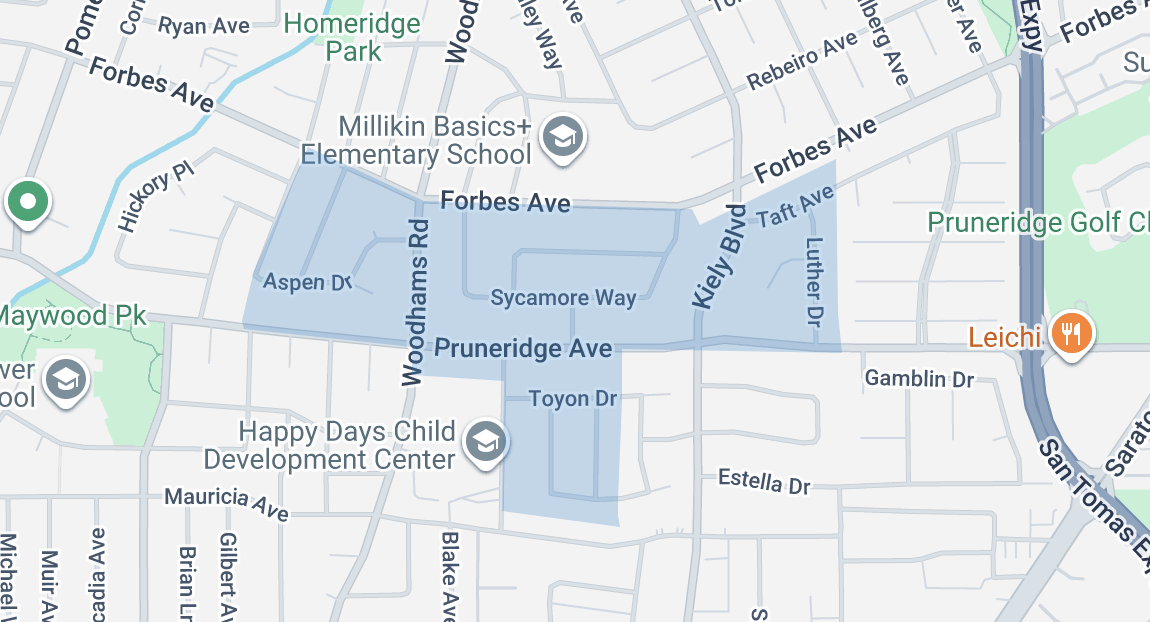
Nestled in the southwest corner of Santa Clara (ZIP 95051), Forest Park is a mid-century suburban enclave prized for its “quiet, tree-lined” streets and proximity to Silicon Valley’s tech hubs. Developed in the early 1960s by homebuilder John Mackay, the neighborhood’s stock of single-story ranch homes on generous 6,000+ sq ft lots exudes timeless charm. Forest Park blends a relaxing, family-friendly atmosphere with an enviable location: it sits minutes from Apple’s Cupertino campus, the Stevens Creek retail corridor, and major freeways. This unique mix of serene living and instant access to tech jobs and shopping keeps demand high. Indeed, Redfin data show that Bay Area buyers – especially San Franciscans seeking more space – are flocking here. The Boyenga Team, Silicon Valley luxury real estate experts, consistently highlights Forest Park’s long-term upside for value and location-minded buyers.
Historical Development of Forest Park
Forest Park’s history begins in the postwar boom. In the early 1960s, developer John Mackay carved several residential blocks off Woodhams Drive and Pruneridge Avenue. His vision was a classic mid-century tract: sprawling single-story ranches with 3–4 bedrooms, 2 baths, and attached two-car garages. These homes typically measured about 1,250–1,500 sq ft and sat on large 6,000+ sq ft lots. (Several corner lots reached 10,000+ sq ft.) Foundations were poured either as slab-on-grade with radiant heating or raised with forced-air systems, but all featured low-slope roofs and integral gutters.
Over the decades, Forest Park remained architecturally cohesive but not static. Many original homes have been modernized or expanded. Homeowners opened up kitchens into adjacent family rooms, added master suites and second floors, and finished attics. A number of 1960s ranches have undergone full remodels – and a few have been torn down for brand-new construction – to suit today’s luxury tastes. (Zoning in Forest Park is traditional single-family [“R1”], so lots remain single-family parcels.) These transformations balance the tract’s mid-century character with fresh amenities. While the streetscape still reads as “classic ranch,” the interiors now boast chef’s kitchens, spa baths, and high ceilings in many cases. Even as floorplans evolve, the neighborhood footprint has stayed largely intact, preserving its organized street layout.
Architectural Character & Housing Inventory
Forest Park showcases Santa Clara’s quintessential mid-century ranch style, with a few contemporary twists:
Classic Ranch-Style Homes: Most houses are the original one-story ranch (3–4 beds, 2 baths, about 1,200–1,500 sq ft). These feature open living/dining rooms, sliding patio doors and picture windows overlooking large backyards. Slab or raised foundations were used; ceiling heights are generally 8–9 ft.
Expanded and Remodeled Homes: Many owners have enlarged homes to meet modern needs. Common expansions include second-story additions or ground-floor extensions adding 1–2 beds and baths. These expanded plans often reach 2,000+ sq ft (e.g. 4–5 bedrooms).
Contemporary New Builds: A handful of tear-downs have made way for fully custom modern homes. These new constructions bring two-story layouts, luxury finishes and sometimes accessory dwelling units, while taking advantage of the same large lots.
Typical floor plans start around 1,200 sq ft for an original 3 bed/2 bath home, and stretch to 2,000+ sq ft after additions. With nearly all lots ≈6,000 sq ft or larger, homes often include spacious yards, patios, and in rare cases, private pools. The appeal of single-story living endures here: first-time buyers and downsizers alike value the ease of one-level layouts. At the same time, families prize the neighborhood’s remodel potential: virtually any house can be updated or rebuilt on these large lots. In sum, Forest Park’s inventory spans modest ranches up to full-blown executive estates, blending original mid-century charm with modern upgrades.
Demographics & Socioeconomics
Forest Park is a small, affluent community. The tract comprises just a few blocks – roughly 80–100 homes – home to about 1,000 residents. NeighborhoodScout calls it “one of the wealthiest communities in the nation,” noting that only about 4% of U.S. neighborhoods are richer. Reflecting Silicon Valley’s economic profile, household incomes here are well above average (Santa Clara’s median is around $179K, and Forest Park skews higher). Most adults hold college or advanced degrees, with many employed in tech, engineering, healthcare or executive roles. It’s common to find dual-income tech families – Apple, Nvidia, Cisco, and Meta employees, for example – in Forest Park.
While specific Census data for Forest Park aren’t published, community info sites note a strong owner-occupancy rate. Almost all homes are owner-occupied single-family residences (rental homes are very rare). The population is culturally diverse, in line with Santa Clara’s makeup (the city is roughly 50% Asian and 30% White); many residents trace roots to India, China, and other Asian countries. The vibe is family-oriented: Nextdoor locals list “community, dog-friendly, family-friendly, quiet” among Forest Park’s top attributes.
Demographic trends are dynamic. Buyers from pricier Bay Area cities – especially San Francisco and the Peninsula – have been moving in, lured by Forest Park’s combination of school-district advantage and relatively lower cost per square foot. (Redfin reports San Francisco as the top originating metro for homebuyers targeting Forest Park.) Many San Jose tech professionals and even some Silicon Valley newcomers consider Forest Park “affordable Silicon Valley” real estate, compared to neighboring markets like Sunnyvale or Cupertino.
Schools and Education
Forest Park lies within the Cupertino Union School District (CUSD), which is a major draw for families. Assigned public schools are highly rated: Dwight D. Eisenhower Elementary (K–5) and Warren E. Hyde Middle (6–8) are just minutes away, and students then feed into Cupertino High School (Fremont Union High School District). These schools boast excellent test scores and college prep programs; for example, Hyde Middle and Cupertino High both earn a 10/10 on GreatSchools, while Eisenhower Elementary is above average (7/10). Such strong public schools – unusual for a neighborhood just outside Cupertino – significantly bolster home values and demand.
In addition, Forest Park families have nearby private schooling options. Santa Clara itself has a few private K–8 choices (e.g. St. Justin Catholic School and Santa Clara Christian School). Top-rated Bay Area high schools like St. Francis (Mountain View), Archbishop Mitty (San Jose), and others are within a reasonable commute. For higher education, Santa Clara University (just a few miles east) is practically next door, while Stanford University is under 15 miles away. Access to premier schools at all levels underscores Forest Park’s appeal to educated professionals and contributes to the neighborhood’s solid real estate fundamentals.
Lifestyle and Local Amenities
Forest Park offers a balanced lifestyle of suburban leisure and convenience. Within the neighborhood, residents enjoy walking-distance amenities: the Forest Park Cabana Club (a private swim club), Homeridge Park (playground, sports fields) and Maywood Park are all nearby. These green spaces, plus quiet cul-de-sacs, create a friendly, community feel where neighbors know each other and kids play safely. The area is notably walkable for errands: minutes away on El Camino Real and Monroe Street are everyday shops and casual eateries (coffee shops, taquerias, etc.). A Farmers Market operates several times a month at nearby City Hall or parking lots, giving further “small town” charm.
For broader shopping and dining, Forest Park is superbly positioned. The famous Westfield Valley Fair Mall and Santana Row are only a 5–10 minute drive (via Stevens Creek Blvd), providing world-class retail and restaurants. Local retail centers like the Winchester Plaza (Trader Joe’s, Starbucks) and Rivermark Village (breakfast spots, wine bars) are also minutes away. In short, residents can easily get upscale Valley Fair/Santana Row experiences or more casual neighborhood vibes.
The community appeals equally to families and professionals. Young families appreciate the parks, highly-rated schools and multi-bedroom homes. Remote tech workers like the convenience of fiber internet and quiet yards for home offices. In fact, many residents point to the blend of “affordable Silicon Valley location”, quality local schools, and large lots as the reason they chose Forest Park. Walkability is modest (it’s a suburb), but the sense of community and safe streets more than compensate.
Commuting & Tech Employer Access
Forest Park is centrally sited for Silicon Valley commuting. Major tech employers are within easy reach: Apple Park (Cupertino) lies 2–3 miles west on Stevens Creek; NVIDIA and Intelhave corporate offices within 5 miles north in Santa Clara; Google/Mountain View is about 10 miles west; Meta/Sunnyvale and Cisco are around 6–8 miles away. Highway access is excellent: Route 280 and 880 are just a few minutes’ drive north (via Lawrence Expressway or Monroe), while US 101 is to the east. Lawrence Expressway and Highway 237 in nearby Milpitas provide quick north-south alternatives.
Public transit options include the Caltrain commuter rail: the nearest station is Sunnyvale’s Lawrence/US 101 stop (a short drive) or Santa Clara/University station near Levi’s Stadium. VTA local buses run on El Camino and along Pruneridge/Woodhams corridors, connecting to light rail. For example, a commuter can reach Mountain View (for Google) or downtown San Jose via light rail in about 30–40 minutes. The neighborhood’s proximity to Mineta San Jose Airport (10 minutes via 880/87) is a bonus for frequent flyers. In summary, the area’s multiple transit routes and highway links make Forest Park very well-connected for South Bay professionals.
Real Estate Market Analysis
Forest Park’s housing market has been strong and appreciating. As of early 2026, Redfin reports a median sale price of roughly $2.1 million in the Santa Clara Southeast area (which includes Forest Park). Homes here tend to sell quickly and above list: most Forest Park homes go pending in about 12 days and fetch ~105–106% of list price. The median price per square foot in the area is about $1,100, up roughly 50% year-over-year, reflecting surging demand. (Top-tier remodeled homes, like the one at 299 Manzanita, can exceed $1,600/sq ft.) Days on market have generally stayed low (often under 15 days for well-priced homes). Inventory is limited: only a handful of listings are active at any time, contributing to regular multiple-offer scenarios for renovated or well-priced properties.
Over the past decade, Forest Park home values have climbed steadily, roughly in line with Silicon Valley trends (on the order of 4–5% annual appreciation before 2020, and an acceleration post-pandemic). Compared to adjacent areas, Forest Park remains a relative value. For example, average prices in Cupertino or Los Altos are typically 20–30% higher per sqft. Buyers here tout Forest Park as one of the “more affordable Silicon Valley neighborhoods” that still offers upsize potential. Key demand drivers include the neighborhood’s location and lot sizes: families and investors prize the large lots (6000+ sq ft) which allow for expansions or new builds. The Cupertino schools are a draw (often adding a premium). And tech employers are close by without the price tag of Cupertino or Palo Alto.
Looking ahead, investment potential is strong. The combination of underlying land value (for possible rebuild) and high demand for single-family homes suggests continued appreciation. Even as new luxury tracts emerge, Forest Park’s established setting and mature landscaping give it an enduring appeal. Real estate agents note that “original-condition” homes in Forest Park sell for significantly less than equivalent homes that have been fully modernized. The upgrade gap is a clear opportunity: a house on an 8,000 sq ft lot might sell at ~$1.2M in original state, but similar homes at over $2.5M post-remodel. This gap, combined with the shortage of new home construction in the area, bodes well for sellers who invest in improvements.
Representative Sales & Price Points
Recent sale examples illustrate the range:
459 Kiely Boulevard – A 3-bed, 2-bath, 1,444 sq ft ranch on an 8,470 sq ft lot. It was updated modestly (new kitchen counters, flooring, patio enclosure) and sold in early 2026 for $988,000.
250 Manzanita Avenue – A 4-bed, 2-bath, 1,687 sq ft ranch on a huge 9,775 sq ft lot (corner location). Fully updated kitchen and open living areas, with Cupertino schools, led to a sale price of $1,599,000.
431 Magnolia Lane – A completely renovated “executive” home: 5 bedrooms, 4 baths, 3,628 sq ft on an 11,350 sq ft lot (with pool and dual-master suites). This custom two-story sold at $2,100,000, reflecting its trophy-caliber upgrades.
299 Manzanita Avenue – A fully modernized 4-bed, 2-bath, 1,902 sq ft ranch on 7,705 sq ft. Featuring vaulted ceilings, skylights, smart home features and lush landscaping, it commanded $3,140,000 – one of Forest Park’s highest per-sq-ft sales ($1,650+/sq ft).
These cases highlight the condition gap: the Kiely Ranch, though well-maintained, reflects original size and sold for under $1M. By contrast, high-end remodels with additional square footage are fetching $2–3M. This is typical: well-updated homes see multiple competing offers, while homes “as-is” will sell more modestly. Investors note that adding a second story or gourmet kitchen in Forest Park can easily pay off in sale price, given the lot values.
The Boyenga Team Advantage
Eric and Janelle Boyenga in a luxury Forest Park kitchen (image courtesy of Boyenga Team). The Boyenga Team brings decades of Silicon Valley expertise to Forest Park buyers and sellers. As Compass “Property Nerds” and trusted luxury-market advisors, Eric and Janelle Boyenga analyze neighborhoods like Forest Park with data-driven insight. They are known for a design-forward approach: advising clients on strategic renovations and home staging (using Compass Concierge and top designers) to maximize value.
The Boyenga Team leverages exclusive Compass marketing tools and an elite network. They often identify off-market and coming-soon opportunities that other buyers miss. For Forest Park sellers, Eric and Janelle craft bespoke marketing campaigns highlighting architectural character and lifestyle, attracting high-end buyers. For buyers, they source homes with upside – guiding clients toward properties where a smart remodel or addition can unlock premium prices. In short, the Boyenga Team’s local savvy, luxury focus and analytic rigor ensure their clients make winning moves in Forest Park’s competitive market.