
Agnew, Santa Clara: A Historic Silicon Valley Community
Agnew is a north Santa Clara neighborhood where California heritage meets Silicon Valley vitality. Named after pioneer Abram Agnew – who donated land for a railroad depot in the 1870s – the area evolved from orchards and rail lines into a suburban enclave anchored by the famous Agnews Developmental Center (a state hospital opened in 1889). Today Agnew enjoys a unique blend of architectural styles and housing types, from quaint pre-war ranch houses to sleek new infill townhomes and luxury estates. Its tree-lined streets and parks offer a relaxed, community-focused feel, yet the neighborhood is only minutes from Levi’s Stadium, tech campuses, and major highways. With highly regarded schools and diverse housing options, Agnew appeals equally to local families, high-tech professionals, and investors searching for Silicon Valley value. As The Boyenga Team – local real estate experts in design-driven homes – note, Agnew’s mix of history and growth makes it an irresistible choice for today’s upscale buyers (and sellers) seeking the best of Santa Clara living.
Historical Overview of Agnew
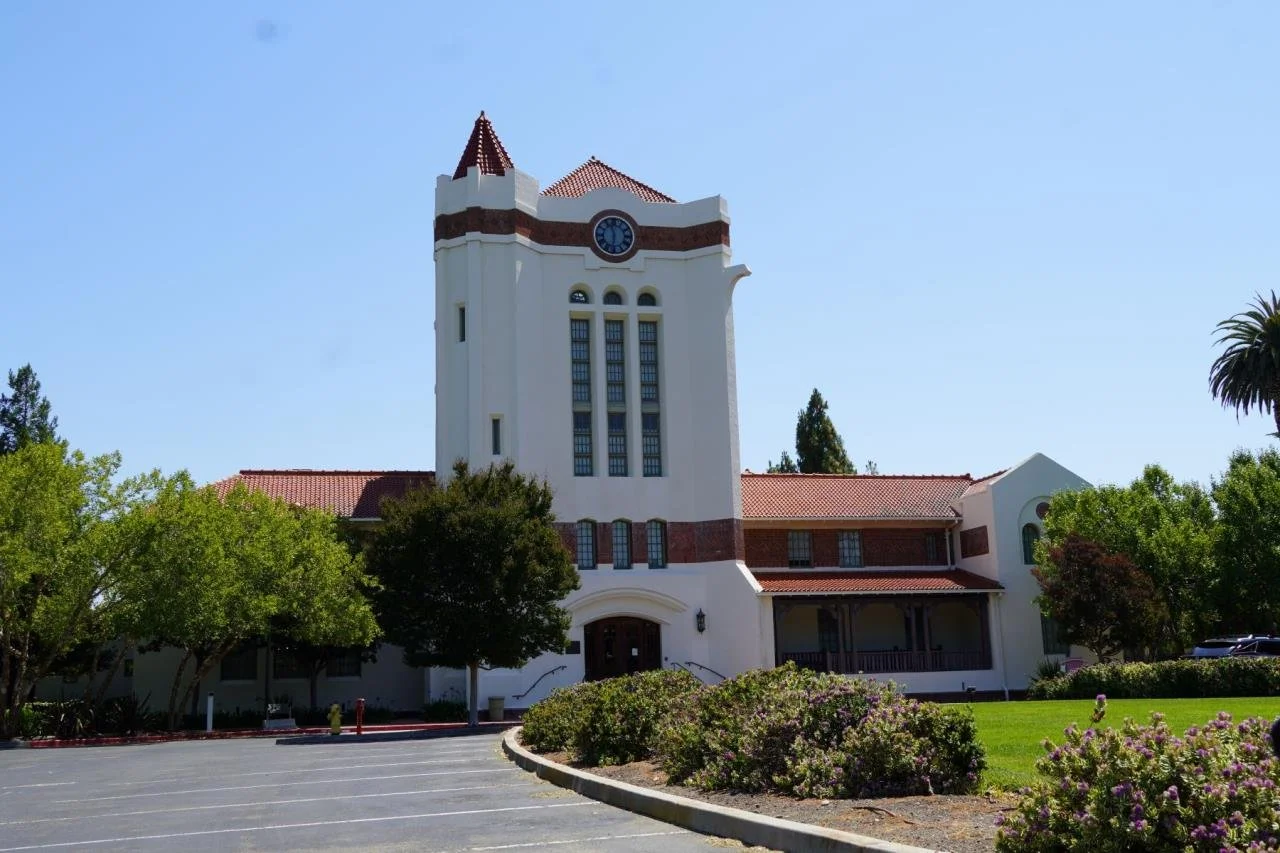
Agnew’s story begins in the 1870s, when Santa Clara Valley was still a patchwork of orchards. Local farmer Abram Agnew donated four acres for a Southern Pacific railroad station in 1878, and the surrounding settlement was named Agnew’s Village. A few years later, in 1889, the California State Legislature opened the new Agnews Residential Facility (“Agnews Asylum”) on farmland east of town. Often called the “Great Asylum,” its Mediterranean-Revival buildings and grand clock tower symbolized the era’s optimism. In 1906 an earthquake devastated the hospital’s original building, killing over 100 patients, and the site was rebuilt on a sprawling cottage-plan campus.
Over the 20th century Agnew remained semi-rural. The surrounding valley land gradually converted from pruned orchards to ranch-style suburban homes after World War II. In the 1970s, state mental health reforms (the Lanterman Act) began closing large institutions. The Agnews State Hospital finally shut down in 1998, and its vast property attracted tech developers. In 2000 Santa Clara approved the Rivermark Master Plan for 1,800+ new homes, parks, a school and retail center on the old west campus. Sun Microsystems (later Oracle) built its Silicon Valley headquarters on the southern portion, renovating the historic clock tower and mansion. By the mid-2000s, Rivermark’s mix of townhouses, condos, and single-family homes had filled in north Agnew, along with new schools and the Rivermark shopping center (featuring a Safeway and eateries).
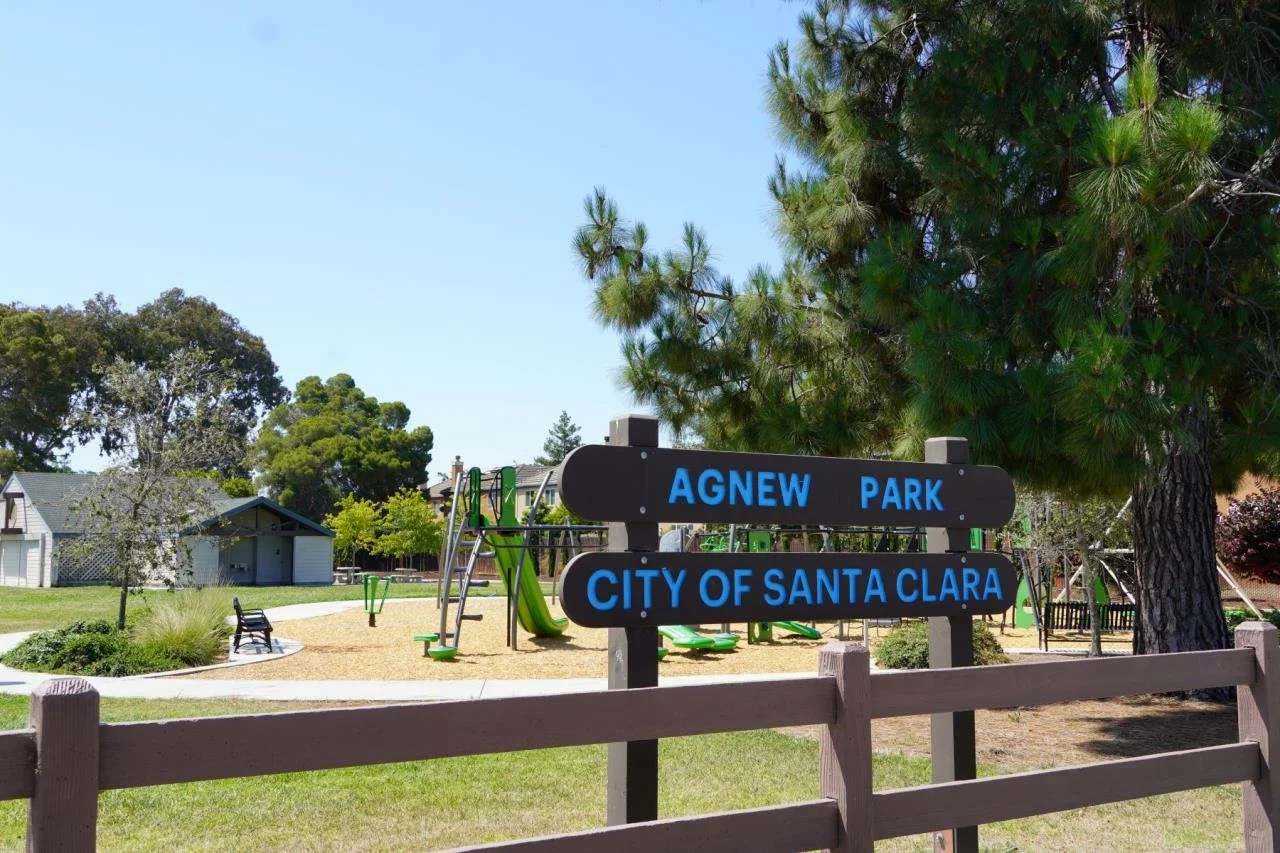
<div>† The *Agnews Historic Park* preserves 14.5 acres of the original hospital grounds, including the restored Director’s Mansion and Auditorium【71†L298-L305】. Nearby *Agnew Park* (on Agnew Road) offers playgrounds, basketball courts and picnic areas【74†L165-L168】, named in honor of the area’s founding family. Together these sites connect Agnew’s mental-health heritage to the high-tech campus around it.
Over time Agnew’s land use has shifted from agriculture to institutional to mixed residential. The neighborhood retains many legacy mid-century homes and modest ranches, even as zoning now allows denser development. Redevelopment trends favor infill and townhomes (especially in Rivermark), while many original homes have been renovated or replaced with modern builds. City preservation efforts (like the Agnews Historic Park) keep Agnew’s past alive, while new construction projects update its streetscapes. The result is a spectrum of older character homes, mid-century Eichler-influenced builds, and brand-new luxury properties, reflecting Santa Clara’s broader evolution.
Architectural Diversity & Housing Inventory
Agnew’s housing is diverse. On the original Agnew streets (east of El Camino Real) and in surrounding blocks, one finds 1950s-era single-family homes: ranch bungalows on ~6,000–8,000 sq ft lots, often ~1,000–1,800 sq ft. Many of these have been updated over time or replaced by slightly larger custom homes. A handful of distinctive mid-century modern and even Eichler-style homes (rare in Santa Clara) add architectural interest in older pockets. South of Agnew Road, the brand-new Agnew Park and Agnew Court developments feature townhouse and condo communities (built in the 2000s) with 2–3 bedrooms, around 1,200–2,200 sq ft, on small attached lots – some as infill behind existing streets.
The Rivermark area (Agnew & Tasman/Garland) introduced contemporary townhome and condo clusters since 2003. These range 1,000–2,500 sq ft and were marketed to tech families and first-time buyers. Separate Planned Communities in Agnew include Bowers Creek and Central Pointe, with mix of condos and townhomes. There are also larger tracts of new single-family homes on quarter-acre lots, built 2010s–2020s, often 2,000–3,000+ sq ft with high ceilings and luxury finishes. Examples include custom infill on Lick Mill/Agnew and new street subdivisions near Central Park.
Today Agnew’s typical home sizes span ~900 sq ft studio condos up to ~3,000+ sq ft custom estates. Older ranches often sat on 0.14–0.18 acres, while new single-family lots can be 0.2+ acres if built as replacements. Multi-family townhome communities have higher density (100–300 units per parcel), whereas mid-century streets average ~4–5 homes per acre. The price segmentation follows this mix: entry-level condos around $600–800K (for 2BR units), townhomes ~$1.2–1.6M, mid-century fixer-uppers ~$1.0–1.4M, and luxury new homes $2M+ (up to $3–4M for custom builds on larger lots).
Layouts in Agnew trends toward open-concept renovations (especially in newly rebuilt homes) and multi-generational features (like separate in-law units). Many buyers perform high-end kitchen/bath upgrades in older homes. Investors have also converted larger lots into two-detached-home infill projects, taking advantage of Santa Clara’s recent duplex/SB9 rules. This architectural diversity drives broad buyer interest: first-time tech employees or families can find smaller condos or mid-range homes, while move-up buyers or executives compete for the new luxury product. Buyers looking for character often snap up well-priced 1960s ranches to modernize, whereas those wanting turnkey design seek fresh townhomes and estates. In short, Agnew’s mix of styles from historic to ultra-modern caters to a spectrum of preferences and budgets, fueling strong demand across the market.
Demographic & Socioeconomic Profile
Agnew (ZIP 95054) is a thriving, affluent neighborhood. Since 2000, its population roughly doubled (from ~13,000 to ~25,000 today), due to new housing and family migration. Households here earn far above the state average: 2023 data puts median income around $202,000. Educational attainment is similarly high – over 70% of adults hold a bachelor’s degree or higher. This aligns with the jobs profile: about 66% of residents work in management, tech or other professional fields. Indeed, Agnew is one of the wealthiest neighborhoods in the Bay Area (cited as wealthier than 98% of U.S. neighborhoods), with home values to match.
The community is very diverse. Over half of residents are of Asian ancestry, and roughly 51% are foreign-born – higher than almost any U.S. neighborhood. Many families have parents who came for engineering and software jobs. Language diversity is high: English is spoken in 43% of homes, but Chinese and languages of India are each common. Despite its affluence, roughly 10% of children live below the poverty line (driven by some lower-income immigrant families), though this is still better than the national average.
Home tenure is split, with many young tech couples starting out as renters in townhouses or apartments, but a significant portion of long-time residents are owner-occupied. The neighborhood appeal to families is strong: nearly half of households have children (49%, above state median). Owner-occupied units often have 3–5 bedrooms, while rentals skew 2–3 bedrooms. Investors have also targeted Agnew: average rents are about $5,760/month (placing Agnew in the top 2% of California for rental cost), reflecting strong demand from tech employees.
Trends influencing Agnew’s demographics include ongoing tech migration into Santa Clara. As cities like Cupertino and Palo Alto outprice many, workers are moving to Santa Clara for new housing like Rivermark. Startups and campus expansions in nearby areas also bring relocation buyers. At the same time, traditional Bay Area families (with roots in Santa Clara’s schools and culture) keep the community grounded. The blend of high incomes, strong education levels, and multicultural character means Agnew attracts both Silicon Valley professionals and upwardly mobile parents. It’s a neighborhood where gated luxury homes sit a few blocks from long-time ranches, uniting diverse socioeconomic groups under one zip code.
Schools & Education Landscape
Families in Agnew benefit from the Santa Clara Unified School District, known for solid but mixed performance. The neighborhood’s public elementary students are zoned to schools like Don Callejon (K-8) and Montague or Hughes Elementary, depending on exact location. Middle-schoolers generally attend Cabrillo Middle or Peterson Middle. For high school, most go to Wilcox High School (for north Santa Clara) or Santa Clara High School, both within a few miles. There are also specialized programs: Mission Early College High (a STEM-focused magnet at Central Park) falls in 95054 and enjoys top-tier rankings.
According to SchoolDigger, Mission Early College (grades 9–12) and Don Callejon (K-8) are Agnew’s standout public schools, with test scores in the top 10–15% statewide. Other elementaries like Montague and Kathryn Hughes perform closer to average, indicating room for improvement. For example, only about 40–60% of students meet proficiency in math and reading at several neighborhood schools. This discrepancy is typical in Silicon Valley, where lottery admissions and tutoring supplement public education. The district’s SARC reports generally describe these schools as safe and family-oriented, with English Learner programs and technology integration.
Private education options abound nearby. Nativity School (a private Catholic K-8) and Santa Clara Preparatory are a short drive away, appealing to families wanting parochial or college-prep environments. The presence of Santa Clara University (just 3–4 miles south) adds another higher-education dimension. SCU’s dorms and programs host college events, and its students often live in nearby apartments. For younger residents, SCU offers access to cultural events (theater, sports) and summer camps, boosting Agnew’s intellectual cachet.
Good school access helps support property values. Homes in Agnew often trade on school ratings. In practice, many local buyers are affluent tech families who highly value nearby schools, and they may pay premiums for addresses zoned to Don Callejon or Wilcox High. Similarly, selling agents emphasize school assignments in marketing. The Boyenga Team notes that Agnew’s mix of zones – some stellar (Don Callejon, Mission Early College) and some average – encourages buyers to “doctor-shop” within the area. Overall, education is a key draw for suburban homebuyers in Santa Clara, and Agnew’s schools play into buyer demand and long-term investment potential.
Neighborhood Lifestyle & Amenities
Living in Agnew means balancing a suburban community feel with Silicon Valley conveniences. The neighborhood streets are quiet and shaded, with block parties and local sports common. Agnew Park (2150 Agnew Rd) is a beloved local spot: it has playgrounds, picnic areas and basketball courts, providing recreation just steps from home. Along Agnews Road and Tasman Dr, the green belt along San Tomas Aquino Creek includes the Creek Trail: a paved path for walking, running and biking that spans several miles. Reach 1 of this trail runs from the San Francisco Bay Trail to Agnew Road, complete with undercrossings of major streets. Neighbors often bike or jog this trail to work or weekend outings. Nearby Central Park (1.5 miles south) offers baseball fields, a library and community center, while Bowers Park and Rivermark Park serve northern areas.
For shopping and dining, Agnew residents have plenty of options. The Rivermark Villageshopping center (at Great America and Tasman) includes a Safeway, yoga studio, restaurants and community plazas. On any given day you’ll find parents at Truett’s Grill or Lazy Dog Café, techies at coffeeshops like Peet’s, and families at Fast-casual eateries. The city’s recently revamped East Santa Clara Business Park (at Montague and Central) offers a small food hall, brewery and boutiques. For more variety, downtown Santa Clara’s restaurants on El Camino and Scott Boulevard (e.g. Birrieria La Unica, Athena Grill, Birk’s Steakhouse) are a short drive. Agnew is also only a few minutes from the famed Santana Row and Valley Fair Mall in neighboring San Jose, giving residents access to upscale retail and nightlife.
Major lifestyle anchors lie just outside Agnew’s borders. Levi’s Stadium and California’s Great America amusement park are essentially at Agnew’s doorstep. Game nights or concerts at the stadium bring energy (and traffic) to the neighborhood; on other days, the stadium’s public plazas offer green spaces and a Whole Foods for commuters. Similarly, California Great America’s family attractions are a short walk for Agnew children. Across U.S. 101, Levi’s Plaza Park provides additional trails and sports fields. For a quick getaway, Shoreline Lake (4 miles north) and the Guadalupe River Trail (5 miles east) give access to sailing, biking and nature.
In short, Agnew offers something for everyone: backyard play for kids (parks and playgrounds), trails for fitness enthusiasts, and a village-like retail center for daily errands. It retains a strong community vibe – neighbors often recognize each other on morning dog walks – but all the amenities of Silicon Valley are within easy reach. For remote professionals, fiber internet is ubiquitous and home offices are common. And because Santa Clara is centrally located, Agnew residents benefit from the conveniences of city life (hospitals, cultural events, a future BART line) without sacrificing neighborhood warmth. This mix of family-friendly and tech-focused lifestyle is precisely why Agnew draws a blend of young families and upwardly mobile professionals.
Commuting & Tech Access
Strategically sited in Silicon Valley’s tech corridor, Agnew offers easy commutes. It sits between major highways: Highway 101 (east-west) borders it to the south, with on/off ramps at Central Expressway; Highway 237 (east-west to the north) is just 2 miles away; and I-880 (north-south) is a 5-minute drive west via Great America Parkway. This network gives Agnew residents swift access to all directions: Google and LinkedIn campuses in Mountain View (~15 miles northwest), Apple in Cupertino (~10 miles southwest on 85), and Intel’s Santa Clara headquarters (3 miles northeast). Local employers like NVIDIA and Cisco are even closer – under 5–10 minutes’ drive on Montague Avenue. East Bay commute routes (880/237) also make Facebook in Menlo Park (~30 miles north) and Tech campuses in Fremont and Milpitas accessible.
Public transit is robust. VTA Light Rail Great America Station (just east of Great America Parkway) serves the Orange/Green lines, connecting north to Mountain View and south into San Jose. VTA bus routes 20 and 59 run through Agnew (stop at Agnew & Mission College) connecting to the Santa Clara Transit Center and Milpitas. The ACE and Capitol Corridor trains stop at Santa Clara/Great America station (about 1.5 miles east), providing commuter rail to Sacramento or San Jose. Notably, Google and Apple operate free shuttles that stop near Agnew (Mountain View/Santa Clara stops) – as one resident quipped, Agnew is less than “5 miles from Google, Apple… all right off 101” (a common sentiment among renters). In addition, Mineta San Jose Airport is just 10 minutes south on 880, making business travel quick.
This connectivity underpins Agnew’s reputation among tech workers. Commuter data reflect that roughly two-thirds of employed adults are in professional roles, many in engineering or management. For families, school commutes are also straightforward: Cabrillo Middle and Wilcox High are reachable by bike or short drive. In short, whether driving or taking public transit, Agnew homes put Silicon Valley’s job centers within comfortable reach (often 20 minutes or less). The neighborhood’s technical-savvy population even boasts unusually high car ownership (over 33% of households have 4+ vehicles) to leverage this freeway network. Agnew’s location and transit options make it an ideal home base for anyone working in the Valley’s tech industries.
Real Estate Market Analysis
Agnew’s housing market has been strong and dynamic. Recent data show a median home sale of about $1.375 million (Feb 2026), roughly one-third lower than Santa Clara’s citywide median (~$1.8–1.9M), but well above North San Jose ($1.02M). Homes here typically trade around $900–950 per sq.ft. The market peaked in 2022 (median >$2.4M) before cooling; in 2025–26 prices have softened ~15–25% year-over-year, reflecting wider Silicon Valley trends. Nevertheless, demand remains high: homes in Agnew are still selling on average 13 days on market, and often receive offers ~3% above list price. Inventory is tight: only a handful of homes sell each month (18 sold in Feb 2026), yet this is actually more transactions than the year prior, suggesting steady buyer interest.
Breaking down by type, single-family homes are the highest-value segment: larger ranches and new builds command medians well over $1.5M–$2M. For example, in Q1 2026, typical single-family house in Agnew sold for around $2.05M. By contrast, townhouses (often 3–4 bed, 1,400–1,800 sq.ft) closed near $1.3M–$1.5M in recent quarters. Condos remain entry-level: 2-bed units 900–1,100 sq.ft sell from ~$650K–$800K in this area. Price per square foot also varies: luxury infill houses top ~$1,200–$1,500/sq.ft, whereas older modest ranches might sell for $800–$900/sq.ft. Overall, Agnew’s pricing places it below high-priced Cupertino/Sunnyvale but above much of North San Jose.
Looking back 5–10 years, Agnew has seen solid appreciation. In early 2016, the median home in 95054 was well under $900K; by 2022 it surged past $2.4M, roughly 7–8% annual growth (nearly doubling) – a performance similar to the rest of Santa Clara County. During the last decade, new construction and rezoning (e.g. infill townhome projects) boosted supply, while constant Silicon Valley job growth kept prices rising. Even with recent market flattening, long-term buyers have fared well: those who bought ten years ago at $700K–$800K have seen their equity multiply. Santa Clara’s overall house median is now ~$2.11M, so Agnew, slightly cooler mid-cycle, still presents an attractive price point for the location.
In terms of market segments, demand is strongest for single-family homes and townhomes. Mid-century ranches (even in need of renovation) often spark bidding wars among move-up buyers who want Agnew’s neighborhood feel. Newer custom homes (with contemporary design) also draw high-end buyers willing to pay $3M+; one recent example is a fully remodeled 5-bed house on Garrity Way at ~$3.1M. Conversely, smaller condos see more modest activity; sales of entry-level units around $700k suggest a steady stream of first-time buyers and investors. Rental demand is strong, too: landlords can ask near $4,000–$5,000 for a 3-bedroom rental in Agnew, making small houses and townhomes attractive to investors.
Compared to nearby markets, Agnew strikes a balance. Its median home price undercuts Sunnyvale ($1.87M) and Central Santa Clara ($1.8M), but sits well above North San Jose (~$1.02M). This means buyers from neighboring Sunnyvale may shop in Agnew for relative bargains on larger yards, whereas North SJ homebuyers see Agnew as upscale. In recent reports, analysts note Santa Clara is stabilizing after a heated market; Agnew’s more moderate pricing has insulated it somewhat, so that sales continue steadily. In the luxury tier, Agnew still gets very high per-sqft comps due to newer builds, keeping it more competitive than many older Southern Peninsula suburbs. All told, most indicators (median days, sale-to-list, rent levels) suggest Agnew remains a seller’s market, though less frothy than 2021–22.
Investment Potential: For investors, Agnew offers diverse opportunities. The neighborhood’s proximity to tech employers and schools ensures high rental demand. With a median rent exceeding Santa Clara’s average, rental yields can be attractive given current prices. The mix of older homes and new condos means investors can choose between flip-ready fixer-uppers or turnkey rental units. Additionally, the steady appreciation over decades (Santa Clara’s house prices ~7% annual) hints at long-term value. Given limited new land, Agnew’s housing shortage should keep property values strong in the long run. In comparison to buying in Palo Alto or Los Gatos, Agnew gives investors access to the same tech job market at lower prices, making it a logical choice for investment property buyers focusing on capital growth and rents.
Case Studies & Example Properties
To illustrate Agnew’s market, consider a few representative sales:
Renovated Mid-Century Home: A 1950s ranch on Silva Place (3BR/2BA, ~1,500 sq.ft) was fully remodeled with an open plan, new kitchen and ADU. It recently sold around $1.25M, after multiple offers. This attracted a family-professional couple who valued the neighborhood schools and yard. The interior’s mid-century bones plus modern upgrades fetched nearly 20% above original list price, showing strong ROI on the renovation.
New Construction Townhouse: On Shore Place (a 2022 development off Agnews), a 3-bed/3.5-bath townhome (~1,650 sq.ft) sold for about $1.4M. Buyers were tech-engineer newlyweds priced out of Palo Alto, seeking a contemporary home. They appreciated the attached 2-car garage, rooftop deck, and smart-home features. Competitive bidding lifted the sale price ~5% over list. This case shows how brand-new product with Silicon Valley design draws premium crowds.
Luxury Infill Estate: A recently built modern luxury home on Lick Mill (5BR/4.5BA, 2,645 sq.ft) commanded $3.1M. This ultra-high-end property featured floor-to-ceiling windows, designer finishes and a private yard. It sold to an executive from Los Gatos, illustrating Agnew’s appeal even to Bay Area traditional markets. The nearby comparable older home was ~$1.8M, so the new construction commanded ~70% more – highlighting the mark-up for luxury in Agnew.
Condo Turnover: A 2BR/2BA condo at Agnew Place (1,070 sq.ft) recently closed at ~$675K, attracting an early-career Google employee. With HOA amenities (pool, gym) and proximity to transit, it represents Agnew’s entry-level segment. Another sold 12 months earlier at $600K, so even the condo market is showing modest appreciation ~10%.
Each scenario shows different buyers and strategies: move-up families chasing community and space, tech couples paying for new modern designs, and professionals valuing turnkey living. Renovation ROI is especially strong: Agnew’s mid-century homes, when updated, can sell for 30–50% above prerehab prices, as design-conscious buyers flood the market. Competitive dynamics are intense: popular houses often see over 10 offers, while more common condos move slowly. The Boyenga Team notes that savvy buyers often pre-visit possible properties and act quickly, and sellers who stage homes expertly tend to maximize bids. Overall, examples demonstrate Agnew’s cross-section: it’s a place where a modest ranch and a $3M estate can literally be neighbors, yet each has its eager audience.
The Boyenga Team Advantage
The Boyenga Team at Compass brings unparalleled local expertise to Agnew. Eric and Janelle Boyenga are veteran Silicon Valley brokers, specializing in luxury and architecturally significant homes. With decades of experience and thousands of homes sold across Santa Clara County, they understand the nuanced appeal of neighborhoods like Agnew. As the team emphasizes: “Experience matters in Silicon Valley real estate” – and they leverage that in every transaction.
The Boyengas uniquely marry design sensitivity with tech-savvy marketing. Known as “Property Nerds,” they have deep knowledge of styles from Eichler/modern to traditional ranch. They use Compass’s data analytics and off-market networks to find Agnew properties before they hit MLS, giving buyers an edge and sellers maximum exposure. For instance, they connect homebuyers to upcoming infill releases in Agnew, and advise sellers on premium renovation touches. Their track record (over $2.3 billion in sales) shows they maximize value for clients across Silicon Valley.
Specifically for Agnew, the Boyenga Team highlights hidden gems: they consult on repositioning older houses to appeal to upscale buyers (e.g. adding modern kitchens or ADUs). They also leverage the team’s Eichler and mid-century niche for marketing Agnew’s vintage homes, attracting heritage-loving buyers. In negotiations, their local savvy shines – understanding Agnew’s buyer pool (tech executives vs. Santa Clara native families) means they can craft targeted strategies. And of course, as Compass founding partners, they use state-of-the-art tools: from immersive video tours for remote Silicon Valley recruiters, to targeted online marketing that reaches inbound tech hires from Seattle/SF.
For affluent buyers, the Boyengas provide concierge-level service: identifying Agnew’s hottest blocks (such as newly renovated enclaves) and arranging off-market previews of jewel-like homes. For sellers, they stage Agnew properties to emphasize both historic charm and modern luxury – for example, by blending period woodwork with contemporary glass accents in staging. Above all, Eric and Janelle position themselves as advisers: their “smarter, strategic approach” ensures Agnew clients navigate a competitive market with confidence.
In summary, choosing Agnew means entrusting one’s real estate goals to The Boyenga Team’s local mastery. Their knowledge of Santa Clara’s best neighborhoods and luxury markets ensures that buyers can find exactly the right Agnew lifestyle, and sellers command top dollar for their distinctive Agnew properties. The Boyengas’ decades-long focus on Silicon Valley (from Lafayette Oaks to Santana Row) means clients can rely on well-informed recommendations at every turn. In a premium market like Agnew, that expertise isn’t just valuable – it’s essential for winning the home you want or selling at the peak price.