
Developers and Homebuilders in Sunnyvale 94087
Sunnyvale’s ZIP 94087 is strongly shaped by mid‑century subdivision building, then later by remodeling and teardown/rebuild cycles. The most documentable “signature” developer presence in 94087 is the cluster of Eichler-era tracts (e.g., Fairbrae/Rancho Verde, Fairwood, Primewood, Rancho Sans Souci, and others) mapped by City of Sunnyvale in its Eichler Design Guidelines. Primary archival finding aids from the Environmental Design Archives at University of California, Berkeley tie specific Sunnyvale tracts to named architects and date ranges (for example: Rancho Verde/Fairbrae Tract 2653 to Claude Oakland and Kinji Imada in 1960–1961; Fairwood Tract 2944 and Primewood Tract 4621 to Jones & Emmons in the 1960s).
Beyond Eichler-associated production tracts, two later‑mid‑century builders show repeated, ZIP‑specific presence in 94087 via assessor/MLS-derived “builder/architect” fields attached to many properties: American Housing Guild (often associated with atrium/California-ranch plans in multiple 94087 pockets) and Brown & Kauffmann (notably linked to “Cherryhill West”/related ranch tracts, with many examples in 94087 and late‑1950s/early‑1960s build dates).
For “Lindsey Homes,” the clearest online evidence found is property‑record style attribution of “Builder Architect: LINDSEY” on at least one 94087 home listing; however, that does not by itself confirm a distinct “Lindsey Homes” tract builder brand in 94087 without additional primary record corroboration (recorded tract maps, permits, or period ads).
How We Researched This Guide
This guide focuses on the builders and developers behind Sunnyvale’s 94087 — from the mid-century tract builders to today’s remodels, additions and teardown rebuilds. Our research focused on:
Official/primary documentation and authoritative public institutions:
City-issued design guidance and mapping for Eichler neighborhoods (a direct municipal record of which tracts are treated as “Eichler Neighborhoods” for design review purposes).
Archival finding aids for tract projects held by the Environmental Design Archives (metadata-level primary evidence tying tract names/numbers to architects and project dates).
Government context documentation on postwar tract housing where relevant (for early Sunnyvale Eichler-era context).
Operational reality constraints were also documented: Santa Clara County Clerk-Recorder indicates recorded maps are not available through phone or online ordering, and official-record contents may require in-person access—this materially affects what can be “confirmed” from public web sources alone.
To support tract-level structure and future parcel/tract reconciliation workflows, the report also references the City’s public GIS/ArcGIS REST layers for (i) subdivision polygons (fields include tract name/number and volume/page references) and (ii) parcel polygons with ZIP-code and legal-description fields. These layers enable rigorous tract-by-tract parcel counts and tract membership checks when combined with GIS analysis.
Confirmed builders and developments in 94087
Eichler-era production tracts are the most formally documented “builder-by-neighborhood” story inside 94087. The City’s Eichler Design Guidelines describe Sunnyvale as the birthplace of Eichler’s building activity, noting early construction in 1949, and state that Eichler built “over 1,000” homes in Sunnyvale between 1949 and 1972; they also identify the major architect collaborators as Anshen & Allen, Jones & Emmons, and Claude Oakland (later). The Guidelines’ Appendix A map names the specific Eichler Neighborhoods that include multiple 94087 tracts (e.g., Rancho Verde, Fairbrae, Primewood, Fairwood, Fairorchard, Rancho Sans Souci, and Fairpark Addition).
Primary archival metadata strengthens tract-specific attribution by linking tract numbers, place, and architects:
Rancho Verde (aka Fairbrae) No. 1 & 2, Tract 2653 (Sunnyvale, 1960–1961) is cataloged as an Eichler project associated with Claude Oakland and Kinji Imada.
Fairwood Units 1B & 2, Tract 2944 (Sunnyvale, 1961–1962) is cataloged with Jones & Emmons as creator.
Primewood, Tract 4621 (Sunnyvale, 1967–1970) is cataloged with Jones & Emmons as creator.
Rancho Sans Souci, Subdivision 4465 (Sunnyvale, 1968 and 1972) is cataloged with Claude Oakland and Kinji Imada as creators.
These archival records are not themselves recorded tract maps or permits, but they are high-grade evidence of which architect practices produced project materials for given tracts and years, and are especially valuable when cross-checked with recorded maps and permits.
Separate from Eichler production, the names American Housing Guild and Brown & Kauffmann appear repeatedly in property “builder/architect” fields for 94087 homes on multiple listing platforms and brokerage portals—suggesting real, trackable builder footprints in this ZIP even where tract maps are not easily accessible online:
American Housing Guild appears as “Builder Architect” on 94087 homes (example: Princeton Dr, Sunnyvale 94087) and is also associated with tract branding such as “Greentree” in listing metadata. A separate 94087 example (Persimmon Ave) includes both a “Year Built” (1970) and “American Housing Guild” attribution.
Brown & Kauffmann appears as “Builder Architect” on multiple 94087 ranch-era properties. Several listings explicitly associate the builder with “Cherryhill West” as the subdivision text, and show late‑1950s/early‑1960s build years (e.g., 1958–1961 in multiple examples).
For Lindsey Homes: current public-facing sources located in this pass do not clearly demonstrate a named tract (“Lindsey Homes” as a consistent subdivision builder brand). The strongest direct connection found is at least one 94087 property with “Builder Architect: LINDSEY” in listing metadata. This suggests a builder identity (“Lindsey”) in the ZIP, but additional primary records are needed to confirm whether this reflects a tract builder entity, a smaller infill builder, or a one-off attribution.
📍 Builder-by-Tract Overview — 94087 (Sunnyvale)
The table below consolidates tracts/neighborhoods that are (a) explicitly mapped as Eichler neighborhoods by the City and/or (b) repeatedly tied to named builders in 94087 through property record metadata. “Units” are approximate and only included where a source provides or implies a count.
🏡 Rancho Verde
(Includes archival reference “aka Fairbrae”)
Builder/Developer: Eichler
Architect(s): Claude Oakland; Kinji Imada
Years Built: 1960–1961
Approx. Units: ~68
Notes: Archival tract record confirms architect attribution; often grouped within broader Fairbrae references.
🏡 Fairbrae (Units 1–5)
Builder/Developer: Eichler
Architect(s): Robert Anshen / Anshen & Allen; Jones & Emmons; Claude Oakland
Era: Broadly 1950s–1960s
Key Tract Record: 1960–1961 (Rancho Verde reference)
Approx. Units: ~110
Notes: Core Eichler enclave per City mapping; multiple sub-units.
🏡 Fairwood (Units 1B & 2)
Builder/Developer: Eichler
Architect(s): Jones & Emmons
Years Built: 1961–1962
Approx. Units: ~30
Notes: Archival tract documentation confirms attribution.
🏡 Primewood
Builder/Developer: Eichler
Architect(s): Jones & Emmons
Years Built: 1967–1970
Approx. Units: ~100
Notes: Later-period Eichler development.
🏡 Rancho Sans Souci
Builder/Developer: Eichler
Architect(s): Claude Oakland; Kinji Imada
Subdivision Years: 1968 and 1972
Approx. Units: 35
Notes: Subdivision records confirm architect attribution.
🏡 Fairpark Addition
Builder/Developer: Eichler
Architect(s): Not specifically identified
Years Built: ~1971–1973
Approx. Units: ~19–20
Notes: Considered part of later-era Eichler expansion.
🏡 Fairorchard
Builder/Developer: Eichler
Architect(s): Not consistently specified by tract
Era: Commonly cited mid-1950s (some archival documentation shows 1966–1971 range)
Approx. Units: ~31–54 (sources vary)
Notes: One of the earlier Sunnyvale Eichler pockets; documentation dates may reflect filing rather than original build period.
🏡 Cherryhill West
Builder: Brown & Kauffmann
Architect: Not identified
Years Built: Late 1950s–early 1960s (examples: 1958–1959, 1961)
Units: Not confirmed
Notes: Subdivision text explicitly references Cherryhill West / Cherry Hill West.
🏡 Greentree
Builder: American Housing Guild
Architect: Not identified
Era: Approx. late 1970s (based on property age data)
Units: Not confirmed
Notes: Attribution derived from listing metadata.
🏡 South Wolfe Road Area Infill
Builder: “LINDSEY” (builder field in listing metadata)
Architect: Not identified
Era: Approx. mid-1980s (based on property age data)
Units: Not confirmed
Notes: Small infill development per property record fields.
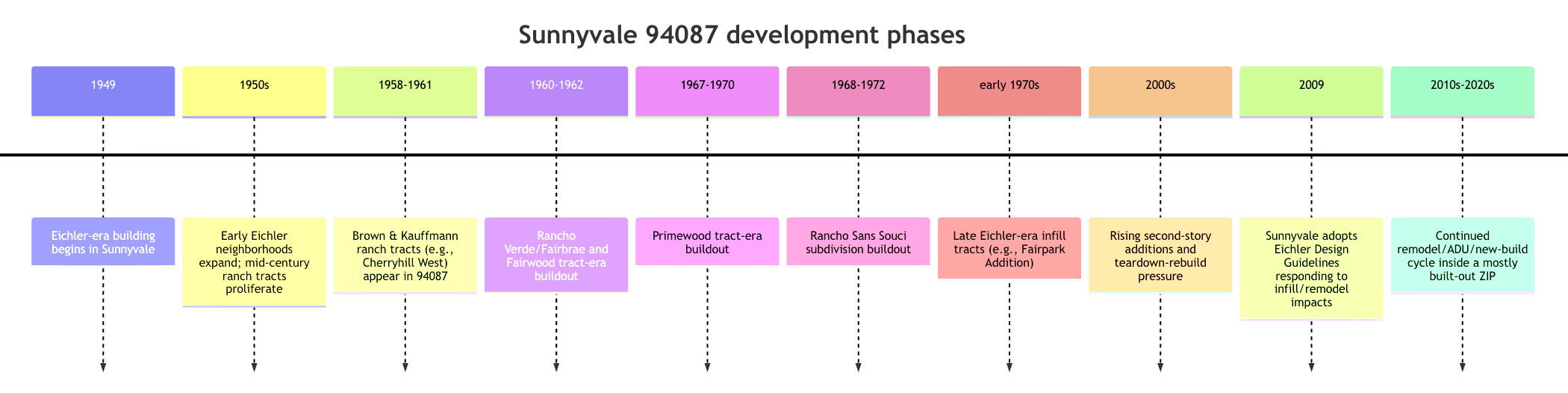
Development phases timeline
The timeline below highlights the major development phases that most consistently show up in 94087’s documented built environment: mid‑century tract building (Eichler and non‑Eichler ranch tracts), then later intensification through remodeling and infill—an issue explicitly discussed as a driver for the City’s 2009 Eichler Design Guidelines.
Additional Developers and Builder Presence in Sunnyvale 94087
While the most formally documented and architecturally cohesive builder presence in 94087 is clearly associated with Eichler Homes, the ZIP’s development history reflects a layered and multi-builder evolution rather than a single-brand identity.
Beyond Eichler: Additional Builder Patterns in 94087
Outside of Eichler-era production tracts, two later mid-century builders show repeated ZIP-specific presence through assessor and MLS “builder/architect” metadata attached to numerous properties:
American Housing Guild
Frequently associated with atrium-style and California ranch plans within several 94087 pockets, particularly tracts branded in listing metadata such as “Greentree.” Multiple homes in 94087 list “American Housing Guild” in builder/architect fields, often with late-1960s to 1970s build dates. While not as architecturally codified as Eichler tracts, the repetition across properties indicates a genuine production footprint within the ZIP.Brown & Kauffmann
Strongly tied to ranch-era subdivisions, most notably “Cherryhill West.” Numerous late-1950s and early-1960s homes in 94087 list Brown & Kauffmann as builder in property records. Although formal tract map confirmation requires recorded map review, the volume of listing-level attribution suggests a meaningful builder presence during the post-war expansion phase.
Early Ranch-Era Merchant Builders
In addition to these identifiable names, a substantial portion of 94087’s 1955–1965 housing stock appears attributable to regional merchant builders operating tract-by-tract. These builders:
Produced classic California ranch floor plans
Used low-pitch rooflines and garage-forward elevations
Did not incorporate atrium or exposed post-and-beam structural systems
Often filed subdivision maps under small development corporations
Many of these entities are under-documented online and require recorded tract maps or permit archives for confirmation. This category likely accounts for a significant share of non-Eichler single-family inventory in 94087.
Mackay and Early Sunnyvale Context
Although more concentrated in other Sunnyvale ZIP codes, Mackay Homes played a foundational role in Sunnyvale’s early post-war development beginning in the late 1940s. While Mackay’s footprint appears lighter inside 94087 specifically, its broader influence shaped the ranch-based subdivision template that defined much of the area’s early build-out.
Lindsey Attribution: Current Evidence Limitations
For “Lindsey Homes,” current public-facing documentation shows at least one 94087 property listing with “Builder Architect: LINDSEY” in its metadata. However, this does not yet confirm a formally branded tract developer operating under a “Lindsey Homes” identity within 94087.
To establish Lindsey as a distinct tract builder would require one or more of the following:
Recorded subdivision map title blocks naming the subdivider/developer
City building permit archives identifying contractor of record
Period newspaper advertisements referencing a Lindsey subdivision
At present, the evidence supports the existence of a builder attribution but not yet confirmation of a cohesive tract-scale developer brand.
Development Phases Within 94087
Understanding 94087 requires viewing it as a sequence of development cycles rather than a single builder narrative.
Phase 1: Post-War Ranch Subdivisions (1950–1960)
Merchant builders and early production developers established the dominant single-story ranch fabric.
Phase 2: Architect-Forward Modern Production (1960–1972)
Dominated by Eichler-associated tracts documented in City mapping and archival records, with architect collaborations including Anshen & Allen, Jones & Emmons, and Claude Oakland.
Phase 3: Late Ranch / Atrium Builders (Late 1960s–1970s)
Builders such as American Housing Guild contributed atrium-influenced and ranch-derivative homes.
Phase 4: Infill, Remodel, and Teardown Cycles (1980s–Present)
Following full subdivision build-out, development shifted toward:
Second-story additions
Major remodels
Custom luxury infill construction
This shift is explicitly acknowledged in the City’s 2009 Eichler Design Guidelines as a key driver for neighborhood preservation and design review controls.
Is There Another Builder Comparable to Bahl in 94087?
In Sunnyvale more broadly, Bahl Homes is recognized for mid-century modern–influenced construction. However, within ZIP 94087 specifically, the archival and listing-level evidence does not currently demonstrate a second architecturally cohesive, production-scale builder presence comparable to Eichler.
Inside 94087, the hierarchy of identifiable builder influence appears to be:
Eichler (clearly documented tract-scale production identity)
American Housing Guild (repeated ZIP-level attribution)
Brown & Kauffmann (subdivision-tied ranch builder)
Multiple smaller merchant builders (tract-by-tract, requiring map verification)
Later infill/custom builders (permit-driven rather than subdivision-branded)
Gaps, uncertainties, and recommended next steps
The biggest research bottleneck for a fully exhaustive “all builders in 94087” accounting is record accessibility. Santa Clara County’s recorded maps are explicitly described as not available via online ordering, and official-record contents may require in-person viewing. As a result, the report can strongly confirm many tract-builder connections, but it cannot yet compile a complete tract-map bibliography and lot-count ledger for every tract inside 94087 using purely online sources.
The most rigorous next steps (with low ambiguity) are:
First, build a tract inventory for 94087 from official GIS and recorded-map references. Use the City’s publicly exposed GIS layers:
The City “Subdivisions” polygon layer includes subdivision NAME, NUMBER, and VOLPAGE (volume/page references), which can be exported and filtered spatially to a ZIP boundary.
The City “Sunnyvale Parcels” layer includes PROPERTY_ZIPCODE and multiple LEGAL fields (legal description fragments), enabling ZIP‑filtered tract extraction and parcel counting per tract (a strong proxy for lot/unit counts in single‑family areas).
Second, reconcile each tract to primary recorded maps and permit history. For each tract number appearing in 94087 (example: “Tract 2653 Fairbrae Book 119 Page 48–49” appears in property legal descriptions), request the corresponding recorded tract map from the Clerk‑Recorder and/or use the County Surveyor record-index tooling to confirm recordation date and lot count.
Third, confirm builder identity for ambiguous names (especially “Lindsey”). A listing field reading “Builder Architect: LINDSEY” is a useful lead, but to confirm “Lindsey Homes” as a tract builder you would want at least one of the following:
Recorded tract map title block naming the subdivider/developer (often listed on the map).
Building permits showing contractor/developer of record (City permit archives).
Period newspaper subdivision advertisements naming the builder and tract (microfilm or databases).
Fourth, use the Environmental Design Archives as a targeted retrieval tool rather than a “complete tract list.” The UC Berkeley finding aids are excellent for architect/tract associations and likely contain site plans that, when requested, can yield tract boundaries, model lists, and sometimes unit totals—especially for Eichler-related projects. Prioritize requests for site plans for: Tract 2653 (Rancho Verde/Fairbrae), Tract 2944 (Fairwood), Tract 4621 (Primewood), and Subdivision 4465 (Rancho Sans Souci).
Finally, interpret “later infill/custom builders” as a permit-driven question. The City’s own Eichler Design Guidelines explicitly describe increased second‑story additions and new two‑story infill as a motivating context, meaning a modern builder list should be generated from permits rather than tract maps.
As Founding Agents at Compass and recognized Silicon Valley luxury home experts, Eric and Janelle Boyenga bring a strategic, data-driven approach to representing buyers and sellers in 94087 and throughout the South Bay.
The Boyenga Team specializes in architecturally significant properties—including Eichler, mid-century modern, and legacy ranch homes—combining deep neighborhood knowledge with refined marketing execution.
Eric and Janelle personally guide their clients through valuation strategy, positioning, negotiation, and exposure planning, ensuring that each home is represented with precision and elevated presentation. For buyers, they provide insight into builder pedigree, tract nuance, architectural integrity, and long-term value—critical advantages in competitive luxury markets like Sunnyvale 94087.
Thinking about buying or selling in Sunnyvale?
We’re Eric & Janelle Boyenga — the Property Nerds at Compass. Since 1996, we’ve helped Silicon Valley families buy and sell with data-driven pricing, sharp negotiation and beautiful marketing. Let’s talk about your next move — no pressure, just answers.
Get Your Free Home Valuation Call or Text (408) 373-1660 Email Us
Selling? Ask about Compass Concierge — we front the cost of staging, paint and repairs, and you pay nothing until closing.