
Monastery Gardens, Santa Clara: A Quiet, Classic Ranch-Home Enclave
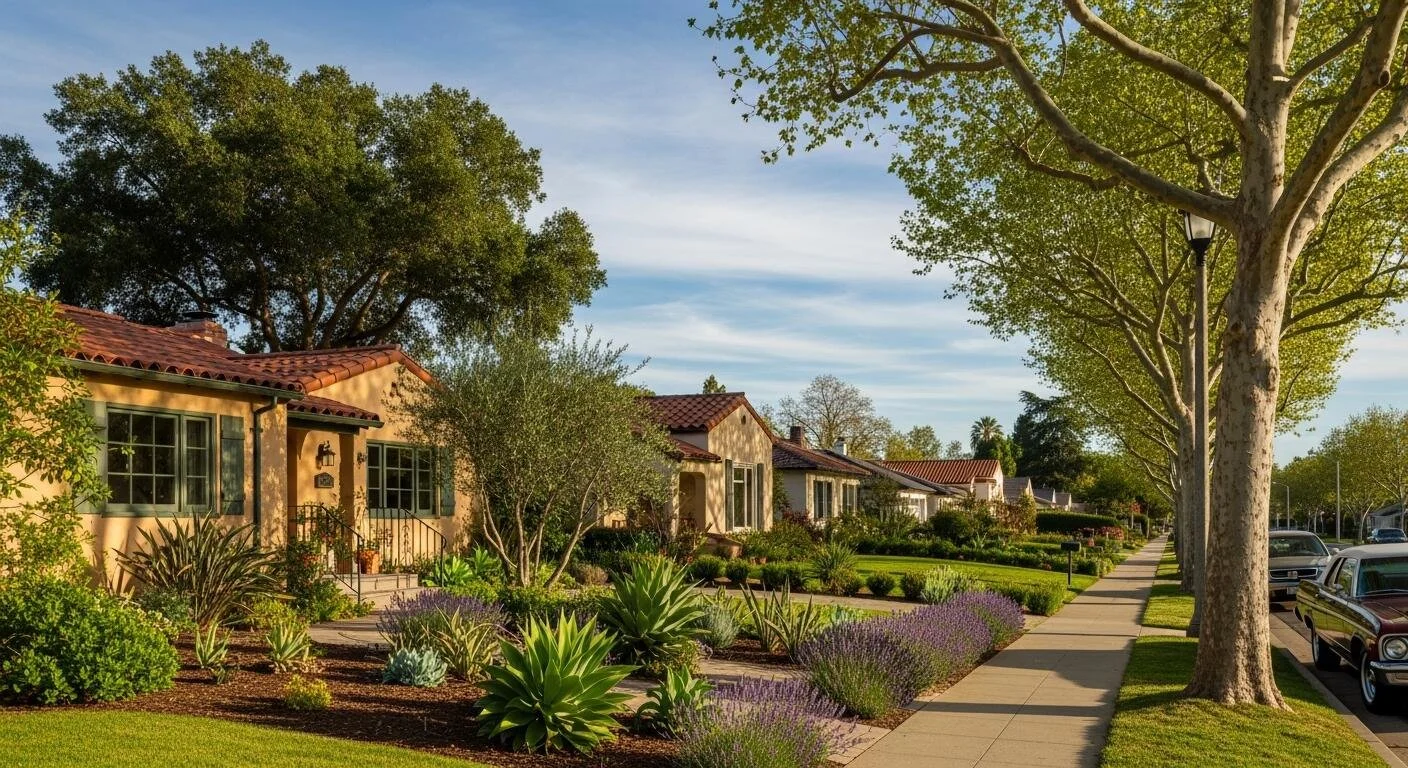
Nestled just south of Santa Clara’s downtown core, Monastery Gardens is a quietly distinguished neighborhood prized for its solid fundamentals and long-term ownership. One local guide notes Monastery Gardens was “established in the late 1940s and early 1950s” with about 350 single-family homes – one of the first post–World War II subdivisions in Santa Clara. Its name comes from the Carmelite Monastery at Benton and Lincoln, which anchors the corner of this community. Despite Silicon Valley’s constant churn, Monastery Gardens stands out for its stability and pride of ownership: many homes remain in original hands or have been updated gradually over decades. Homebuyers seeking space, privacy and long-term value—rather than glitzy trends—are naturally drawn here. With large lots and tree-lined streets, it feels more like a smart “investment property” suburb than a high-intensity tech enclave. The Boyenga Team, Silicon Valley real estate experts with a design-focused perspective, frequently highlights Monastery Gardens as a “high-retention” neighborhood: a place where savvy buyers find value-add ranch homes and traditional houses ripe for modernization.
According to Boyenga Team market research, Santa Clara’s overall market “thrives on insight and precision,” not hype. In that vein, our deep dive into Monastery Gardens shows a classic Silicon Valley “smart money” neighborhood: not ostentatious, but fundamentally strong, centrally located, and rich in architectural potential.
Historical Overview
Monastery Gardens owes much of its character to its mid-20th-century roots. The subdivision was planned and built in the boom following World War II, as Santa Clara shifted from agricultural orchards to a residential city. In fact, local records describe the tract at Scott Boulevard and El Camino Real as “one of the first housing tracts built in Santa Clara after World War II”. The development comprises two adjacent sections – El Camino Manor and Monastery Gardens – each filled with modest, California-style ranch houses of the era. The neighborhood’s namesake, the Carmelite Monastery on Benton and Lincoln, dates to that same period and was a well-known local landmark that gave identity to the community.
From the outset, Monastery Gardens was never an architect-designed tract or an “Eichler community,” but rather a builder-driven subdivision of traditional forms. Early homes were simple ranch/Spanish-bungalow bungalows: 2–3 bedrooms, one bath, on generous 5,000–6,000 sq ft lots. Unlike strict mid-century enclaves, Monastery Gardens has noHomeowners’ Association, so over time owners have freely modified and expanded their homes. Gradual renovation, rather than wholesale teardown, has defined the neighborhood’s evolution. Many original houses now boast added rooms, modern kitchens, or second stories, but most retain their original foundations and general footprint. In short, Monastery Gardens matured quietly: a stable community of long-term owners who have incrementally upgraded homes over decades, rather than a flash-in-the-pan development.
Architecture & Housing Inventory
Homes in Monastery Gardens are unmistakably classic California ranches and traditional postwar dwellings. Almost all are single-story or one-and-a-half-story detached houses, typically on large 5,000–6,000+ sq ft lots. Early floor plans were 2–3 bedrooms and 1 bath on roughly 1,000–1,500 sq ft. Many of these have since been expanded to 3–4 beds and 2–3 baths (often by enclosing carports or adding rear family rooms), bringing typical home sizes into the 1,500–2,500 sq ft range. Garages are usually one or two cars (attached or detached), and nearly every lot has room for a broad driveway and yard.
The floor-plan diversity is a selling point. A neighborhood specialist notes that Monastery Gardens “offers a variety of floor plan elevations ranging from 2–3 bedrooms and 1–2 bath homes… on 5,000 to over 6,000 square feet lots”. The original architecture—“traditional California bungalow style” with raised foundations and balanced living areas—gives way to a mix of aesthetics today. Some homes remain true mid-century ranch, with low-pitched roofs and simple facades, while others have been remodeled with Craftsman or modern details. A few investors have even demolished original structures to build new contemporary designs, but these are exceptions; the overwhelming majority of properties preserve the original footprint.
Buyers value the large lots and flexible layouts here. The flat lots offer space for pools, ADUs, or expansive additions. It is common to find older ranches extended to 2,000+ sq ft; one local realtor notes many properties “having been renovated and modified throughout the years”. Today, 3×2 homes (3 beds, 2 baths) are prevalent, and 4-bedroom layouts are common after additions. Front yards are often landscaped with mature trees, while deep backyards provide privacy and play areas—especially appealing to families. In summary, Monastery Gardens’s housing stock is not architecturally uniform, but it is consistently low-slung, traditional in form, and extremely adaptable. Design-forward buyers see each ranch house as a blank canvas: opening walls, enlarging kitchens, and injecting mid-century flair can transform these humble starters into luxury residences.
Demographic & Socioeconomic Profile
Monastery Gardens (zip code 95051) is a well-off, highly educated community reflective of Silicon Valley’s professional class. According to recent ACS data, the median household income in 95051 is about $196,690—roughly 20% above the Silicon Valley metro average. Per capita income is also high (~$97,420), and poverty is low (about 7%). Homeownership is the norm; the neighborhood’s median owner-occupied home value is about $1.68 million. (By comparison, Zillow reports Santa Clara’s 95051 homes at a typical value around $1.9 million.)
Educational attainment is striking: over 94% of adults have at least a high-school diploma, and roughly 70% hold a bachelor’s degree or higher. This outpaces California norms and underscores a highly skilled population. Professionally, many residents work in tech, engineering, healthcare or management. Average commute times are relatively modest—about 24 minutes to work—since major employers are nearby or easily accessible. Census data even show that only about 21% of residents moved in the past year, meaning nearly 79% lived at the same address. This low turnover confirms what realtors see anecdotally: Monastery Gardens is a low-attrition market where owners stay for the long haul.
In sum, Monastery Gardens is affluent and stable. Household incomes and home values are well above national averages, and the population is highly educated. It attracts dual-income professionals (especially tech and healthcare) and families. Ownership is dominant (most homes are owner-occupied), and residents value the neighborhood’s continuity. These demographic fundamentals – high income, strong education levels, high ownership rates – mirror the profile of a desirable, low-turnover Silicon Valley enclave.
Schools & Education
Families in Monastery Gardens benefit from strong schools. The neighborhood falls into the Santa Clara Unified School District (SCUSD). Public school assignments are C.W. Haman Elementary (K–5), Westwood/Buchser Middle (6–8), and Santa Clara High (9–12). These schools have solid reputations. For example, C.W. Haman Elementary earns an A– grade on Niche, reflecting above-average academics and student outcomes. Buchser Middle School (the district’s flagship middle school) likewise ranks at the top of SCUSD. Santa Clara High School is rated 8/10 on GreatSchools, indicating strong college-prep performance and test scores.
SCUSD itself consistently outperforms statewide averages, with most schools rated above average. Nearby private and charter options abound too: for example, the Canterbury Christian School and Stratford Academy are within a few miles, and Santa Clara University is just south of the neighborhood. (Santa Clara U. adds a collegiate vibe and cultural events to the area.) Overall, the quality and stability of the assigned schools helps sustain property values. Top-ranked elementary and secondary schools here make Monastery Gardens attractive to buyer households and reinforce the “family-friendly” character of the area.
Lifestyle & Amenities
Monastery Gardens delivers a comfortable, suburban lifestyle without sacrificing convenience. Its streets are quiet and leafy, giving a sense of space and privacy. Neighborhood parks and green spaces are minutes away. Santa Clara’s Central Park – a 52-acre recreation complex with playgrounds, picnic groves, sports fields, and the Central Park Library – lies just northeast of the area. Young families often walk or bike to Central Park’s Magical Bridge Playground and community pool. Another local spot is Henry Schmidt Park (555 Los Padres Blvd), an 8-acre field-and-playground park named after a legendary local coach. It includes baseball/softball diamonds, tennis courts, volleyball, picnic tables and a playground – all free for public use. (Henry Schmidt Park is undergoing upgrades in 2026, but it has long been a neighborhood staple.) Together, these parks ensure ample outdoor recreation: morning jogs along the Santa Clara Creek Trail, weekend soccer games, or strolls by the lake and amphitheater at Central Park.
Retail and dining options are also nearby. Just south along El Camino Real is the Santa Clara Town Centre shopping mall. While smaller than Valley Fair, it offers key amenities – including a Macy’s, Target, and a movie theater – along with casual eateries (such as Subway, Jamba Juice, and small local cafes). Farther south, the Lawrence Expressway/El Camino retail corridor has Trader Joe’s, Costco, and big-box stores. Closer in, the El Camino real/driv.ing corridor hosts family-run restaurants, from Vietnamese pho shops to Italian trattorias. Downtown Santa Clara (a 5–10 minute drive) also offers restaurants, breweries, and local boutiques in a quaint civic center setting. Despite these options, Monastery Gardens itself remains purely residential – free of through-traffic and commercial noise. Its advantage is quiet convenience: families enjoy nearby markets, schools, and entertainment centers, yet return home to a peaceful street each evening.
In short, the lifestyle is that of a classic suburban enclave. Children walk to neighborhood playgrounds and public schools; adults bike to nearby cafes or the gym; and everyone appreciates the sprawling lawns and mature trees. It is deliberately not a trendy, high-density scene. Rather, it’s a stable, mature environment: practical living for professionals who want amenities at arm’s reach, without the hustle of downtown cores.
Commuting & Tech Access
Monastery Gardens offers Silicon Valley’s ideal balance of location and ease of commute. Major tech hubs are surprisingly close. Apple’s main campus in Cupertino lies roughly 10 miles southwest – about a 15–20 minute drive on freeways. Google’s Mountain View offices (Amphitheatre Parkway) are also roughly 10 miles north – again only 15–20 minutes via Central Expressway or US‑101. The NVIDIA Santa Clara campus is practically in town (at Brokaw Rd/Lawrence), just 2–3 miles away, so many employees can be home in under 10 minutes. Even firms like Intel (Santa Clara) and Lockheed Martin (Mountain View) are within a 15–minute commute.
Freeway access is convenient: El Camino Real/Stevens Creek Blvd to the south connects to US 101 and I-880, while Lawrence Expwy to the east leads to I-880 and I-280. Commuting data reflect this centrality: the Census shows an average one-way commute of just 23.6 minutes – shorter than much of the Bay Area. For Silicon Valley professionals, Monastery Gardens represents a sweet spot: you’re “minutes” from the offices of Apple, Google, NVIDIA, and dozens of tech employers, yet far from the congestion and high prices of core tech suburbs. (It’s literally a single-digit drive to the new Apple campus and Stanford/UCSC via the Bay Bridge.) Public transit is also accessible: VTA light rail has nearby stations on the Tasman line, and the Santa Clara Caltrain station is a few miles southeast for those heading to San Francisco or San Jose.
In essence, Monastery Gardens is a centrally located residential refuge. Commuters save time on the road compared to western suburbs, without paying Palo Alto–level prices. It is a pragmatic homebase: close enough to Silicon Valley’s tech spine for daily drives, yet free of the “bedroom community” detachment often felt in more remote cities.
Real Estate Market Analysis
The Monastery Gardens real estate market is robust and competitive. As of early 2026, median home prices in this part of Santa Clara hover around the upper six figures to low seven figures. Realtor.com data list Zip 95051 (which covers much of central Santa Clara, including Monastery Gardens) with a median home price of $1,673,957 and about 80 active listings. This aligns well with Zillow’s report for 95051: a median sale price ~$1.78M (Jan 2026) and average home value $1.90M. By contrast, neighboring Zip 95050 (north Santa Clara) has a slightly lower median ($1.50–$1.65M). In broader terms, Santa Clara Citywide median listing is about $1.54M with roughly 142 homes for sale. Thus Monastery Gardens sits above the city average, reflecting its prime location near downtown Santa Clara.
Inventory remains tight. Realtor.com shows only a few dozen listings at a time in Monastery Gardens, and homes typically sell quickly. Market trackers note Santa Clara homes are going under contract in roughly 2–3 weeks. For example, Redfin reports a median days-on-market around 17 in early 2026 for 95050, and Zillow notes 95051 homes median 13 days to pending. These fast turns are testament to strong buyer demand – fueled by tech buyers who prize move-in-ready homes and by investors seeking renovation flips.
Pricing dynamics have generally been positive. Even through late-2025, Santa Clara saw high single-digit or low double-digit percentage gains year-over-year. Realtor.com data indicate Santa Clara’s median sale price increased by over 10% in 2025 (reflecting the hot market before interest rates peaked). Monastery Gardens, with its limited supply, kept pace. Move-in condition homes command premiums, especially if updated in a contemporary style. By one measure, Santa Clara North Central (the region including Town Center) has a median price around $1.749M, whereas areas farther south like West Central (Bowers, Laurelwood) are closer to $1.26M. This premium captures Monastery Gardens’ appeal.
At the same time, “opportunity” homes persist here. Many original-condition ranches trade at prices noticeably below their renovated neighbors – a gap that value-conscious buyers can exploit. Savvy investors and design-oriented end-users pay particular attention to these homes, banking on adding bathrooms, expanding kitchens or even building an ADU to boost value. Thus, the market has two parallel dynamics: pristine, turnkey ranches fetch top dollar per sq ft; while as-is fixers often attract multiple offers to secure a below-market entry price. Overall, competition is strong: well-priced homes often sell above list price, especially those with modern updates. In all, Monastery Gardens stays aligned with Silicon Valley trends – steady appreciation for prime product balanced by pockets of “value-add” opportunities in original housing stock.
Case Studies / Buyer Behavior
In practice, buyer behavior in Monastery Gardens breaks along familiar lines. Renovated homes – especially those with open-concept layouts, modern kitchens, and designer touches – tend to generate the most buzz. For example, a recently finished mid-century remodel on El Camino Real (3 bed/2 bath, ~2,000 sq ft) sold for about $200–$300K above its less-updated peers. Buyers here will gladly pay a premium for gleaming interiors, smart-home upgrades, or high-end finishes. On the other hand, original-condition homes still draw plenty of interest, but of a different kind. Investors and end-users looking for a project scoop up these diamonds in the rough. Typical scenarios: a family buys a worn 1950s ranch at $1.4M (below market) with plans to add a bathroom and remove a wall, pushing future value much higher.
We also observe buyer mix trends. Whereas in pricier enclaves some buyers enter bidding wars purely to “land a footprint,” Monastery Gardens still sees a blend. Roughly equal parts investors (those eyeing flips or long-term holds) and owner-occupiers (families, tech professionals) compete here. Investors are often willing to stretch on price for the right lot. End-users, particularly local tech couples and Silicon Valley families, prize space and schools, and will pay up for homes in move-in condition. While census data show 23% mobility, implying much stability, the market snapshot often shows multiple offers for desirable homes. The strongest offers typically go to homes that are turnkey and architecturally interesting (open beams, mid-century details) or those that have earned energy upgrades (solar panels, ADUs). Conversely, cookie-cutter flips with no soul might be overlooked.
In short, the most valuable listings are those that combine practicality with style: a ranch floor plan opened up for modern living, but still allowing expansion on a large lot. Buyers effectively pay premiums for features that family households value long-term: extra bedrooms, home offices, and outdoor living space. At the same time, “tear-down” or highly non-standard lots that would require full redevelopment may sell at discounts, signaling their risk. Ultimately, Monastery Gardens buyers act like investors in disguise: they seek lifestyle assets – homes that can grow in equity as well as accommodate real life.
The Boyenga Team Advantage
In a neighborhood like Monastery Gardens, working with seasoned local experts is key. The Boyenga Team at Compass brings precisely that advantage. Their Santa Clara market analysis emphasizes skills that fit this micro-market: “specialized expertise in Silicon Valley neighborhoods, schools, and zoning”, plus decades of negotiation experience. For buyers, the team touts “data-backed negotiation strategies” and off-market access, ensuring they identify the best Monastery Gardens opportunities.
The Boyenga Team’s approach is deeply analytical, matching Santa Clara’s own data-driven ethos. As one of their strategic reports notes, success here “requires representation grounded in analytics, local expertise, and an understanding of Silicon Valley’s complex ecosystem”. Indeed, Boyenga Team marketing highlights their “deep analytical framework, tech-aligned ethos, and decades-long presence” in Silicon Valley. In practice, this means they can advise clients on exactly what renovations will pay off, which blocks have under-the-radar value, and how to position a design-forward house for maximum interest.
For example, they might help a Monastery Gardens seller stage a ranch home to highlight its expansion potential, or use their off-market network to quietly scout an original house before it hits MLS. For buyers, their hyper-local school and zoning knowledge ensures families are matched to optimal school boundaries, and their Compass tools bring pricing comps and marketing reach that typical agents lack. Simply put, navigating Santa Clara’s dynamic market “demands strategic interpretation of data, hyperlocal insight, and forward-looking positioning” – criteria by which the Boyenga Team measures itself.
In summary, Monastery Gardens is a prime Silicon Valley neighborhood for value-seeking buyers. It may lack the glitz of Palo Alto or Los Altos, but it delivers a combination of lot size, school quality, and architectural potential that savvy purchasers recognize. The Boyenga Team positions itself as the ideal guide for such buyers – framing Monastery Gardens as a practical luxury alternative with upside. By leveraging neighborhood expertise and design-focused marketing, they help clients maximize every square foot and identify smart investments in this understated Santa Clara enclave.